The Sculptor of Milanese Grandeur
Giuseppe Rusnati stands as a pivotal figure in the Lombard Baroque, an artist whose hands breathed life into marble to embody the opulent aesthetic sensibilities of his era. Born in 1650 in Gallarate, near the vibrant artistic hub of Milan, Rusnati’s journey was one of profound mentorship and technical mastery. His early training began under the esteemed Ercole Ferrata, a connection that firmly rooted him within the influential artistic milieu of Northern Italy. This formative experience provided the foundation for a career defined by movement and spiritual depth. By 1673, his evolution continued as he accepted a mentorship from Camillo Rusconi, a relationship that fostered deep collaboration and refined his understanding of the sculptural complexities required to command large-scale architectural spaces.
The legacy of Rusnati is etched into the very stone of Italy’s most iconic religious and civic landmarks. His reputation soared through prestigious commissions for institutions such as the Duomo di Milano and the Certosa di Pavia, projects that demanded both immense physical labor and a sophisticated grasp of Baroque grandeur. Beyond the city limits, his influence reached the Sacri Monti of Piedmont and Lombardy, where he contributed monumental religious sculptures designed to inspire awe and devotion in pilgrims. His work at the Santa Maria della Passione in Milan, particularly his role in adorning its elaborate facades, remains a testament to his ability to marry structural architecture with delicate, expressive carving.
Mastery of Form and Motion
Rusnati’s artistic style is characterized by a breathtaking dynamism and an expressive realism that are hallmarks of the Baroque tradition. He was a master of contrapposto, utilizing the subtle offset of weight in his figures to imbue cold stone with a sense of vitality and organic movement. This technique allowed him to capture nuanced human emotions, ranging from quiet piety to dramatic intensity, effectively bridging the gap between the earthly and the divine. Influenced by the theatricality of Bernini and the dramatic chiaroscuro of Caravaggio, Rusnati embraced the use of light and shadow to heighten the visual impact of his compositions, creating a sense of stage-like drama that engaged the viewer’s imagination.
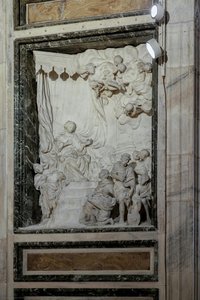
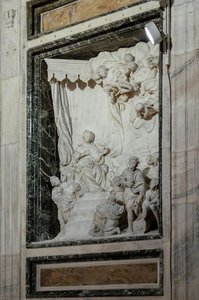
His technical prowess extended into the intricate details of relief work and portraiture. Whether carving delicate religious scenes or monumental busts, such as those attributed to the Marquis of Cislago, Rusnati maintained a standard of meticulous execution. His ability to manipulate marble to mimic the softness of skin or the heavy folds of drapery ensured that his works were not merely decorations, but living narratives. This mastery helped shape the broader artistic landscape of Milanese Baroque, leaving behind a trail of masterpieces that continue to define the cultural identity of Northern Italy.
A Lasting Artistic Legacy
The historical significance of Giuseppe Rusnati lies in his role as a bridge between generations of Italian sculptors. By training under Ferrata and subsequently mentoring the young Camillo Rusconi, he acted as a vital link in the transmission of sculptural excellence from the mid-17th century into the dawn of the Rococo period. His life, which concluded in Milan in 1713, marked the end of an era of intense Lombard craftsmanship that prioritized both emotional resonance and architectural integration.
Today, his contributions are recognized through several key achievements:
- Architectural Integration: His transformative work on the facades of Milanese churches, most notably Santa Maria della Passione.
- Religious Devotion: The creation of profound sculptural elements for the Sacri Monti, contributing to the spiritual landscape of the Piedmont and Lombardy regions.
- Technical Innovation: The sophisticated use of movement and light to advance the expressive capabilities of Baroque marble carving.
- Pedagogical Influence: His role in nurturing the next generation of masters, ensuring the continuity of the Italian sculptural tradition.