The Titan of Flemish Tapestry: The Life and Legacy of Willem de Pannemaker
In the vibrant, industrious heart of sixteenth-century Brussels, a golden age of textile artistry unfolded, driven by the unparalleled mastery of Willem de Pannemaker. Born around 1510, likely in the burgeoning artistic hub of Beverwijk or within the bustling streets of Brussels itself, Willem was destined for greatness through the lineage of his craft. He was the scion of the prestigious Pannemaker workshop, led by his father, Pieter, a man whose reputation for excellence laid the foundation upon which Willem would build his monumental career. To study under Pieter was to undergo a rigorous apprenticeship in the very soul of Flemish craftsmanship—learning not merely the mechanics of the loom, but the delicate alchemy of dyeing fine wool and silk, and the complex geometry required to translate grand artistic visions into woven reality.
As Willem matured, he did not merely inherit a tradition; he elevated it to heights previously unimagined in Northern Europe. His talent caught the eye of the most powerful figures of the Renaissance, most notably Charles V, Holy Roman Emperor. This divine patronage transformed the Pannemaker workshop from a respected local institution into the premier atelier for the Habsburg court. Through these royal commissions, Willem became a bridge between the meticulous, detailed traditions of the Low Countries and the sweeping, classical grandeur emerging from Italy. His work began to breathe with the influence of masters like Raphael, integrating a new sense of anatomical precision and dynamic composition into the heavy, luxurious medium of tapestry.
A Symphony of Thread and Symbolism
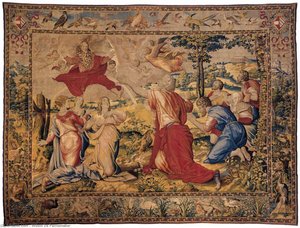
The artistry of Willem de Pannemaker is defined by a breathtaking synthesis of realism and decorative splendor. He possessed a rare ability to render the tactile world—the sheen of silk, the weight of velvet, and the subtle textures of natural landscapes—with such precision that his tapestries often felt like windows into another realm. His compositions were never static; they pulsed with an emotional intensity that drew the viewer into the sacred and the heroic alike. Whether depicting a biblical covenant or a contemporary military conquest, Willem utilized a bold color palette to guide the eye through intricate narratives of grace, struggle, and triumph.
His most celebrated achievements remain some of the most significant treasures of the Renaissance era:
- The Conquest of Tunis: A monumental eight-part series created between 1548 and 1554, based on designs by Jan Cornelisz Vermeyen. This work is historically profound, not only for its depiction of imperial power but for its remarkable inclusion of one of the earliest European artistic renderings of a tornado, showcasing Willem's eye for naturalistic drama.
- The Wedding of Mercury: A rare and exquisite series that serves as a vital visual record of Ovid’s Metamorphoses, depicting the myth of Mercury and Herse in a way that remains unparalleled in surviving textile art.
- The Months of Lucas: A charming and sophisticated series attributed to the influence of Lucas van Leyden, which captures the rhythmic cycle of seasonal life among both the nobility and the peasantry, blending genre painting with high-art weaving.
Historical Significance and Enduring Influence
Willem de Pannemaker’s career represents the zenith of the Brussels tapestry industry. He was more than a weaver; he was a visual storyteller for the most influential dynasty in Europe. By successfully merging the Northern European preoccupation with minute detail and symbolic depth with the Italian Renaissance's focus on classical proportion and movement, he helped define the aesthetic language of his age. His workshop became a crucible of innovation, where the boundaries between fine art and decorative craft were blurred, creating works that functioned as both political propaganda for the Habsburgs and timeless masterpieces of human expression.
Though he passed away in 1581, leaving behind a legacy etched in silk and gold thread, the impact of his work continues to resonate. To look upon a Pannemaker tapestry is to witness the moment when the Flemish tradition reached its most magnificent crescendo, capturing the grandeur of an empire and the delicate nuances of the human spirit within the enduring embrace of woven art.