 Предпросмотр
 Поделиться
 Поделиться
 Детали произведения

 Скачать
 Похожие работы
 Рентгенография
 Слайд-шоу
 Статистика
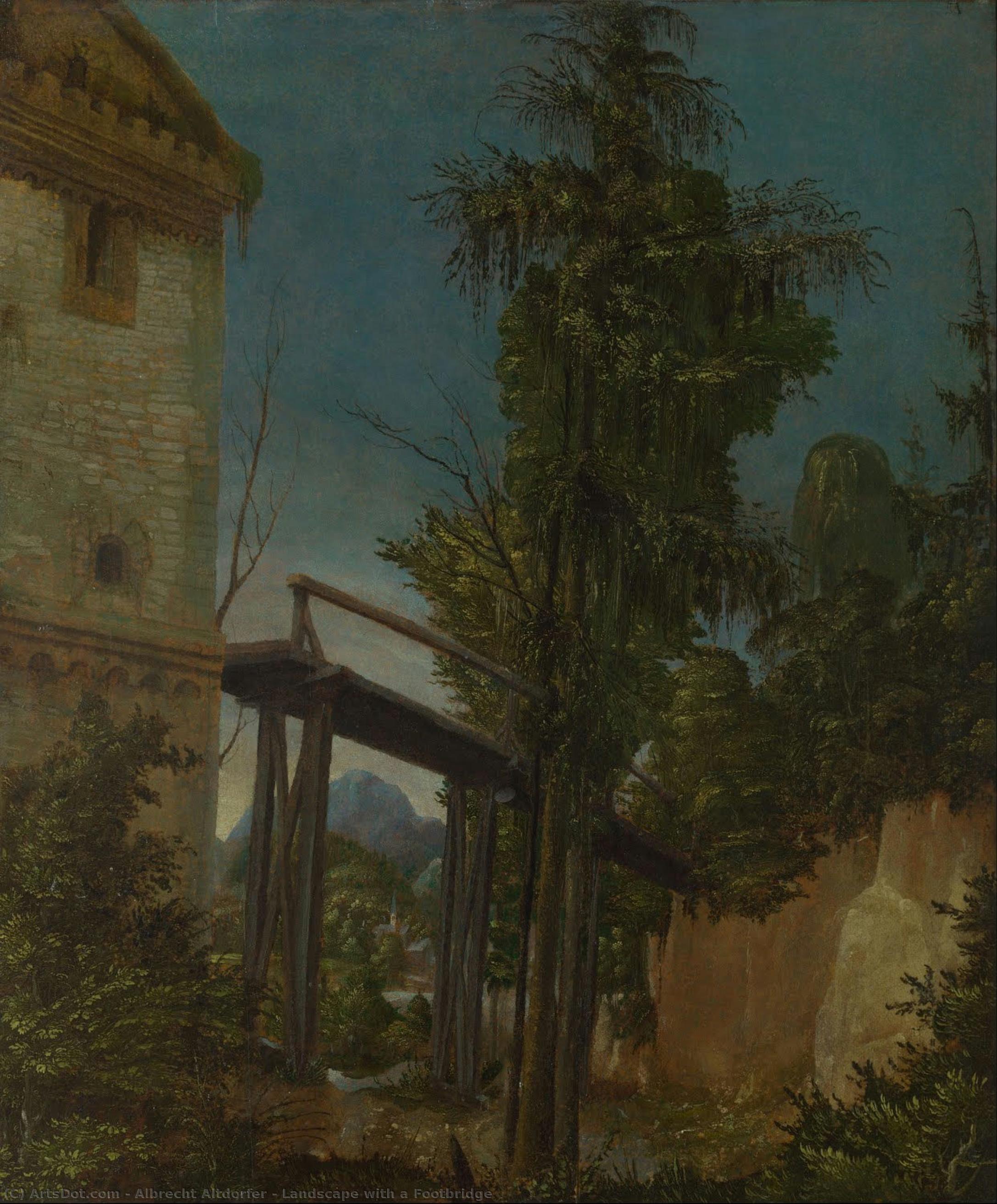
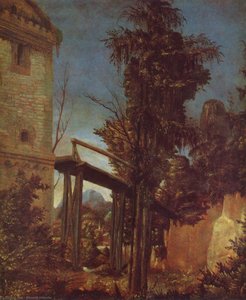
Landscape with a Footbridge
 Oil On Canvas
- WallArt
- Northern Renaissance Landscape
 1518
1518 41.0 x 35.0 cm
 Национальная галерея
 Читать далее
Масляная репродукция ручной работы
Картина маслом на холсте в выбранном вами размере и раме, написанная на заказ нашими художниками. ( Перейти к печати Перейти к цифровым изображениям)




P118B $10

P118H $10

P118W $10

P438Z $10

P508JH $12

P508YH $12

P805H $10

P805Z $10

P919BZ $10

P919G $10

P919XJ $10

P959ZH $10

P968JZ $12

W106C $8

W218G $10

W218JH $8

W218Y $10

W307PJ $10

W316G $10

W316PJ $8

W316Y $10

W398PJ $8

W4111J $10

W500HY $15

W500JH $15

W692G $12

W849H $8

W940BG $15

W953PJ $8




Выберите один из наших стандартных размеров, соответствующих оригинальным пропорциям произведения искусства.

Вы можете указать собственные размеры, чтобы картина идеально вписалась в выбранную раму или пространство. Если выбранный вами размер не соответствует пропорциям оригинала, мы либо обрежем полотно, либо расширим его за счет дополнительных элементов, написанных вручную. Цифровой макет будет отправлен вам на утверждение перед началом производства.
Обратите внимание, что предварительный просмотр на экране не отражает фактическую обрезку или расширение. Только макет точно покажет окончательную композицию.
Хотя доступны индивидуальные размеры, мы рекомендуем выбирать вариант из предопределенного списка, чтобы сохранить исходные пропорции.
После оформления заказа команда ArtsDot.com свяжется с клиентом по электронной почте для уточнения деталей и предоставит предварительный макет
Доставка по всему миру () за 3–4 недели вместо стандартных 5 недель. (10 Сентябрь). Без компромиссов в качестве.

Бесплатная экспресс-доставка по всему миру

Высококачественный льняной холст

Полное страхование доставки

Гарантия возмещения таможенных пошлин

Гарантия точного соответствия цветов

100-дневная политика возврата (только при обнаружении дефектов)

Гарантия возврата 100% средств

Предложение оптовых скидок
 Вариант со стеклом доступен только для размеров менее 110 см

Landscape with a Footbridge
Техника репродукции
Размер репродукции
-


Итоговая стоимость
$ 263
A Pioneering Vision: Albrecht Altdorfer’s ‘Landscape with a Footbridge’
Albrecht Altdorfer's “Landscape with a Footbridge,” painted around 1518-20, stands as a remarkably significant work in the history of European art. More than simply a depiction of a river and mountains, it represents a bold departure – one of the earliest independent landscapes ever conceived by a Western European artist, devoid of human figures. This wasn’t merely an exercise in observation; Altdorfer was actively reshaping artistic conventions, laying the groundwork for what would become the flourishing German landscape tradition of the Danube School. Born in Regensburg, a vibrant hub on the Danube River, Altdorfer's upbringing instilled within him a deep connection to the natural world – a connection that profoundly informs every brushstroke of this evocative piece.
The painting’s genesis lies not in a specific location but rather in an impressionistic rendering of the Danube valley. Altdorfer, a man deeply involved in civic life as both architect and council member, possessed a keen eye for detail and a sophisticated understanding of perspective. Yet, he deliberately eschewed the common practice of including figures within his landscapes, choosing instead to focus entirely on the interplay of light, shadow, texture, and form. This decision elevates the landscape itself to the primary subject – a revolutionary concept at the time.
Composition and Technique: A Study in Detail
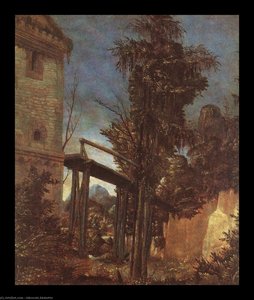
The composition is meticulously crafted, drawing the viewer’s eye through a carefully orchestrated arrangement of elements. The dominant feature is undoubtedly the wooden footbridge, its sturdy pillars anchoring the scene and creating a visual pathway that leads towards the distant village. Altdorfer's mastery of oil paint is immediately apparent; he employs a rich, layered technique, building up textures with remarkable precision. Notice the intricate detailing of the bridge’s timbers, the subtle variations in color representing the flowing water, and the almost sculptural quality of the trees that frame the composition.
The artist's use of color is particularly noteworthy. He employs a palette of deep greens, browns, and blues to create a sense of depth and atmosphere. The distant mountains are rendered in muted tones, suggesting their immense scale and remoteness, while the foreground elements – the bridge, trees, and riverbank – are depicted with greater vibrancy. The lighting is carefully considered, casting long shadows that enhance the three-dimensionality of the scene and contribute to its overall mood.
Symbolism and Spiritual Resonance
Beyond its purely visual appeal, “Landscape with a Footbridge” carries significant symbolic weight. The footbridge itself can be interpreted as a metaphor for transition – connecting the earthly realm with the spiritual one. The village, nestled amongst the mountains, represents human civilization, while the vast wilderness symbolizes nature’s untamed power and beauty. Altdorfer's decision to omit figures further emphasizes this duality, suggesting that true understanding comes not from observing humanity but from contemplating the natural world itself.
Furthermore, the painting reflects a growing interest in spirituality during the Renaissance. Altdorfer’s landscapes often evoke a sense of awe and wonder, inviting viewers to contemplate their place within the grand scheme of creation. The towering trees, bathed in sunlight, can be seen as symbols of strength and resilience – qualities highly valued by both artists and patrons of the time.
A Legacy of Innovation
“Landscape with a Footbridge” is not merely a beautiful painting; it’s a pivotal work that fundamentally altered the course of landscape art. By prioritizing the landscape itself as the subject, Altdorfer paved the way for generations of artists who followed in his footsteps. His innovative approach—characterized by meticulous detail, atmospheric perspective, and a profound appreciation for nature—established him as a pioneer of the Northern Renaissance landscape and a key figure within the Danube School. Today, reproductions like this one offer a remarkable opportunity to experience the power and beauty of Altdorfer’s vision, bringing his groundbreaking work into homes and spaces around the world.
Похожие произведения

Биография художника
Albrecht Altdorfer: The Pioneer of German Landscape
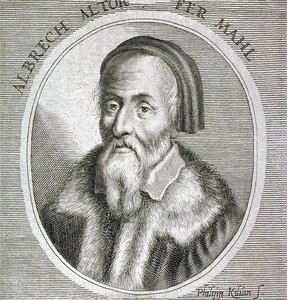
Albrecht Altdorfer, born around 1480 in the vibrant city of Regensburg on the banks of the Danube River, stands as a truly remarkable figure – a bridge between the late Gothic era and the burgeoning artistic spirit of the German Renaissance. He wasn’t merely an artist *of* his time; he fundamentally reshaped it, particularly through his groundbreaking exploration of landscape painting. His origins were deeply rooted in a family steeped in artistic tradition: his father, Ulrich Altdorfer, was himself a painter and miniaturist, providing Albrecht with an early immersion into the world of art. This familial legacy, combined with Regensburg’s position as a thriving center of trade and culture – a free imperial city strategically located on the Danube – fostered within him a unique artistic sensibility, a profound connection to the natural world that would become the cornerstone of his distinctive style. Beyond his artistic pursuits, Altdorfer was also a man of civic responsibility, serving not only as an artist but also as a town architect and a respected member of Regensburg’s council – a testament to his diverse talents and multifaceted personality. His legacy rests primarily on his early engravings and drawings from around 1506, such as *Stygmata of St. Francis* and *St. Jerome*, which offered tantalizing glimpses into the emotional intensity and meticulous detail that would define his mature work.The Danube School: A Revolutionary Approach to Nature
Altdorfer’s most significant contribution to art history lies in his membership within the influential Danube School, a collective of artists active primarily during the early 16th century in southern Germany. This group shared a common passion – an intense fascination with capturing the expressive potential of landscape, elevating it from its traditional role as mere background to become a central and vital subject in its own right. Prior to Altdorfer’s arrival on the scene, landscapes were largely relegated to serving as settings for religious or historical narratives; he dared to depict nature *for itself*, imbuing it with atmosphere, emotion, and a profound sense of presence. A pivotal moment in his artistic development occurred around 1511 when Altdorfer embarked on a transformative journey down the Danube River and into the majestic Alps. The dramatic vistas – towering mountains, dense forests, and expansive valleys – ignited within him an unquenchable desire to translate these experiences onto canvas, capturing not just what he saw but also *how* it felt to be immersed in such breathtaking beauty. This marked a radical shift; Altdorfer became, arguably, the first modern landscape painter, prioritizing emotional response over strict topographical accuracy – conveying the awe, mystery, and even spiritual connection evoked by the natural world. His work, exemplified by pieces like “The Large Spruce,” demonstrates this shift brilliantly, offering a serene and intricately detailed depiction of nature’s beauty that transcends simple representation.Masterpieces and Artistic Influences: A Synthesis of Styles
Throughout his prolific career, Altdorfer produced an astonishingly diverse body of work encompassing paintings, engravings, drawings, and even architectural designs. Among the most celebrated achievements of his oeuvre is *The Battle of Alexander at Issus* (1529), a monumental painting commissioned by Duke William IV of Bavaria. This epic artwork showcases not only Altdorfer’s exceptional mastery of composition, perspective, and detail but also his innovative use of landscape to heighten the dramatic tension and visceral impact of the battle scene itself. The swirling clouds, jagged mountain peaks, and chaotic melee of soldiers create a sense of overwhelming energy, dynamism, and almost apocalyptic grandeur. His collaboration with Emperor Maximilian I in Innsbruck from 1513 further broadened his artistic horizons, providing him with opportunities to undertake large-scale projects that showcased his versatility and ambition. Altdorfer’s artistic style wasn't born in isolation; he was deeply influenced by a range of artists and movements. The poetic lyricism of Italian Renaissance painter Giorgione, the expressive figures of Lucas Cranach the Elder, and the meticulous detail evident in the works of Albrecht Dürer all left an indelible mark on his art. However, Altdorfer skillfully synthesized these diverse influences into a uniquely personal vision – one characterized by its intense emotionality, dramatic use of light and shadow, and evocative depictions of landscapes. His engravings, such as “Mucius Scaevola Burning His Hand,” demonstrate his exceptional skill in this medium, showcasing delicate lines, intricate details, and a remarkable ability to convey movement and drama.Legacy and Lasting Impact: A Foundation for Future Generations
Albrecht Altdorfer’s artistic legacy extends far beyond the 55 panels, 120 drawings, and numerous engravings he created during his lifetime. He fundamentally altered the way artists approached landscape painting, paving the way for future generations to explore its expressive possibilities and embrace it as a subject worthy of independent consideration. His influence can be seen in the works of later German Romantic painters who similarly sought to capture the sublime beauty and emotional power of nature – figures like Caspar David Friedrich drew inspiration from Altdorfer’s pioneering approach. Today, Altdorfer’s art is proudly displayed in major museum collections around the world, including the Museum Ostdeutsche Galerie in Germany (where his *Madonna (Beautiful Maria of Regensburg)* resides) and the Kunstsammlungen und Museen Augsburg in Austria. His innovative spirit, technical skill, and profound connection to the natural world continue to inspire artists and captivate audiences centuries after his death in 1538. He remains a towering figure of the German Renaissance – a true pioneer who dared to see landscape not merely as scenery but as a powerful force capable of evoking deep emotion and spiritual meaning. His work stands as a testament to the enduring power of art to transform our perception of the world around us, a legacy that continues to resonate with viewers today.Exploring Altdorfer’s Diverse Works
Beyond his iconic landscapes and battle scenes, Altdorfer's artistic range encompassed religious subjects, mythological narratives, and even architectural designs. His depictions of biblical stories, such as “Abraham’s Sacrifice,” are imbued with a dramatic intensity and emotional depth that set them apart from earlier interpretations. He wasn’t simply illustrating scripture; he was exploring the human condition through the lens of faith – grappling with themes of sacrifice, obedience, and divine justice.- Engravings: Altdorfer's engravings, like “Mucius Scaevola Burning His Hand,” demonstrate his mastery of line and detail, often conveying a sense of movement and drama.
- Drawings: His drawings offer intimate glimpses into his creative process, revealing his meticulous observation skills and expressive use of shading.
- Architectural Designs: As town architect of Regensburg, Altdorfer contributed to the city’s fortifications and urban planning, showcasing his practical as well as artistic talents.
Альбрехт Альтдорфер
1480 - 1538 , Германия
Основные сведения
- Artistic Movement Or Style: Данновская школа, Ренессанс
- Artists Or Movements Influenced By This Artist: ['Немецкий романтизм']
- Artists Who Influenced This Artist:
- Джорджоне
- Лукас Кранх
- Альбрехт Дюрер
- Date Of Birth: ок. 1480 г.
- Date Of Death: 1538 г.
- Full Name: Albrecht Altdorfer
- Nationality: Немецкий
- Notable Artworks: ['Битва Александра при Иссе", "Большое сосна", "Святой Георг и дракон']
- Place Of Birth: Рейгенсбург, Германия
Похожие статьи
The Northern Awakening: Artistic Innovation & Cultural Transformation in the German Renaissance
Explore the artistic innovation of the German Renaissance! Discover Dürer, the Danube School & Reformation art. Learn about techniques, materials & lasting influence. Find museum-quality reproductions at ArtsDot.
Альбрехт Дюрер: 25 шедевров эпохи Возрождения для вашего интерьера | ArtsDot
Погрузитесь в мир Альбрехта Дюрера! 25 величайших гравюр и картин немецкого Ренессанса. Узнайте историю создания шедевров, символизм и технику художника. Репродукции высокого качества для вашего интерьера на ArtsDot.com.
Albrecht Altdorfer: Innovation, Spirituality & the Northern Renaissance Landscape
Explore the groundbreaking art of Albrecht Altdorfer, a pioneer of the Northern Renaissance's Danube School. Discover his innovative landscapes, spiritual symbolism & lasting influence on German painting.
Evoking Nature's Sublime: A Comprehensive Exploration of 19th-Century Landscape Painting
Explore the captivating world of 19th-century landscape painting! Discover renowned artists like Friedrich & Monet, key movements, and find the perfect artwork to bring nature's serenity into your home. Expert insights at ArtsDot.

Романтический пейзаж: 10 шедевров, изменивших искусство | ArtsDot.com
Погрузитесь в мир романтического пейзажа! 10 шедевров Фридриха, Тёрнера и других гениев. Узнайте историю создания культовых картин и вдохновитесь для декора интерьера. Репродукции высокого качества на ArtsDot.com.