

 Предпросмотр
 Поделиться
 Поделиться
 Детали произведения

 Скачать
 Похожие работы
 Рентгенография
 Слайд-шоу
 Статистика
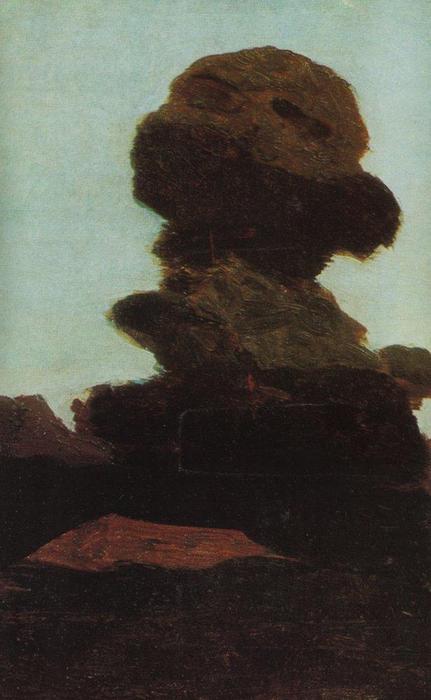
Tree against the evening sky


 Читать далее
Жикле / Арт-принт
Печать (жикле) или холст музейного качества с быстрыми сроками изготовления и широким выбором вариантов отделки. ( Купить картину ручной работы Перейти к цифровым изображениям)




































Выберите один из наших стандартных размеров, соответствующих оригинальным пропорциям произведения искусства.

Вы можете указать свои собственные размеры, чтобы репродукция идеально подошла под конкретную раму или пространство. Если выбранный вами размер не будет соответствовать пропорциям оригинала, мы либо обрежем произведение, либо дополним изображение зеркальным отражением краев или однотонной заливкой. Перед началом производства вам будет отправлен цифровой макет для утверждения.
Пожалуйста, обратите внимание, что предварительный просмотр на экране не отображает фактическую обрезку или расширение изображения. Только макет точно покажет финальную композицию.
Несмотря на возможность заказа индивидуальных размеров, мы рекомендуем выбирать размер из предопределенного списка, чтобы сохранить оригинальные пропорции.
Доставка по всему миру () за 2 недели вместо стандартных 4/5 недель. (12 Сентябрь)

Бесплатная экспресс-доставка по всему миру

Высококачественный льняной холст

Полное страхование доставки

Гарантия возмещения таможенных пошлин

Гарантия точного соответствия цветов

100-дневная политика возврата (только при обнаружении дефектов)

Гарантия возврата 100% средств

Предложение оптовых скидок
 Вариант со стеклом доступен только для размеров менее 110 см

Tree against the evening sky
Жикле / Арт-принт
Размер репродукции
-


Итоговая стоимость
$ 62
A Vision of Desert Dusk: Arkhip Kuindzhi's "Tree against the Evening Sky"
Arkhip Kuindzhi’s “Tree against the Evening Sky,” painted in 1895, offers a captivating glimpse into a stark yet beautiful desert landscape. The painting depicts a monumental rock formation crowned with a boulder, dominating the scene. A solitary tree stands resiliently near the base of this geological giant, its form silhouetted against an expansive evening sky. While seemingly simple in subject matter – rocks, a tree, and sky – Kuindzhi elevates these elements into a powerful study of light, atmosphere, and the sublime beauty of nature. The composition evokes a sense of quiet grandeur and solitude, inviting contemplation on the forces that shape our world.Luminism and the Mastery of Light
Kuindzhi was renowned as a master of *luminism*, an artistic movement focused on capturing the effects of light with unprecedented realism and emotional intensity. This painting exemplifies his signature style. Notice how Kuindzhi doesn't simply depict the colors of twilight; he conveys the *feeling* of it – the cool, diffused glow that softens the harshness of the rocks and casts long shadows across the arid ground. The sky isn’t a uniform color but a complex interplay of hues suggesting the fading light and approaching darkness. His technique involved meticulous layering of glazes to achieve this luminous effect, creating an almost ethereal quality.- Color Palette: Dominated by cool blues, purples, and muted oranges reflecting the evening sky.
- Brushwork: Characterized by smooth blending and subtle gradations of color to create a sense of atmospheric perspective.
- Luminosity: Achieved through layering techniques and careful observation of light’s interaction with natural forms.
Historical Context and Kuindzhi's Artistic Journey
Painted during a period of significant artistic innovation in Russia, “Tree against the Evening Sky” reflects a growing interest in realism and capturing the beauty of the Russian landscape. Kuindzhi, having studied under Ivan Aivazovsky (another prominent Russian landscape painter), developed his own distinct style that moved beyond traditional romanticism towards a more scientific and observational approach to depicting nature. He was fascinated by optics and atmospheric phenomena, often conducting experiments with light and color in his studio to better understand how they interacted. This dedication to understanding the science of light is evident in the painting’s remarkable realism and emotional depth.Symbolism and Emotional Resonance
Beyond its technical brilliance, “Tree against the Evening Sky” carries a subtle symbolic weight. The lone tree, standing firm against the vastness of the desert and the approaching night, can be interpreted as a symbol of resilience, endurance, and hope in the face of adversity. The imposing rock formation represents the enduring power of nature, while the fading light evokes a sense of melancholy and transience. The overall emotional impact is one of quiet awe and contemplation – a reminder of our place within the grand scheme of the natural world. It's a scene that resonates with feelings of solitude, peace, and the sublime beauty found in unexpected places.Похожие произведения
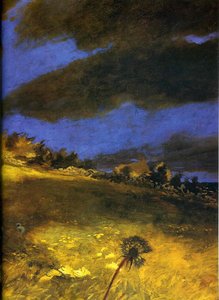
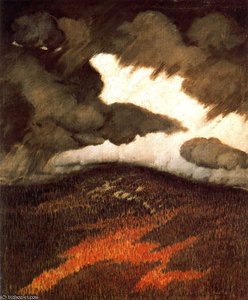
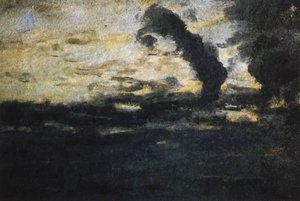
Биография художника
A Life Illuminated: The World of Arkhip Kuindzhi
Arkhip Ivanovich Kuindzhi (Архи́п Ива́нович Куи́нджи; Russian: Архи́п Ива́нович Куи́нджи; Ukrainian: Архип Іванович Куї́нджі; January 27, 1842(?) – July 24, 1910) was a Russian landscape painter. Arkhip Kuinji’s exact date of birth is not known. Although it was believed that he was born in 1842, the latest discoveries in archives suggest that he was born in 1841. Kuindzhi himself, when asked by St. Petersburg Academy of Arts to clarify his date of birth, “clearly wrote 1841, then, with doubt, January, and then several times crossed out the month”. The researchers believe he was born somewhere between January and March 1841. The commonly recognized date is January 27, although Kuindzhi celebrated his name day on February 19 (O.S.) (March 4 N.S.), on the feast of Archippus. His family background was a blend of Greek and Ukrainian heritage – his father, Ivan Khristoforovich Kuindzhi, was a Greek shoemaker who had sought refuge near the Azov Sea during Catherine II’s reign, while his mother was Ukrainian. This multicultural upbringing profoundly shaped his artistic vision, imbuing it with a sensitivity to both landscapes and human experiences.Early Years and Artistic Beginnings
Kuindzhi's childhood in Mariupol was marked by hardship and labor. Orphaned at a young age, he worked diligently from an early age, contributing to the family income through various jobs – assisting on church construction sites, tending livestock, and working as a corn merchant’s assistant. Despite these challenging circumstances, a nascent artistic inclination began to blossom, nurtured by a Greek family friend who provided him with rudimentary education and introduced him to the world of art. This early exposure sparked his interest in drawing and painting, laying the foundation for his future career. Following his parents' death, Kuindzhi moved to Taganrog, where he found work as a retoucher for photographs, a skill that would later prove invaluable in understanding light and shadow – essential elements of his artistic practice. This period honed his eye for detail and precision, developing the technical skills necessary to capture the nuances of color and form. He briefly attempted to establish his own photographic studio but faced financial difficulties, leading him to relocate to Saint Petersburg in 1865.Saint Petersburg: Academy and Independent Development
In Saint Petersburg, Kuindzhi enrolled at the Imperial Academy of Arts, though he largely pursued his artistic development independently. While he received formal training, he primarily learned through observation and experimentation, absorbing influences from various artists and movements. He initially studied under Ivan Aivazovsky, a renowned marine painter, gaining valuable insights into color theory and composition. However, Kuindzhi’s artistic interests extended beyond the sea; he was particularly drawn to landscape painting, seeking to capture the essence of nature's beauty and atmosphere. He also worked as a freelance artist, contributing to various exhibitions and developing his unique style. His early works, such as “Na ostrove Valaam” (On the Island of Valaam) from 1873, demonstrated his technical skill and an emerging interest in capturing the effects of light. This painting, depicting the serene beauty of Lake Ladoga, showcased Kuindzhi’s meticulous attention to detail and his ability to evoke a sense of tranquility.The Alchemy of Light: A Revolutionary Technique
Kuindzhi's artistic breakthrough came with his exploration of “luminism,” a style characterized by its emphasis on capturing the effects of light and atmosphere. Unlike traditional landscape painting, which often focused on precise representation, Kuindzhi sought to recreate the *experience* of being immersed in nature – the warmth of sunlight, the coolness of shadow, the ethereal glow of twilight. He achieved this through innovative techniques, including composite methods and layering pigments to create an unparalleled luminosity. His most celebrated works—"Ukrainian Night," "Birch Grove," and “Moonlit Night on the Dnieper”—are prime examples of his mastery of luminism. “Ukrainian Night” (1876), for instance, depicts a moonlit landscape with an almost supernatural glow, achieved through careful manipulation of color and texture. Similarly, “Birch Grove” (1879) captures the dappled light filtering through the trees, creating a sense of depth and atmosphere that is both captivating and dreamlike. “Moonlit Night on the Dnieper” (1880), perhaps his most iconic work, depicts a river scene bathed in an ethereal moonlight, evoking a profound sense of mystery and beauty. These paintings weren’t merely representations of scenes; they were immersive experiences, designed to transport the viewer into the heart of nature.Legacy and Recognition
Despite achieving significant success and recognition during his lifetime, Kuindzhi withdrew from public exhibitions after 1880, choosing a more solitary existence. He continued to teach at the St. Petersburg Academy of Arts, imparting his knowledge and expertise to generations of aspiring artists. His work was admired by many prominent figures, including Pavel Tretyakov, who acquired several of his paintings for his renowned collection. Arkhip Kuindzhi died in 1910, leaving behind a legacy as one of Russia’s most beloved landscape painters – a master of light and color whose works continue to inspire awe and wonder. His paintings are now housed in major museums around the world, testament to their enduring beauty and artistic significance.- A Pioneer of Luminism: Kuindzhi is considered a key figure in the development of luminism, an artistic style emphasizing the effects of light in landscapes.
- Influence on Symbolism: His dramatic use of light and atmosphere also foreshadowed elements found in symbolist painting.
- National Identity & Ukrainian Pride: His depictions of Ukrainian landscapes contributed to a growing sense of national identity and artistic pride within Ukraine, even as his work was celebrated across Russia.
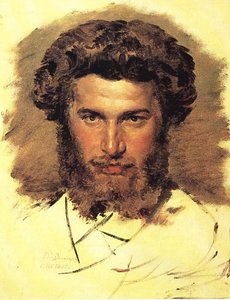
Архип Куинджи
1842 - 1910 , Украина
Основные сведения
- Artistic Movement Or Style: Реализм, Импрессионизм
- Artists Or Movements Influenced By This Artist: ['Символизм']
- Artists Who Influenced This Artist:
- Иван Айвазовский
- Адольф Фесслер
- Date Of Birth: Янв 27, 1842 (или 1841)
- Date Of Death: Июл 24, 1910
- Full Name: Архип Иванович Куинджи
- Nationality: Русский/Украинский/Греческий
- Notable Artworks:
- Вечер в Украине
- Дубовая роща
- Ночь на Днепре
- Place Of Birth: Мариуполь, Украина
Похожие статьи
Fyodor Vasilyev: A Poetic Vision of Russian Landscape – Life, Legacy, and the Transience of Nature
Explore the captivating world of Fyodor Vasilyev, a pioneering Russian landscape painter. Discover his lyrical style, influential works like 'Clouds' & lasting legacy. Learn about his life, artistic journey & impact on Russian art history.

Evocations of Place: A Historical Journey Through Landscape Art
Explore the rich history of landscape art with ArtsDot. Discover renowned artists, movements like Impressionism & Romanticism, and expert guidance for collecting timeless pieces. Find your perfect serene escape today!
Arkhip Kuindzhi: Capturing Light & Romantic Vision in Imperial Russia's Landscapes
Explore the captivating world of Arkhip Kuindzhi, a master of light and Romantic realism in Imperial Russia. Discover his iconic landscapes, artistic techniques, and lasting legacy with ArtsDot.

Романтический пейзаж: 10 шедевров, изменивших искусство | ArtsDot.com
Погрузитесь в мир романтического пейзажа! 10 шедевров Фридриха, Тёрнера и других гениев. Узнайте историю создания культовых картин и вдохновитесь для декора интерьера. Репродукции высокого качества на ArtsDot.com.

Джон Констебль: 25 шедевров английского пейзажа для вашего интерьера
Погрузитесь в мир английского пейзажа с Джоном Констеблом! 25 шедевров романтизма, история создания картин и вдохновение для вашего интерьера. Репродукции высокого качества на ArtsDot.com – искусство для ценителей.