

 Предпросмотр
 Поделиться
 Поделиться
 Детали произведения

 Скачать
 Похожие работы
 Рентгенография
 Слайд-шоу
 Статистика
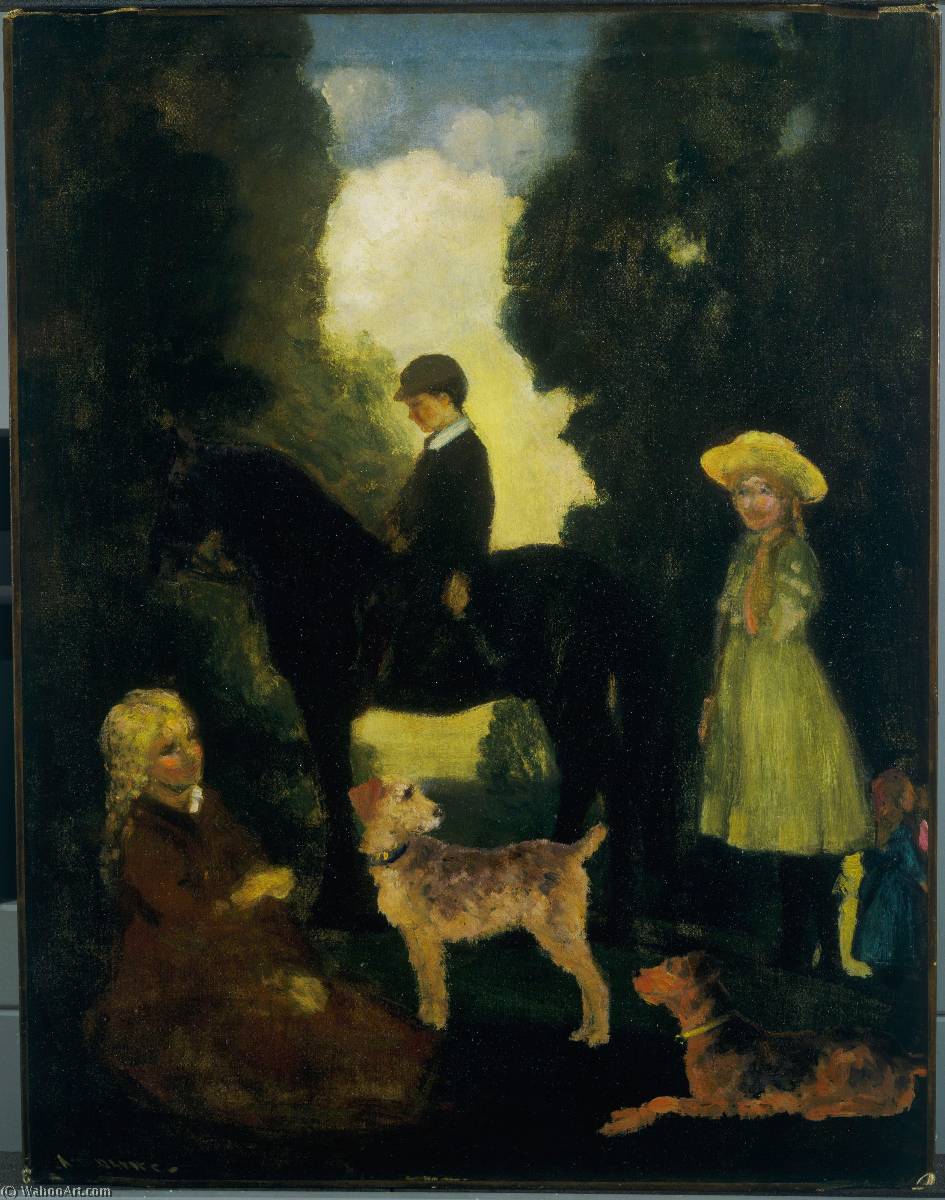
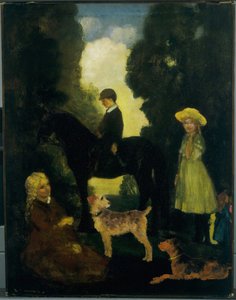
Children, Dogs and Pony
 Acrylic On Canvas
- WallArt
- American Modernism
 1905
1905 2.0 x 2.0 cm
 Галерея Филлипсов
 Читать далее
Приобретите цифровое изображение высокого разрешения в улучшенном качестве, которое значительно превосходит онлайн-превью.
Каждый файл тщательно подготавливается нашими специалистами с использованием передовых инструментов и экспертной ручной ретуши. Мы гарантируем исключительную четкость, точную цветопередачу и детальную проработку каждого изображения.
Финальный файл доставляется по электронной почте в течение 72 часов и оптимизирован для немедленного использования в профессиональной среде, при верстке и печати. Это тот же уровень качества, которому доверяют ведущие дизайнерские студии, издательства и галереи.
Цифровое изображение
Скачайте файл высокого разрешения для личного использования, печати и творческих проектов. ( Перейти к печати Купить картину ручной работы)
Включено в каждый заказ цифровых изображений
Гарантия экспертной цифровой доставки
Выбирая ArtsDot.com, вы получаете не просто изображение — вы приобретаете профессионально обработанное цифровое произведение искусства, созданное с безупречной точностью и под защитой гарантии качества. Вот всё, что автоматически входит в ваш заказ:

Мгновенная доставка по e-mail
Ваш цифровой файл в высоком разрешении будет отправлен вам по электронной почте в течение 72 часов после оформления заказа — и сразу станет доступен для использования.

Цифровой файл с ИИ-улучшением
Ваше произведение искусства проходит профессиональную оптимизацию с использованием передовых инструментов ИИ и ручной обработки, что гарантирует максимальную детализацию, четкость и точность цветопередачи.

Бессрочная бесплатная повторная доставка
Случайно удалили или потеряли файл? Не беспокойтесь — мы отправим его вам повторно в любое время и совершенно бесплатно.

Без импортных пошлин — навсегда
Наслаждайтесь вашим произведением искусства мгновенно без таможенных пошлин, сборов или затрат на доставку — цифровые загрузки всегда не облагаются налогом.

Гарантия точности цветопередачи
Мы гарантируем, что ваше цифровое изображение максимально точно передает оригинальные цвета благодаря использованию профессиональных инструментов и систем управления цветом.

Гарантия удовлетворенности 100 дней
Если вы не будете удовлетворены своим цифровым изображением, мы внесем правки или вернем 100% стоимости в течение 100 дней — без лишних вопросов.

100% Гарантия возврата средств
Не удовлетворены покупкой? Получите полный возврат средств в течение 100 дней после получения цифрового файла — без лишних вопросов.

Скидки на оптовые заказы
Купите 3 изображения, сэкономьте 10% — Купите 5, сэкономьте 15% — Купите 10+, сэкономьте 20%. Отличное решение для творческих проектов, галерей и агентств.
A Mystic in the Modern Age: Exploring Arthur B. Davies’ “Children, Dogs and Pony”
Arthur Bowen Davies (1862 – 1928), born in Utica, New York, stands as a fascinating anomaly within the trajectory of American art—a figure simultaneously rooted in the traditions of landscape painting and propelled forward by the burgeoning currents of European modernism. His artistic journey began with an undeniable reverence for the natural world, fostered by witnessing George Inness’s evocative canvases during a touring exhibition that captivated him and instilled in him a mastery of technique honed through meticulous observation. Yet Davies refused to confine himself solely to replicating picturesque vistas; he possessed an inner conviction—a profound desire to communicate something beyond mere visual representation—a yearning that would define his distinctive artistic vision. Following formative studies at the Chicago Academy of Design, Davies embarked on a path marked by experimentation and intellectual engagement. He wasn’t merely reacting to stylistic trends; he actively wrestled with philosophical questions about humanity's relationship with nature and spirituality. This preoccupation is powerfully conveyed in “Children, Dogs and Pony,” completed in 1905—a deceptively simple monochrome composition that belies its complex layers of meaning. The painting depicts three children accompanied by dogs and horses against a backdrop of stylized trees, capturing a fleeting moment of idyllic rural life. Davies’ stylistic approach is characterized by a deliberate restraint – a technique rooted in Impressionistic principles yet tempered with a distinctly American sensibility. He eschewed the vibrant palettes favored by many European contemporaries, opting instead for a muted tonal range that emphasizes form and texture rather than coloristic illusion. This masterful control of pigment allows Davies to capture the subtle nuances of light and shadow, creating an atmosphere imbued with tranquility and warmth. The artist’s meticulous attention to detail—evident in the expressive rendering of the horses' musculature and the careful depiction of foliage—underscores his commitment to portraying nature with uncompromising accuracy. Beyond its technical prowess, “Children, Dogs and Pony” resonates deeply with symbolic significance. The inclusion of children represents innocence and vitality – qualities Davies wished to celebrate amidst the anxieties of a rapidly changing world. Animals, particularly dogs and horses, symbolize companionship, loyalty, and connection to the earth—themes central to Davies’ broader philosophical concerns. Furthermore, the horse itself carries connotations of nobility and freedom, mirroring Davies' belief in the transformative power of artistic contemplation. The painting’s emotional impact is palpable. It evokes a feeling of nostalgia for simpler times – a longing for communion with nature and the uncomplicated joys of childhood. Davies skillfully utilizes tonal gradation to convey this mood, drawing viewers into a contemplative space where beauty and serenity reign supreme. “Children, Dogs and Pony” isn't merely a depiction of a pastoral scene; it’s an embodiment of Davies’ artistic philosophy—a testament to his conviction that art can illuminate the deepest recesses of human experience. Its enduring appeal lies in its ability to transport us back to a moment of pure joy and connection – a timeless reminder of the beauty inherent in the natural world and the importance of preserving childlike wonder.Похожие произведения
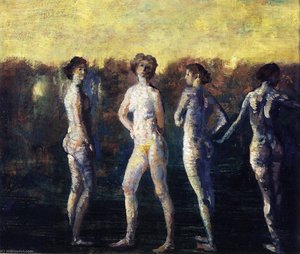
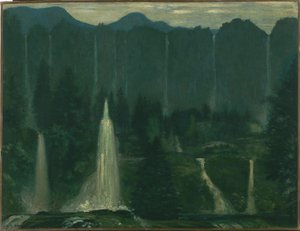
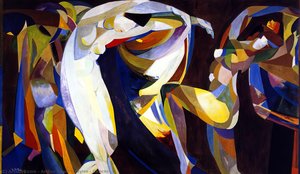
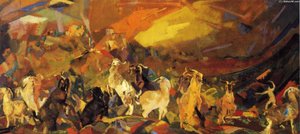
Биография художника
A Mystic in the Modern Age: The Life and Art of Arthur B. Davies
Arthur Bowen Davies, born in Utica, New York, in 1862, occupies a uniquely complex position within the narrative of American art. He wasn’t simply *of* his time—the tumultuous era bridging the 19th and 20th centuries—but actively shaped it, serving as both a conduit for European modernism and a champion of distinctly American artistic voices. His journey began with an early fascination for landscape painting, sparked by a touring exhibition that showcased the works of George Inness and the Hudson River School masters. This initial exposure instilled in him a reverence for nature’s beauty and a technical proficiency that would remain hallmarks of his style throughout his career. However, Davies wasn't destined to become merely another practitioner of traditional landscape; he possessed an inner vision, a yearning to express something beyond the purely representational. After studies at the Chicago Academy of Design and the Art Students League in New York, he began to forge a path that blended romantic sensibilities with emerging modernist ideals. His early career involved illustration work, but his true calling lay in painting—in creating worlds imbued with symbolism and emotional resonance.The Ashcan School & The Armory Show: A Catalyst for Change
Davies’s artistic development unfolded against a backdrop of significant social and cultural shifts. He became associated with “The Eight,” a group of artists who challenged the conservative norms of the National Academy of Design in 1908. While often linked to the Ashcan School—a movement known for its gritty depictions of urban life—Davies stood somewhat apart. Where artists like John Sloan focused on the raw realities of city streets, Davies sought refuge in a more ethereal realm. His paintings weren’t about documenting the visible world; they were about evoking moods, dreams, and spiritual longings. Nevertheless, his involvement with The Eight demonstrated his commitment to artistic independence and his willingness to challenge established conventions. This spirit of rebellion culminated in his pivotal role as one of the organizers of the 1913 Armory Show—a watershed moment that introduced European modernism (Cubism, Fauvism, Futurism) to a largely unsuspecting American public. The show was met with both outrage and excitement, irrevocably altering the course of American art history. Davies’s contribution wasn't merely logistical; he possessed an exceptional understanding of contemporary artistic trends and a keen eye for talent, making him instrumental in selecting the works exhibited. He understood that art needed to reflect the changing world, even if that meant embracing radical new forms.A Language of Symbolism & Ethereal Visions
Davies’s mature style is characterized by its lyrical quality, delicate brushwork, and evocative use of color. His paintings often feature figures—often women or mythological beings—immersed in dreamlike landscapes. These aren't portraits in the traditional sense; they are archetypal representations of human emotions and spiritual states. Unicorns: Legend, Sea Calm, perhaps his most famous work, exemplifies this approach. The painting depicts a group of ethereal figures frolicking with unicorns on a tranquil shore—a scene that is both enchanting and deeply symbolic. His works frequently explore themes of longing, loss, and the search for transcendence. He wasn’t interested in depicting reality as it *is*, but rather as it *feels*. This emphasis on subjective experience aligns him with Symbolist painters like Odilon Redon and Pierre Puvis de Chavannes, artists who sought to express inner truths through evocative imagery. Davies's palette is often muted and harmonious, creating a sense of atmosphere and mystery. He masterfully employed techniques such as glazing and scumbling to achieve luminous effects and subtle gradations of tone. **His art invites contemplation**, urging viewers to look beyond the surface and delve into the realm of the imagination.Influences & Artistic Development
Davies’s artistic journey was shaped by a diverse range of influences. His early exposure to George Inness instilled in him a deep appreciation for tonalism—the use of subtle gradations of color to create atmospheric effects. The Hudson River School, with its idealized depictions of American landscapes, provided a foundation for his technical skills. However, he also drew inspiration from European Symbolist painters like Gustave Moreau and Edward Munch, whose works explored themes of mythology, dreams, and the subconscious. The burgeoning modernist movement in Europe—particularly Cubism and Fauvism—also exerted a significant influence on his later work. He experimented with geometric forms and bold colors, though he always retained a distinctly personal style. The impact of Impressionism is also evident in his use of light and color, although he moved beyond mere optical representation to explore emotional and symbolic content. His time spent studying at the Art Students League exposed him to a wider range of artistic techniques and ideas, fostering his experimentation and pushing him towards greater innovation.A Complex Legacy
The life of Arthur B. Davies was marked by contradictions. While publicly advocating for artistic freedom and innovation, he maintained a relatively conservative personal life—at least, the one presented to the world. The revelation after his death in Florence, Italy, in 1928, that he had lived a double life with two families—Virginia Meriwether Davies, whom he married in 1892, and Edna—shocked the art community. This hidden aspect of his biography adds another layer of complexity to his artistic persona. Despite this personal turmoil, or perhaps because of it, Davies left an indelible mark on American art. He was a pivotal figure in the development of American modernism, bridging the gap between traditional aesthetics and avant-garde experimentation. His influence can be seen in the work of subsequent generations of artists who continued to explore themes of spirituality, symbolism, and emotional expression.- He remains a testament to the power of art to transcend boundaries—both artistic and personal.
- His paintings continue to resonate with viewers seeking beauty, mystery, and a glimpse into the hidden depths of the human soul.
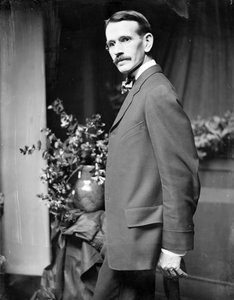
Артур Боуэн Дэвис
1862 - 1928 , США
Основные сведения
- Artistic Movement Or Style: Модернизм, Символизм
- Artists Or Movements Influenced By This Artist:
- Американский модернизм
- Хэппенская школа
- Artists Who Influenced This Artist:
- George Inness
- Корот
- Date Of Birth: 1862
- Date Of Death: 1928
- Full Name: Arthur Bowen Davies
- Nationality: Американский
- Notable Artworks: ['Unicorns: Legend']
- Place Of Birth: Утица, США