

 Предпросмотр
 Поделиться
 Поделиться
 Детали произведения

 Скачать
 Похожие работы
 Рентгенография
 Слайд-шоу
 Статистика
Жавы Мира

 Читать далее
Приобретите цифровое изображение высокого разрешения в улучшенном качестве, которое значительно превосходит онлайн-превью.
Каждый файл тщательно подготавливается нашими специалистами с использованием передовых инструментов и экспертной ручной ретуши. Мы гарантируем исключительную четкость, точную цветопередачу и детальную проработку каждого изображения.
Финальный файл доставляется по электронной почте в течение 72 часов и оптимизирован для немедленного использования в профессиональной среде, при верстке и печати. Это тот же уровень качества, которому доверяют ведущие дизайнерские студии, издательства и галереи.
Цифровое изображение
Скачайте файл высокого разрешения для личного использования, печати и творческих проектов. ( Перейти к печати Купить картину ручной работы)
Включено в каждый заказ цифровых изображений
Гарантия экспертной цифровой доставки
Выбирая ArtsDot.com, вы получаете не просто изображение — вы приобретаете профессионально обработанное цифровое произведение искусства, созданное с безупречной точностью и под защитой гарантии качества. Вот всё, что автоматически входит в ваш заказ:

Мгновенная доставка по e-mail
Ваш цифровой файл в высоком разрешении будет отправлен вам по электронной почте в течение 72 часов после оформления заказа — и сразу станет доступен для использования.

Цифровой файл с ИИ-улучшением
Ваше произведение искусства проходит профессиональную оптимизацию с использованием передовых инструментов ИИ и ручной обработки, что гарантирует максимальную детализацию, четкость и точность цветопередачи.

Бессрочная бесплатная повторная доставка
Случайно удалили или потеряли файл? Не беспокойтесь — мы отправим его вам повторно в любое время и совершенно бесплатно.

Без импортных пошлин — навсегда
Наслаждайтесь вашим произведением искусства мгновенно без таможенных пошлин, сборов или затрат на доставку — цифровые загрузки всегда не облагаются налогом.

Гарантия точности цветопередачи
Мы гарантируем, что ваше цифровое изображение максимально точно передает оригинальные цвета благодаря использованию профессиональных инструментов и систем управления цветом.

Гарантия удовлетворенности 100 дней
Если вы не будете удовлетворены своим цифровым изображением, мы внесем правки или вернем 100% стоимости в течение 100 дней — без лишних вопросов.

100% Гарантия возврата средств
Не удовлетворены покупкой? Получите полный возврат средств в течение 100 дней после получения цифрового файла — без лишних вопросов.

Скидки на оптовые заказы
Купите 3 изображения, сэкономьте 10% — Купите 5, сэкономьте 15% — Купите 10+, сэкономьте 20%. Отличное решение для творческих проектов, галерей и агентств.
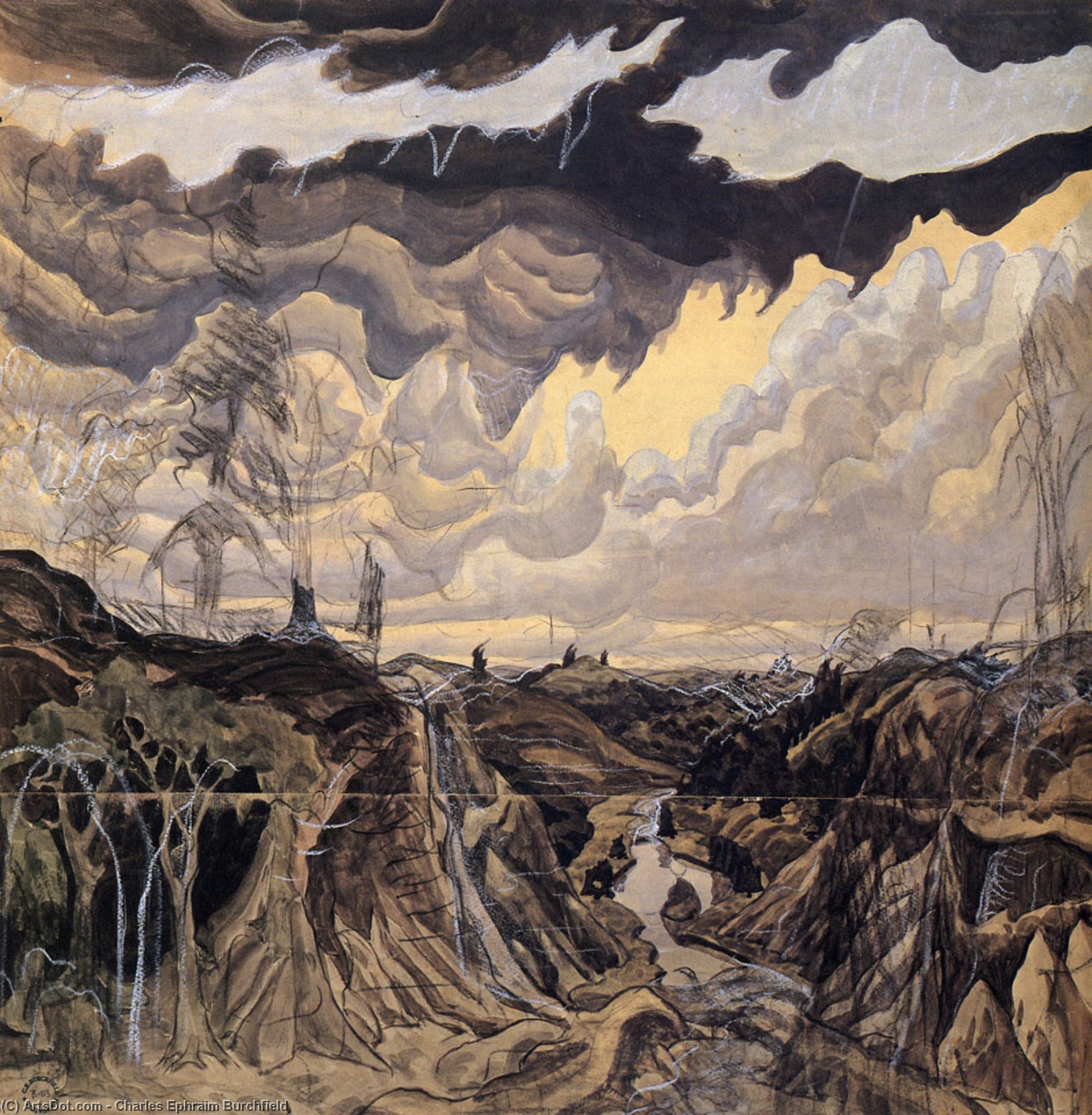
Charles Burchfield’s “Jaws Of The World”: A Landscape of Anxiety and Transcendence
The artwork "Jaws Of The World" by Charles Burchfield stands as a testament to the artist's singular ability to translate profound emotional experience into visual form. More than just a depiction of Ohio’s rural landscape, it embodies a complex tapestry of anxieties about the natural world intertwined with an underlying yearning for spiritual understanding—a characteristic hallmark of American Modernism and particularly influential in the Regionalist movement. Born in Ashtabula Harbor, Ohio, in 1893, Burchfield developed a lifelong fascination with observing and interpreting the subtle energies of his surroundings, shaping his artistic vision from its inception.- Subject Matter & Context: Burchfield’s inspiration stemmed directly from his observations of the Ohio countryside—rolling hills, meandering rivers, and dense woodlands. However, he wasn't merely documenting these familiar vistas; he sought to capture their inherent dynamism and psychological significance. The painting reflects a broader cultural preoccupation with confronting the forces of nature during the early 20th century, mirroring anxieties about industrialization and urbanization alongside an enduring belief in the restorative power of wilderness.
- Style & Technique: Burchfield’s artistic style is undeniably expressive—a deliberate rejection of photographic realism in favor of conveying emotional states through heightened visual language. He employed watercolor washes combined with meticulous pen and ink drawing, layering colors and lines to achieve remarkable textural depth and atmospheric luminescence. This technique allowed him to capture not just what he *saw*, but what he *felt*.
- Composition & Visual Language: The artwork’s composition is deliberately unbalanced, mirroring the turbulent emotional landscape it portrays. A dominant sky filled with brooding clouds commands attention, visually overshadowing a lower section depicting rugged terrain and waterways. Thick, expressive lines delineate major landforms and cloud shapes, while finer lines suggest intricate details within the scene—a masterful use of visual cues to heighten dramatic tension.
- Symbolism & Emotional Impact: The title itself—“Jaws Of The World”—immediately establishes a tone of apprehension and impending danger, reflecting Burchfield’s preoccupation with confronting existential anxieties. Recurring motifs of jagged rocks and swirling clouds symbolize instability and chaos, yet simultaneously evoke a sense of awe and reverence for the sublime beauty of nature.
- Historical Significance: “Jaws Of The World” aligns seamlessly with the tenets of Transcendentalism and Regionalism—movements that championed individualism and celebrated the spiritual resonance of American landscapes. Burchfield’s work anticipates later explorations in Abstract Expressionism, demonstrating a pioneering spirit in prioritizing emotional intensity over formal accuracy.
Movement: Regional American Modernism
Topics: Landscape, Turbulence, Sky, Terrain, Riverine, Emotion, Symbolism
Creative Period: Mature Period
Corpus Context: Nature’s Power, Spiritual Depth, American Vision, Landscape Expression, Symbolic Resonance
Похожие произведения
Биография художника
A Visionary of the American Landscape: The Life and Art of Charles Burchfield
Charles Ephraim Burchfield, born in Ashtabula Harbor, Ohio, in 1893, was an artist profoundly attuned to the rhythms and mysteries of the natural world. His life unfolded against the backdrop of a rapidly changing America, yet his artistic vision remained steadfastly rooted in a profound connection to the land—a connection that transcended mere representation and ventured into realms of spiritual and emotional resonance. Raised primarily by his widowed mother in Salem, Ohio, Burchfield’s early years were marked by an intense observation of nature, fostering a sensibility that would define his entire artistic career. He wasn't simply *seeing* the landscape; he was experiencing it with an almost mystical intensity, registering not just its visual forms but also its moods, energies, and hidden meanings. This sensitivity found early expression in detailed journals filled with both written observations and sketches—a practice he continued throughout his life, treating these notebooks as vital extensions of his creative process. His formal training at the Cleveland Institute of Art from 1916 proved pivotal, exposing him to modernist trends while simultaneously reinforcing his commitment to a uniquely personal artistic path.The Evolution of a Style: From Realism to Transcendental Vision
Burchfield’s artistic development wasn't linear; it was characterized by distinct phases reflecting his evolving inner world and responses to external influences. Initially, his work leaned towards realism, depicting the everyday scenes of small-town Ohio with meticulous detail—the weathered barns, the quiet streets, the faces of ordinary people. Even in these early pieces, a sense of underlying emotion and symbolic weight began to emerge, hinting at the deeper currents that would later flow through his art. A crucial turning point came with his move to Buffalo, New York, in 1921. While working as a wallpaper designer—a necessity for supporting his growing family—he continued to paint, gradually shifting away from strict representation towards a more expressive and visionary style. This period saw the emergence of what might be called his “haunted house” paintings, evocative depictions of vernacular architecture imbued with an unsettling atmosphere. These weren’t merely architectural studies; they were explorations of memory, nostalgia, and the hidden anxieties lurking beneath the surface of American life. The influence of European Modernists, particularly their exploration of form and color, was evident here. Later, profoundly influenced by Transcendentalist writers like Thoreau—whose writings celebrated the beauty and power of nature—and a fascination with traditional Chinese painting’s emphasis on capturing essence rather than mere likeness, Burchfield's work exploded into swirling compositions of color and form—hallucinatory renditions of nature that captured not just what he *saw*, but what he *felt*. He sought to convey the very essence of natural forces – wind, rain, sunlight – transforming landscapes into vibrant expressions of inner experience.Influences and Artistic Kinship
While fiercely independent in his artistic vision, Burchfield wasn’t entirely isolated from the broader currents of modern art. He admired the work of European Modernists, particularly their exploration of form and color, but his primary influences were often found closer to home. The English Romantic painters, with their emphasis on emotional intensity and sublime landscapes, resonated deeply with him. Writers like Willa Cather—whose novels captured the spirit of the American Midwest—also played a significant role in shaping his artistic sensibility. His exposure to modernist European trends during his time at the Cleveland Institute of Art significantly shaped his artistic approach. He developed a close friendship with Edward Hopper, who recognized and championed Burchfield’s unique talent, writing an influential essay on his work in 1935. This recognition helped bring Burchfield to wider attention, though he remained somewhat outside the mainstream art world throughout much of his career. His paintings also show influence from artists like Frederick Childe Hassam and Max Liebermann, demonstrating a broad engagement with artistic traditions while forging his own distinct path.Major Achievements and Legacy
Charles Burchfield’s work gained increasing recognition during his lifetime, culminating in the creation of the Charles Burchfield Center at Buffalo State College in 1966—a month before his death in January 1967. This center remains a vital resource for scholars and art lovers alike, housing the largest collection of his paintings, archives, and journals. His paintings are now held in over 109 museums across the United States, including the Smithsonian American Art Museum, the Metropolitan Museum of Art, and the Whitney Museum of American Art. Burchfield’s legacy extends beyond his paintings; he also left behind a wealth of writings—journals, essays, and letters—that offer invaluable insights into his artistic process and philosophical beliefs. He stands as a powerful reminder that art can be more than just representation; it can be a vehicle for exploring the deepest mysteries of human experience and our relationship to the natural world. Across the Valley, with its expressive pen and ink lines, exemplifies his ability to capture both the tranquility and underlying energy of the natural world. Burchfield’s work continues to inspire artists and viewers alike with its unique blend of realism, fantasy, and spiritual vision.Museums and Collections
- Tunbridge Wells Museum and Art Gallery (Royal Tunbridge Wells, United Kingdom)
- Frye Art Museum (Seattle, Washington)
- Smithsonian American Art Museum (Washington D.C.)
- Metropolitan Museum of Art (New York City)
- Whitney Museum of American Art (New York City)
- Burchfield Penney Art Center (Buffalo, New York) – holds the largest collection.
Чарльз Берхфилд
1893 - 1967 , США
Основные сведения
- Artistic Movement Or Style: Визионер, Акварель
- Artists Or Movements Influenced By This Artist:
- Импрессионизм
- Современное искусство
- Artists Who Influenced This Artist:
- Thoreau
- Willa Cather
- Date Of Birth: 9 апреля 1893
- Date Of Death: 10 января 1967
- Full Name: Charles Ephraim Burchfield
- Nationality: Американский
- Notable Artworks:
- Across the Valley
- Dutch Farmhouse...
- Place Of Birth: Аshtabula, США