

 Предпросмотр
 Поделиться
 Поделиться
 Детали произведения

 Скачать
 Похожие работы
 Рентгенография
 Слайд-шоу
 Статистика
Still-Life


 Читать далее
Жикле / Арт-принт
Печать (жикле) или холст музейного качества с быстрыми сроками изготовления и широким выбором вариантов отделки. ( Купить картину ручной работы Перейти к цифровым изображениям)




P118B $10

P118H $10

P118W $10

P438Z $10

P508JH $12

P508YH $12

P805H $10

P805Z $10

P919BZ $10

P919G $10

P919XJ $10

P959ZH $10

P968JZ $12

W106C $8

W218G $10

W218JH $8

W218Y $10

W307PJ $10

W316G $10

W316PJ $8

W316Y $10

W398PJ $8

W4111J $10

W500HY $15

W500JH $15

W692G $12

W849H $8

W940BG $15

W953PJ $8




Выберите один из наших стандартных размеров, соответствующих оригинальным пропорциям произведения искусства.

Вы можете указать свои собственные размеры, чтобы репродукция идеально подошла под конкретную раму или пространство. Если выбранный вами размер не будет соответствовать пропорциям оригинала, мы либо обрежем произведение, либо дополним изображение зеркальным отражением краев или однотонной заливкой. Перед началом производства вам будет отправлен цифровой макет для утверждения.
Пожалуйста, обратите внимание, что предварительный просмотр на экране не отображает фактическую обрезку или расширение изображения. Только макет точно покажет финальную композицию.
Несмотря на возможность заказа индивидуальных размеров, мы рекомендуем выбирать размер из предопределенного списка, чтобы сохранить оригинальные пропорции.
Доставка по всему миру () за 2 недели вместо стандартных 4/5 недель. (10 Сентябрь)

Бесплатная экспресс-доставка по всему миру

Высококачественный льняной холст

Полное страхование доставки

Гарантия возмещения таможенных пошлин

Гарантия точного соответствия цветов

100-дневная политика возврата (только при обнаружении дефектов)

Гарантия возврата 100% средств

Предложение оптовых скидок
 Вариант со стеклом доступен только для размеров менее 110 см

Still-Life
Жикле / Арт-принт
Размер репродукции
-


Итоговая стоимость
$ 62
A Window into Baroque Still Life: Christian Berentz’s Delicate Observation
Christian Berentz (1658-1722) represents a fascinating convergence of artistic traditions—primarily rooted in Dutch still life painting—yet decisively shaped by his residency within the vibrant artistic landscape of Rome. Born in Hamburg, Germany, Berentz’s early training under Hermann Kamphusen and Georg Hainz established him firmly within the burgeoning German Baroque tradition. However, it was his journey to Amsterdam and Venice that truly broadened his horizons, immersing him in the stylistic currents circulating amongst leading artists of the time. This dual influence is palpable throughout his oeuvre, resulting in a style characterized by meticulous observation and masterful execution—a hallmark of masters like Pieter Claesz, Maximilian Pfeiler, Willem Kalf, and Pietro Navarra.- Dutch Roots: Berentz’s formative years were spent absorbing the tenets of Dutch Baroque painting, particularly its emphasis on realism and careful depiction of textures. Artists such as Claesz and Kalf championed a style that prioritized capturing the subtle nuances of everyday objects with painstaking detail.
- Roman Resonance: Simultaneously, Berentz cultivated connections within Rome’s artistic circles, encountering the grandeur and expressive dynamism of Baroque art originating from Italy. This exposure undoubtedly contributed to his stylistic refinements, subtly incorporating elements of Roman Mannerism—a movement known for its elongated figures and stylized compositions.
The Composition: A Symphony of Light and Texture
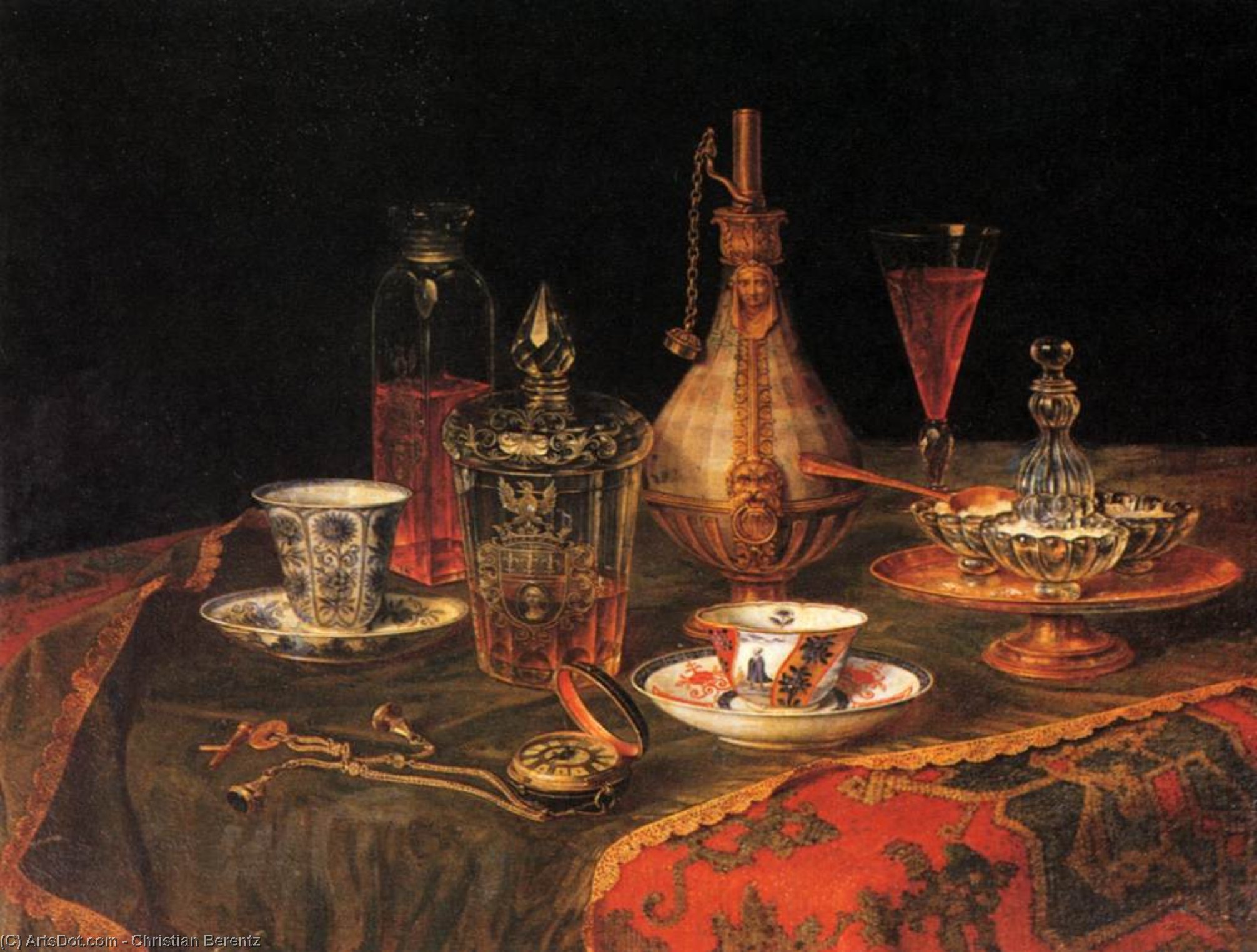
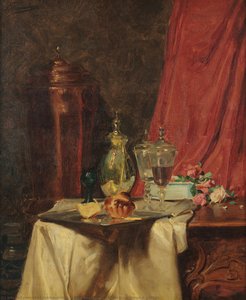
Berentz’s still lifes are renowned for their serene beauty and compositional elegance. The image depicts a meticulously arranged tableau featuring a dark cloth serving as the backdrop, upon which rests an assortment of objects—primarily vases adorned with floral motifs, glassware filled with crimson wine, candlesticks bearing unlit candles, bowls brimming with fruit and flowers, and delicate cups embellished with intricate designs. Each element is illuminated by soft, diffused light emanating from an unseen window, creating a palpable sense of intimacy and inviting contemplation. The artist skillfully employs textural contrasts—the velvety surface of the cloth juxtaposed against the smooth sheen of porcelain and glass—to heighten visual interest and convey a profound appreciation for materiality.Symbolism Beneath the Surface: Vanitas Revisited
Like many Baroque artists, Berentz engaged in the exploration of *vanitas*, a genre that served as a poignant reminder of mortality and the transience of earthly pleasures. The inclusion of objects such as the withered sponge cake (referenced in the accompanying link), the scissors representing time’s relentless passage, and the locket symbolizing remembrance speaks to this overarching theme. These symbols are not merely decorative; they function as conduits for conveying philosophical meditations on human existence—a characteristic feature of Baroque art's desire to provoke reflection and inspire spiritual awareness.Technical Mastery: Precision and Detail
Berentz’s technique exemplifies the exacting standards upheld by Baroque painters. He achieved remarkable realism through painstaking layering of glazes, meticulously blending colors to create subtle gradations of tone and luminosity. The artist's meticulous attention to detail—evident in the intricate floral patterns on the vases and bowls, as well as the delicate rendering of candlelight—underscores his commitment to capturing the essence of his subjects with unparalleled accuracy. As evidenced by the detailed description provided in the linked article ("Still-Life with Crystal Glasses and Sponge-Cakes by BERENTZ ..."), Berentz’s work stands as a testament to the enduring legacy of Dutch Baroque painting and its profound influence on European art history.A Timeless Reflection: Exploring Reproduction Options
ArtsDot.com offers exceptional reproductions of Christian Berentz's "Still Life," allowing collectors and enthusiasts alike to experience the beauty and intellectual depth of this iconic masterpiece firsthand. Explore high-resolution prints and canvases that faithfully capture the artist’s masterful technique and evocative atmosphere—bringing a touch of Baroque elegance into any interior space.Похожие произведения
Биография художника
The Alchemist of Light: The Life and Legacy of Christian Berentz
In the grand, sweeping tapestry of the Baroque era, few threads are as intricately woven as those of Christian Berentz. Born in the industrious city of Hamburg in 1658, Berentz emerged from the German tradition not merely as a student of form, but as a bridge between disparate worlds. His early years were defined by rigorous discipline under the tutelage of masters such as Hermann Kamphusen and Georg Hainz, providing him with a foundational mastery of the Northern European penchant for precision. Yet, the soul of an artist often craves the horizon, and for Berentz, that horizon lay far beyond the borders of Germany. His subsequent journeys through the Netherlands and Venice acted as a transformative pilgrimage, exposing him to the luminous palettes of the Mediterranean and the profound, quiet realism of the Dutch Golden Age.
By the time Berentz established himself in Rome, he had become a true cosmopolitan of the canvas. He did not merely adopt the Roman style; he synthesized it with his Northern roots to create something entirely singular. His residency in the Eternal City allowed him to absorb the grandeur and theatricality of the Italian Baroque, most notably through his involvement in the prestigious studio of Carlo Maratta. This period of collaboration was instrumental in refining his ability to marry the meticulous, almost scientific observation of Dutch still life with the sweeping, emotive energy of Roman classicism. In doing so, Berentz became a vital conduit for the dissemination of Northern stylistic nuances into the heart of Italy.
A Symphony of Texture and Symbolism
To gaze upon a Berentz masterpiece is to enter a world where time seems to suspend itself in a moment of exquisite decay and eternal beauty. He was a master of the still life, a genre that, under his brush, transcended simple representation to become a profound meditation on existence. His compositions are often characterized by a sophisticated use of chiarosc Century, where deep, velvety shadows provide a dramatic stage for the sudden, brilliant emergence of light upon a dew-kissed petal or a translucent grape. This interplay of light and dark does more than create depth; it breathes life into the inanimate.
His technique, often described with a touch of mannerist elegance, reveals a conscious effort to distill the essence of nature into highly stylized yet breathtakingly realistic forms. One might observe:
- The tactile richness of heavy drapery and dark cloths that anchor his compositions.
- The delicate, almost fragile rendering of floral motifs that suggest the fleeting nature of life.
- The masterful depiction of glass and liquid, capturing the way light refracts through wine and crystal.
Historical Significance and Artistic Endurance
The historical importance of Christian Berentz lies in his role as an artistic mediator. He stood at the crossroads of Northern realism and Southern grandeur, proving that these seemingly opposing movements could be harmonized into a cohesive visual language. His ability to navigate the technical demands of the Dutch masters—such as the precision of Pieter Claesz—while embracing the atmospheric depth of the Roman school, allowed him to occupy a unique niche in the Baroque hierarchy. Furthermore, his legacy extends through his role as an educator; by training figures such as Pietro Navarra, he ensured that his particular brand of stylistic synthesis would ripple through subsequent generations of painters.
Today, Berentz’s contributions are preserved in some of the world's most esteemed institutions, including the Hermitage Museum. His works remain vital touchstones for anyone seeking to understand the complexity of the Baroque period—a time when art was not merely a mirror held up to nature, but a sophisticated dialogue between the seen and the unseen, the fleeting and the eternal. Through his meticulous observation and emotive execution, Berentz continues to invite viewers into a silent, beautiful conversation with the ephemeral wonders of the natural world.
Christian Berentz
1658 - 1722 , Germany
Основные сведения
- Artistic Movement Or Style: Baroque
- Artists Or Movements Influenced By This Artist:
- Pieter Claesz
- Carlo Maratta
- Artists Who Influenced This Artist:
- Hermann Kamphusen
- Georg Heinz
- Date Of Birth: 1658
- Full Name: Christian Berentz
- Nationality: German
- Notable Artworks: ['Flowers & Fruits']
- Place Of Birth: Hamburg, Germany
Похожие статьи
Silent Narratives: Exploring the Enduring Appeal of Still Life Painting Across Centuries
Explore the rich history of still life painting with ArtsDot. Discover Dutch Masters, decode vanitas symbolism & learn about collecting timeless art. Expert insights and museum-quality reproductions.
Jan Jansz Wijnants: A Study in Dutch Golden Age Still Life & Floral Transience
Explore the captivating world of Jan Wijnants and Dutch Golden Age still life painting. Discover symbolism, masterful techniques & lasting influence on floral art history. Learn more!

Golden Age Reflections: Dutch Baroque Painting & Cultural Innovation
Explore the Dutch Golden Age of painting! Discover key artists like Vermeer & ter Borch, their innovative techniques, and the rich cultural context behind these Baroque masterpieces. Learn about collecting & appreciating this iconic art period.
Abraham Hendricksz van Beyeren: Pioneering Dutch Still Life & the Banquet Tradition
Explore the captivating world of Dutch Golden Age still life with Abraham van Beyeren. Discover his innovative techniques, symbolic banquet scenes & lasting influence on art history. Learn about collecting these masterpieces.

Топ-10 шедевров голландского барокко: искусство для вашего интерьера от ArtsDot.com
Погрузитесь в мир голландского барокко! От Рембрандта до Вермеера – 10 шедевров, изменивших искусство. Узнайте истории создания и технику великих мастеров. Репродукции картин высочайшего качества для вашего интерьера на ArtsDot.com.