 Предпросмотр
 Поделиться
 Поделиться
 Детали произведения

 Скачать
 Похожие работы
 Рентгенография
 Слайд-шоу
 Статистика
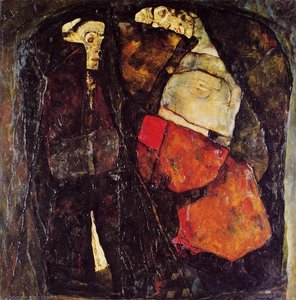
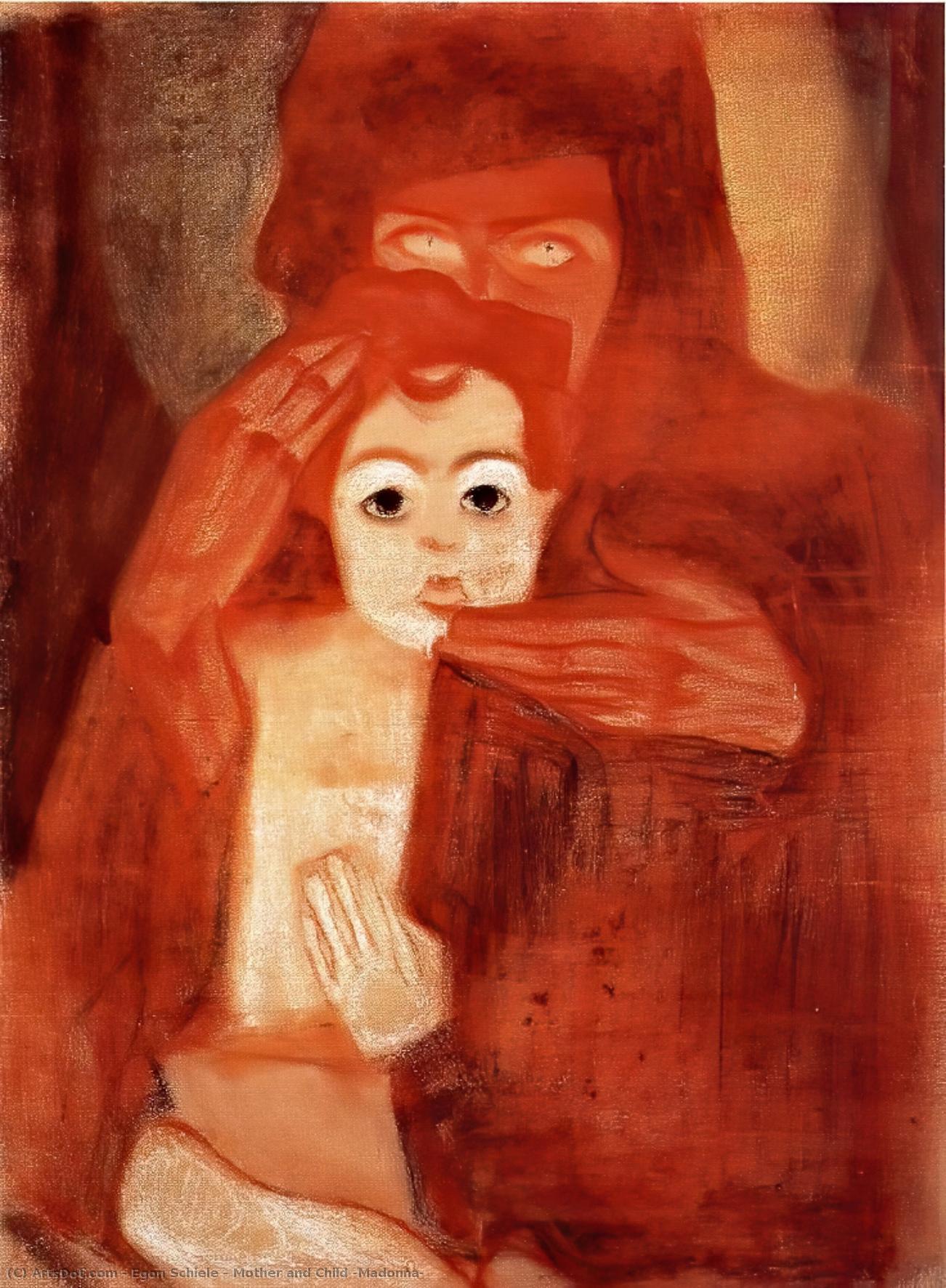
Mother and Child (Madonna)
 Oil
Oil- WallArt
- Expressionist Style
 1908
1908- Modern
 60.0 x 43.0 cm
 Читать далее
Масляная репродукция ручной работы
Картина маслом на холсте в выбранном вами размере и раме, написанная на заказ нашими художниками. ( Перейти к печати Перейти к цифровым изображениям)




P118B $10

P118H $10

P118W $10

P438Z $10

P508JH $12

P508YH $12

P805H $10

P805Z $10

P919BZ $10

P919G $10

P919XJ $10

P959ZH $10

P968JZ $12

W106C $8

W218G $10

W218JH $8

W218Y $10

W307PJ $10

W316G $10

W316PJ $8

W316Y $10

W398PJ $8

W4111J $10

W500HY $15

W500JH $15

W692G $12

W849H $8

W940BG $15

W953PJ $8




Выберите один из наших стандартных размеров, соответствующих оригинальным пропорциям произведения искусства.

Вы можете указать собственные размеры, чтобы картина идеально вписалась в выбранную раму или пространство. Если выбранный вами размер не соответствует пропорциям оригинала, мы либо обрежем полотно, либо расширим его за счет дополнительных элементов, написанных вручную. Цифровой макет будет отправлен вам на утверждение перед началом производства.
Обратите внимание, что предварительный просмотр на экране не отражает фактическую обрезку или расширение. Только макет точно покажет окончательную композицию.
Хотя доступны индивидуальные размеры, мы рекомендуем выбирать вариант из предопределенного списка, чтобы сохранить исходные пропорции.
После оформления заказа команда ArtsDot.com свяжется с клиентом по электронной почте для уточнения деталей и предоставит предварительный макет
Доставка по всему миру () за 3–4 недели вместо стандартных 5 недель. (11 Сентябрь). Без компромиссов в качестве.

Бесплатная экспресс-доставка по всему миру

Высококачественный льняной холст

Полное страхование доставки

Гарантия возмещения таможенных пошлин

Гарантия точного соответствия цветов

100-дневная политика возврата (только при обнаружении дефектов)

Гарантия возврата 100% средств

Предложение оптовых скидок
 Вариант со стеклом доступен только для размеров менее 110 см

Mother and Child (Madonna)
Техника репродукции
Размер репродукции
-


Итоговая стоимость
$ 263
A Tender Encounter in the Heart of Expressionism
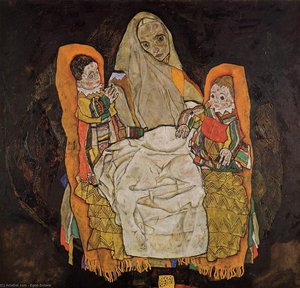
In the realm of early twentieth-century modernism, few works capture the raw, psychological intimacy of human connection as poignantly as Egon Schiele’s “Mother and Child (Madonna).” Created in 1908, this masterpiece serves as a profound meditation on maternal love, stripped of the idealized, porcelain perfection often found in classical religious iconography. Instead, Schiele presents us with an uncompromisingly honest vision of vulnerability. The painting depicts a woman cradling her infant in a close, protective embrace, where every line and color choice seems to pulse with the quiet intensity of a heartbeat. It is not merely a portrait of two figures; it is an exploration of the primal bond that exists between protector and protected, rendered through the turbulent lens of the Viennese avant-garde.
The visual language of the piece is defined by Schiele’s signature Expressionist technique, characterized by a deliberate use of distorted forms and emotive gestures. The composition draws the eye immediately to the central figures, where the striking contrast between the mother's deep, scarlet dress and the child’s pale, luminous skin creates a powerful visual hierarchy. This splash of red acts as an emotional anchor, symbolizing both the warmth of life and the visceral nature of existence. Schiele’s mastery is most evident in his use of gesture; the way the woman’s hand delicately encircles the child’s face conveys a sense of overwhelming tenderness, while the slightly flattened planes and elongated limbs evoke the underlying anxieties of an era standing on the precipulated edge of modernity.
Symbolism and the Weight of Emotion
Beyond its surface beauty, “Mother and Child (Madonna)” is steeped in the symbolic tensions of Schiele’s world. Living in a period marked by the fading grandeur of the Habsburg Empire and the burgeoning rise of psychoanalysis, Schiele utilized the human form to navigate themes of mortality and fragility. The muted yellows and earthy tones that surround the central figures suggest a sense of isolation, as if this moment of maternal peace is a fleeting sanctuary carved out from a chaotic world. The child’s upward gaze, seeking guidance or perhaps mere comfort, mirrors the viewer's own search for stability amidst the shifting currents of history.
For the discerning collector or interior designer, this artwork offers more than just aesthetic appeal; it provides a focal point of profound emotional depth. A high-quality reproduction of this piece brings a sophisticated, contemplative energy to any space, whether it be a private study or a curated gallery wall. The painting’s ability to balance the heavy, somber undertones of Expressionism with the light of human affection makes it a versatile and timeless addition to a collection. It invites conversation, prompting observers to reflect on the enduring strength of love and the beautiful, often jagged, reality of the human condition.
Похожие произведения
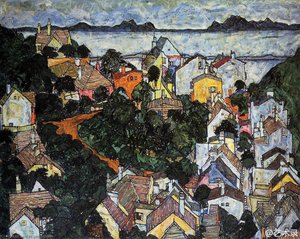
Биография художника
A Life Forged in Expression
Egon Schiele, born in Tulln an der Donau in 1890 – a town nestled amidst the rolling hills and vineyards of Austria – embarked on a life that was both intensely creative and profoundly marked by personal tragedy. His early years were shadowed by illness and loss; his father, Adolf Eugen Schiele, succumbed to syphilis when Egon was just fourteen, a devastating event that would indelibly shape the artist’s perspective and fuel an enduring preoccupation with mortality and the fragility of human existence. Raised initially by his mother and later under the somewhat controlling guardianship of his uncle Leopold Czihaczek, Schiele's childhood lacked the stability often associated with conventional upbringing, yet it fostered within him a remarkable independence of spirit – a characteristic that would become central to his artistic approach. Even as a young boy, he displayed an undeniable fascination with trains—a motif that subtly and repeatedly reappeared in his paintings, symbolizing both movement and perhaps, the relentless passage of time. Alongside this burgeoning interest in trains, Schiele cultivated a talent for drawing, though it was initially met with reservations from his father who viewed artistic pursuits as a distraction from more practical endeavors. The untimely death of his sister Elvira further deepened the emotional landscape of his youth, contributing to a sense of vulnerability and loss that would permeate much of his work. These formative experiences—a confluence of illness, grief, and familial constraints—instilled within Schiele a profound sensitivity and an emotional rawness that became defining features of his artistic expression, driving him to grapple with the fundamental questions of life, death, and the human condition.The Crucible of Vienna: Artistic Development
Schiele’s formal artistic training commenced at the Kunstgewerbeschule (School of Arts and Crafts) in Vienna, but he quickly found himself stifled by its conservative curriculum and adherence to traditional methods. Seeking a more liberating environment, he transferred to the Akademie der bildenden Künste (Academy of Fine Arts), only to discover that even this institution failed to satisfy his artistic aspirations. The rigid academic traditions and restrictive approach left him feeling disillusioned, leading him to abandon formal training altogether in favor of forging his own path—a bold decision that underscored his unwavering conviction in his artistic vision. Crucially, Schiele’s early years were profoundly influenced by the work of Gustav Klimt, a celebrated figure of Viennese Secessionism. He admired Klimt's distinctive decorative style and his exploration of symbolism, even receiving mentorship from the established artist. However, Schiele soon diverged significantly from Klimt’s aesthetic, developing a uniquely personal style characterized by its stark honesty, psychological intensity, and unflinching portrayal of human vulnerability. This divergence was further solidified through his involvement in the *Neues Wiener Kunstgruppe* (New Viennese Art Group), an avant-garde collective that challenged prevailing artistic norms and embraced innovative approaches to artmaking. The group, comprised of artists like Anton Faistauer and Hans Ehrlich, provided a space for Schiele to experiment with new techniques and explore unconventional themes, solidifying his position as a leading figure in the burgeoning modern art scene of Vienna.Raw Emotion and Unflinching Truth
Egon Schiele’s art is immediately recognizable for its raw honesty and psychological depth. He fearlessly confronted subjects often considered taboo – sexuality, death, anxiety, isolation – with an unflinching gaze. His distinctive style features elongated figures, contorted poses, and expressive lines that convey a sense of unease and emotional intensity. The human form, particularly the nude, became his primary subject, not as an object of idealized beauty but as a vehicle for exploring the complexities of human experience. Self-portraits constitute a significant portion of his oeuvre, offering intimate glimpses into his inner world—a world often marked by loneliness and self-doubt. He didn’t shy away from depicting himself in unflattering or vulnerable poses, revealing a profound level of self-awareness and introspection. Beyond self-portraiture, Schiele created numerous portraits of others, capturing their likenesses with an unsettling realism that seemed to penetrate beneath the surface. His landscapes, while less central to his work than his figurative paintings, demonstrate his mastery of form and color, often reflecting the same emotional intensity as his portraits. Recurring motifs like the *Physalis* plant – symbolizing death and transience with its delicate, papery husk – further underscore this preoccupation with mortality. The use of line is particularly striking in Schiele’s work; it's not merely a tool for defining shape but an expressive force that conveys emotion and psychological tension.A Legacy Cut Short: Achievements & Significance
Despite facing censorship and legal challenges—including a brief imprisonment for allegedly corrupting minors with his art—Schiele gained recognition within Vienna’s avant-garde circles. His work challenged the conventions of the time, provoking both admiration and outrage. By the time of his untimely death during the Spanish flu pandemic in 1918 at the age of twenty-eight, he had established himself as a leading figure in Austrian Expressionism. Significant works such as *Self-Portrait with Physalis*, *Couple Embracing*, and *Field Landscape (Kreuzberg near Krumau)* stand as testaments to his artistic genius. His influence on subsequent generations of artists is undeniable, particularly those interested in exploring psychological themes and challenging conventional artistic norms. Schiele’s bold approach to form and subject matter continues to resonate with audiences today, making him one of the most important and influential figures in early 20th-century art. His paintings are now held in major museum collections worldwide, including the Leopold Museum in Vienna and the Egon Schiele Art Centrum in Český Krumlov, ensuring his artistic legacy endures. He left behind a body of work that is not merely aesthetically compelling but profoundly human—a testament to the power of art to confront the complexities of existence with honesty, courage, and unwavering vision.- Key Themes: Mortality, sexuality, isolation, psychological turmoil.
- Influences: Gustav Klimt, Viennese Secession, personal trauma.
- Style Characteristics: Elongated figures, contorted poses, expressive lines, raw emotion.
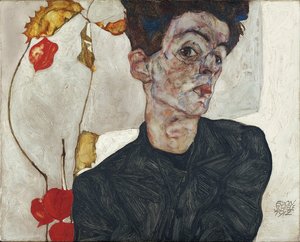
Шиле
1890 - 1918 , Австрия
Основные сведения
- Artistic Movement Or Style: Экспрессионизм
- Artists Or Movements Influenced By This Artist: ['Экспрессионизм']
- Artists Who Influenced This Artist: ['Густав Климт']
- Date Of Birth: 1890
- Date Of Death: 1918
- Full Name: Egon Leo Adolf Ludwig Schiele
- Nationality: Австриец
- Notable Artworks:
- Автопортрет с физиалисом
- Пара обнимаются
- Полевая панорама (Крُمáу)
- Place Of Birth: Тюльн, Австрия
Похожие статьи
Топ-10 шедевров экспрессионизма: картины, изменившие искусство | ArtsDot
Погрузитесь в мир экспрессионизма! Откройте 10 шедевров Мунка, Кирхнера и других гениев. Узнайте истории создания культовых картин и вдохновитесь для декора вашего дома. Репродукции музейного качества на ArtsDot.com
Топ-10 шедевров экспрессионизма: искусство, изменившее мир | ArtsDot
Погрузитесь в мир экспрессионизма! Откройте топ-10 шедевров Мунка, Кирхнера и других гениев XX века. Узнайте истории создания культовых картин и вдохновитесь для оформления интерьера с ArtsDot.com – музейное качество репродукций.
Эгон Шиле: 25 шедевров экспрессионизма для ценителей искусства и декора интерьера
Погрузитесь в мир Эгона Шиле! 25 шедевров экспрессионизма, раскрывающих психологическую глубину и новаторский стиль австрийского художника. Купите репродукции картин Шиле премиум-качества для вашего интерьера на ArtsDot.com.

Рафаэль: 25 шедевров великого художника для ценителей искусства и декора интерьера
Погрузитесь в мир Рафаэля! 25 величайших шедевров эпохи Возрождения, полные гармонии и красоты. Узнайте истории создания картин, технику живописи и вдохновитесь для декора интерьера. Репродукции высокого качества на ArtsDot.com.
Egon Schiele: Expressionism, Anxiety & the Modern Condition – A Comprehensive Exploration
Explore the emotionally charged world of Egon Schiele (1890-1918). Discover his Expressionist masterpieces, psychological themes, and lasting impact on modern art. A comprehensive guide for collectors & enthusiasts.