

 Поделиться
 Поделиться
 Детали произведения

 Скачать
 Похожие работы
 Слайд-шоу
 Статистика
Tomorrow's Apples (5 in White)


 Читать далее
Масляная репродукция ручной работы
Картина маслом на холсте в выбранном вами размере и раме, написанная на заказ нашими художниками. ( Перейти к печати Перейти к цифровым изображениям)




































Выберите один из наших стандартных размеров, соответствующих оригинальным пропорциям произведения искусства.

Вы можете указать собственные размеры, чтобы картина идеально вписалась в выбранную раму или пространство. Если выбранный вами размер не соответствует пропорциям оригинала, мы либо обрежем полотно, либо расширим его за счет дополнительных элементов, написанных вручную. Цифровой макет будет отправлен вам на утверждение перед началом производства.
Обратите внимание, что предварительный просмотр на экране не отражает фактическую обрезку или расширение. Только макет точно покажет окончательную композицию.
Хотя доступны индивидуальные размеры, мы рекомендуем выбирать вариант из предопределенного списка, чтобы сохранить исходные пропорции.
После оформления заказа команда ArtsDot.com свяжется с клиентом по электронной почте для уточнения деталей и предоставит предварительный макет
Доставка по всему миру () за 3–4 недели вместо стандартных 5 недель. (11 Сентябрь). Без компромиссов в качестве.

Бесплатная экспресс-доставка по всему миру

Высококачественный льняной холст

Полное страхование доставки

Гарантия возмещения таможенных пошлин

Гарантия точного соответствия цветов

100-дневная политика возврата (только при обнаружении дефектов)

Гарантия возврата 100% средств

Предложение оптовых скидок
 Вариант со стеклом доступен только для размеров менее 110 см

Tomorrow's Apples (5 in White)
Техника репродукции
Размер репродукции
-


Итоговая стоимость
$ 263
The Poetic Fragility of Form
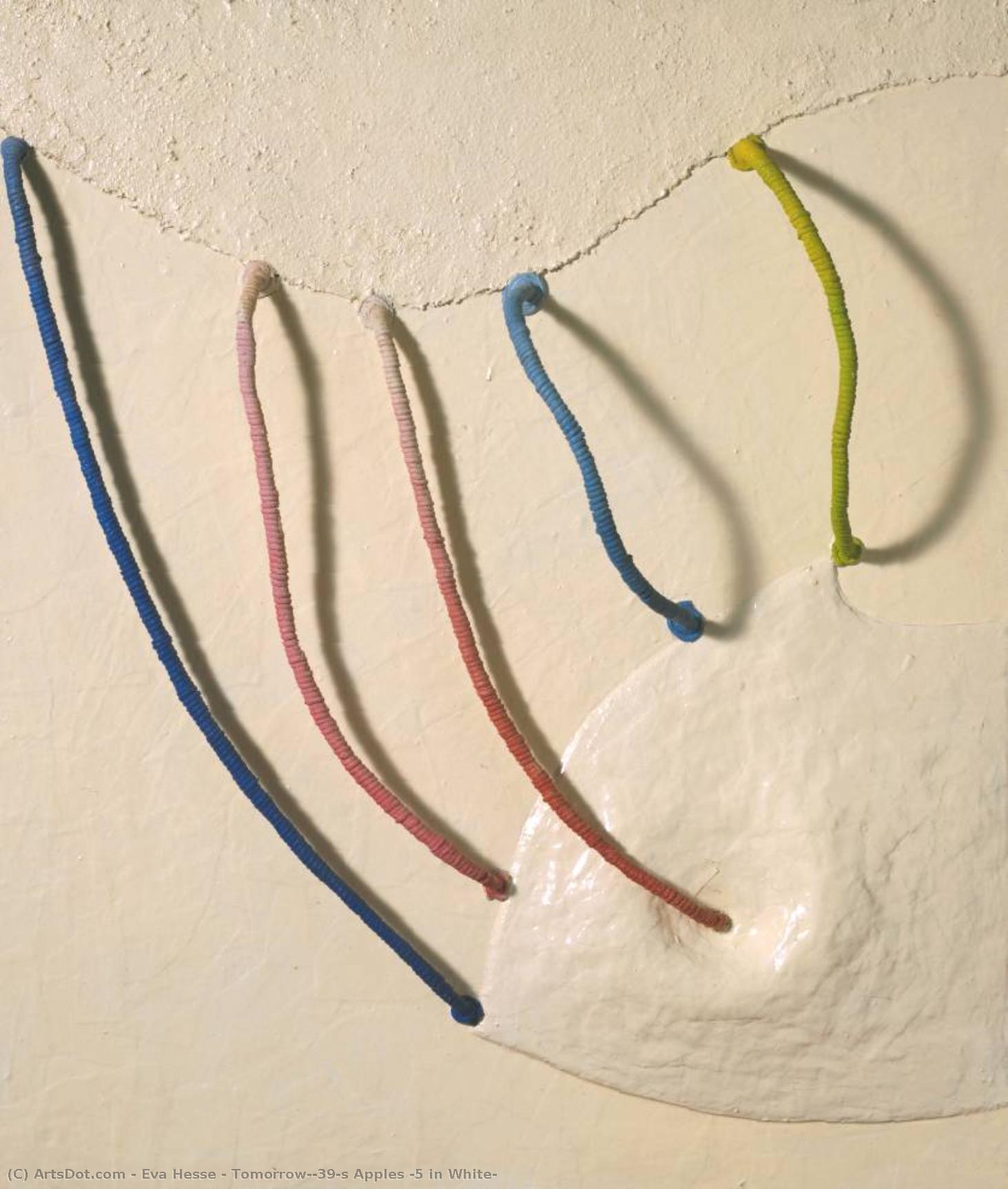
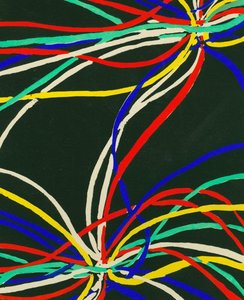
In the quiet, evocative realm of Eva Hesse, materiality speaks where words fail. Her 1965 masterpiece, Tomorrow's Apples (5 in White), stands as a profound testament to the beauty found in imperfection and the delicate balance between structure and decay. At first glance, the viewer is met with a minimalist landscape: five vibrant, rope-like forms—hues of blue, red, pink, yellow, and green—casually draped across a stark, textured white expanse. These organic shapes do not command the space through rigid geometry but rather through a gentle, drooping movement that suggests a life force caught in a moment of stillness. The composition is masterfully asymmetrical, evoking a sense of spontaneous creation, as if the colorful elements were placed with a deliberate yet effortless hand.
The tactile allure of this work lies in its striking contrast. The background, a rough and uneven surface reminiscent of plaster or drywall, provides a rugged stage for the smoother, more fluid ropes. This interplay of textures invites the eye to wander, tracing the curves and loops of the fibers as they interact with the craggy landscape beneath them. For the discerning collector or interior designer, this piece offers a sophisticated focal point that bridges the gap between Minimalism and Postminimalism. It possesses a sculptural depth that, even when rendered as a high-quality reproduction, brings a sense of physical presence and rhythmic energy to any contemporary space.
A Legacy of Vulnerability and Motion
To understand the emotional resonance of Tomorrow's Apples, one must look toward the turbulent life of its creator. Born in Hamburg and shaped by the profound displacements of mid-century Europe, Hesse infused her work with a unique sense of eccentric abstraction. Her art often explores themes of fragility, repetition, and the ephemeral nature of existence—concepts that are deeply embedded in the very fibers of this piece. The "apples" themselves are not literal fruits but symbolic entities; they represent organic growth and the vulnerability of the body, rendered through materials that feel both grounded and fleeting.
The technique employed here is a masterclass in Conceptual Art, where the medium itself becomes the message. By utilizing simple, industrial-adjacent materials like rope and plaster, Hesse stripped away the pretension of traditional sculpture to reveal something much more primal and human. The vibrant primary colors act as pulses of vitality against the neutral white, preventing the work from feeling sterile or cold. Instead, the piece radiates a warmth and a sense of "becoming." For those seeking to adorn a curated collection, this artwork offers more than mere decoration; it provides an invitation to contemplate the beautiful, messy, and transient nature of our own world.
Похожие произведения


Биография художника
Eva Hesse - A Life Interrupted: The Poetic Vulnerability of Eva Hesse
Eva Hesse’s story is one of profound displacement and a relentless pursuit of artistic expression in the face of personal tragedy. Born in 1936 in Hamburg, Germany, her early life was irrevocably altered by the looming shadow of Nazism. Fleeing persecution, her family sought refuge in the United States in 1938, an act that would forever shape Hesse’s identity as a displaced person navigating two worlds. This sense of rootlessness, coupled with the emotional trauma of her parents' separation and her mother’s subsequent suicide when Hesse was just ten years old, became a subtle yet powerful undercurrent in her art—a haunting exploration of fragility, loss, and the ephemeral nature of existence. Her formal artistic training began at Pratt Institute in Brooklyn, followed by studies at Cooper Union and Yale University School of Art and Architecture, where she encountered the rigorous material explorations championed by Josef Albers. However, it was not within the confines of traditional painting that Hesse found her true voice; rather, she embarked on a path of radical experimentation with materials and form, ultimately becoming a pivotal figure in the development of Postminimalism and Eccentric Abstraction.Early Life and Influences
Eva Hesse’s formative years were marked by significant upheaval. Her parents, Jewish immigrants from Poland, faced increasing antisemitic pressures during Hitler’s rise to power, prompting them to relocate their family to America in 1938—a decision that profoundly impacted Hesse's worldview. This experience instilled a deep awareness of vulnerability and displacement, themes that would permeate her artistic vision throughout her career. Hesse’s exposure to Surrealist art during her adolescence ignited her fascination with subconscious imagery and dreamlike landscapes, influencing her approach to composition and symbolism. Simultaneously, she absorbed the energy and dynamism of Abstract Expressionism, particularly the gestural brushstrokes of artists like Willem de Kooning and Jackson Pollock, recognizing their capacity to convey emotion and spontaneity. These influences combined to shape Hesse’s artistic sensibility—a blend of intellectual rigor and visceral feeling that distinguished her from many of her contemporaries.Formal Artistic Training and Initial Exploration
Hesse pursued her formal artistic education diligently, enrolling at Pratt Institute in Brooklyn and subsequently attending Cooper Union and Yale University School of Art and Architecture. At Yale, she encountered the influential teachings of Josef Albers, whose exploration of color theory and perceptual illusion profoundly impacted Hesse’s understanding of visual art. Albers's emphasis on reductive abstraction—the simplification of forms to their essential elements—served as a catalyst for Hesse’s own experimentation with minimalist principles. However, Hesse quickly rejected the perceived limitations of pure geometric abstraction, yearning for a more expressive engagement with materiality—a desire that would propel her into uncharted territory. She sought inspiration from artists who challenged conventional artistic norms and embraced unconventional materials and techniques, including Hans Arp and Jean Dubuffet, whose biomorphic sculptures explored organic forms and textures.A Sculptural Revolution: Embracing Materiality
Initially drawn to abstract painting, Hesse soon felt constrained by its traditional conventions. She recognized that painting alone couldn’t adequately convey the complexities of human experience—the anxieties, uncertainties, and emotional nuances that she wished to explore. This conviction led her to decisively turn towards sculpture, embarking on a transformative journey into the realm of three-dimensional art. Hesse deliberately rejected industrial production methods, favoring instead techniques that allowed for unpredictable results and celebrated imperfections. She experimented with diverse materials—latex rubber, fiberglass, resin, copper wire, felt, and even dirt—pushing their boundaries and revealing their inherent qualities. Her sculptures weren’t intended to represent recognizable objects or figures; rather, they aimed to evoke feelings of vulnerability, disorientation, and contemplation. Hesse's approach mirrored the spirit of Postminimalism—a movement that emerged in the mid-1960s as a reaction against the formalism of Minimalism and championed subjectivity and organic form.Major Achievements and Legacy
Eva Hesse’s sculptural output produced several groundbreaking works that continue to resonate with artists and critics today. Pieces like Hang Up (1966), featuring suspended latex-covered circles, exemplify her masterful manipulation of material properties—the way latex stretched and warped under gravity—to create evocative visual forms. Her series of fiberglass boxes, including Contingent (1968) and Schema and Sequel (1967–68), explored the interplay between geometric precision and organic irregularity, reflecting Hesse’s fascination with both order and chaos. Notably, her installation Accession II (1968)—a monumental assemblage of translucent fiberglass boxes containing phallic forms—challenged societal norms surrounding sexuality and embodied Hesse's commitment to confronting difficult emotions with honesty and vulnerability. Hesse’s influence extended beyond sculpture; she championed feminist art practices by exploring themes of gender identity, bodily experience, and psychological introspection. Her courageous embrace of imperfection and her willingness to experiment with unconventional materials solidified her position as a pioneer in Postminimalism and Eccentric Abstraction—a legacy that continues to inspire artists striving for originality and emotional depth. Hesse’s untimely death from cancer in 1970 tragically curtailed her artistic career, but her work remains a testament to the transformative power of art and its ability to illuminate the human condition.- Useful Links:
- Addendum: A minimalist wire & wood sculpture embodying Postminimalism.
- Contingent: Showcasing Hesse’s mastery of space and form.
- Tomorrow's Apples (5 in White): Demonstrates Hesse's use of repetition and organic forms.
Эва Хессе
1936 - 1970 , Германия
Основные сведения
- Artistic Movement Or Style: Постминимализм и эксцентрическая абстракция
- Artists Or Movements Influenced By This Artist: ['Фемминистское искусство']
- Artists Who Influenced This Artist:
- Йозеф Альберс
- Луиза Бёржеоис
- Ганс Арп
- Жан Дюбуфф
- Date Of Birth: 1936
- Date Of Death: 1970
- Full Name: Eva Hesse
- Nationality: Немецко-американская
- Notable Artworks:
- Ханг ап
- Контингент
- Завтрашние яблоки
- Place Of Birth: Hamburg, Germany
Похожие статьи

10 легендарных бронзовых скульптур, изменивших искусство навсегда | ArtsDot
Погрузитесь в мир великих бронзовых скульптур! От Давида Микеланджело до работ Родена – история искусства, техники и вдохновения. Купите репродукции шедевров для вашего интерьера на ArtsDot.com

10 легендарных бронзовых шедевров, изменивших искусство | ArtsDot
Погрузитесь в мир великих бронзовых шедевров! От Давида Донателло до Мыслителя Родена – узнайте историю создания, технику и значение легендарных скульптур. Вдохновение для интерьера и музейное качество репродукций на ArtsDot.com.

The Enduring Form: Exploring Themes & Techniques in Sculpture Across Historical Periods
Explore the rich history of sculpture from ancient masterpieces to contemporary innovations. Discover key techniques, influential artists & investment potential for discerning art collectors.
Топ-10 шедевров абстрактного экспрессионизма: искусство для вашего интерьера от ArtsDot.com
Погрузитесь в мир абстрактного экспрессионизма! Откройте для себя 10 шедевров Поллока, Ротко и других гениев. История искусства, техники живописи и вдохновение для вашего интерьера от ArtsDot.com. Explore the full collection online!

The Enduring Form: Sculpture Across History, Technique & Emotional Resonance
Explore the rich history of sculpture with ArtsDot. Discover key techniques, influential artists & investment potential for discerning collectors. Expert insights into valuing and collecting timeless masterpieces.