 Поделиться
 Поделиться
 Детали произведения

 Скачать
 Похожие работы
 Слайд-шоу
 Статистика
The Throne of Saint Peter


 Читать далее
Масляная репродукция ручной работы
Картина маслом на холсте в выбранном вами размере и раме, написанная на заказ нашими художниками. ( Перейти к печати Перейти к цифровым изображениям)




































Выберите один из наших стандартных размеров, соответствующих оригинальным пропорциям произведения искусства.

Вы можете указать собственные размеры, чтобы картина идеально вписалась в выбранную раму или пространство. Если выбранный вами размер не соответствует пропорциям оригинала, мы либо обрежем полотно, либо расширим его за счет дополнительных элементов, написанных вручную. Цифровой макет будет отправлен вам на утверждение перед началом производства.
Обратите внимание, что предварительный просмотр на экране не отражает фактическую обрезку или расширение. Только макет точно покажет окончательную композицию.
Хотя доступны индивидуальные размеры, мы рекомендуем выбирать вариант из предопределенного списка, чтобы сохранить исходные пропорции.
После оформления заказа команда ArtsDot.com свяжется с клиентом по электронной почте для уточнения деталей и предоставит предварительный макет
Доставка по всему миру () за 3–4 недели вместо стандартных 5 недель. (10 Сентябрь). Без компромиссов в качестве.

Бесплатная экспресс-доставка по всему миру

Высококачественный льняной холст

Полное страхование доставки

Гарантия возмещения таможенных пошлин

Гарантия точного соответствия цветов

100-дневная политика возврата (только при обнаружении дефектов)

Гарантия возврата 100% средств

Предложение оптовых скидок
 Вариант со стеклом доступен только для размеров менее 110 см

The Throne of Saint Peter
Техника репродукции
Размер репродукции
-


Итоговая стоимость
$ 263
A Celestial Vision in Bronze and Light
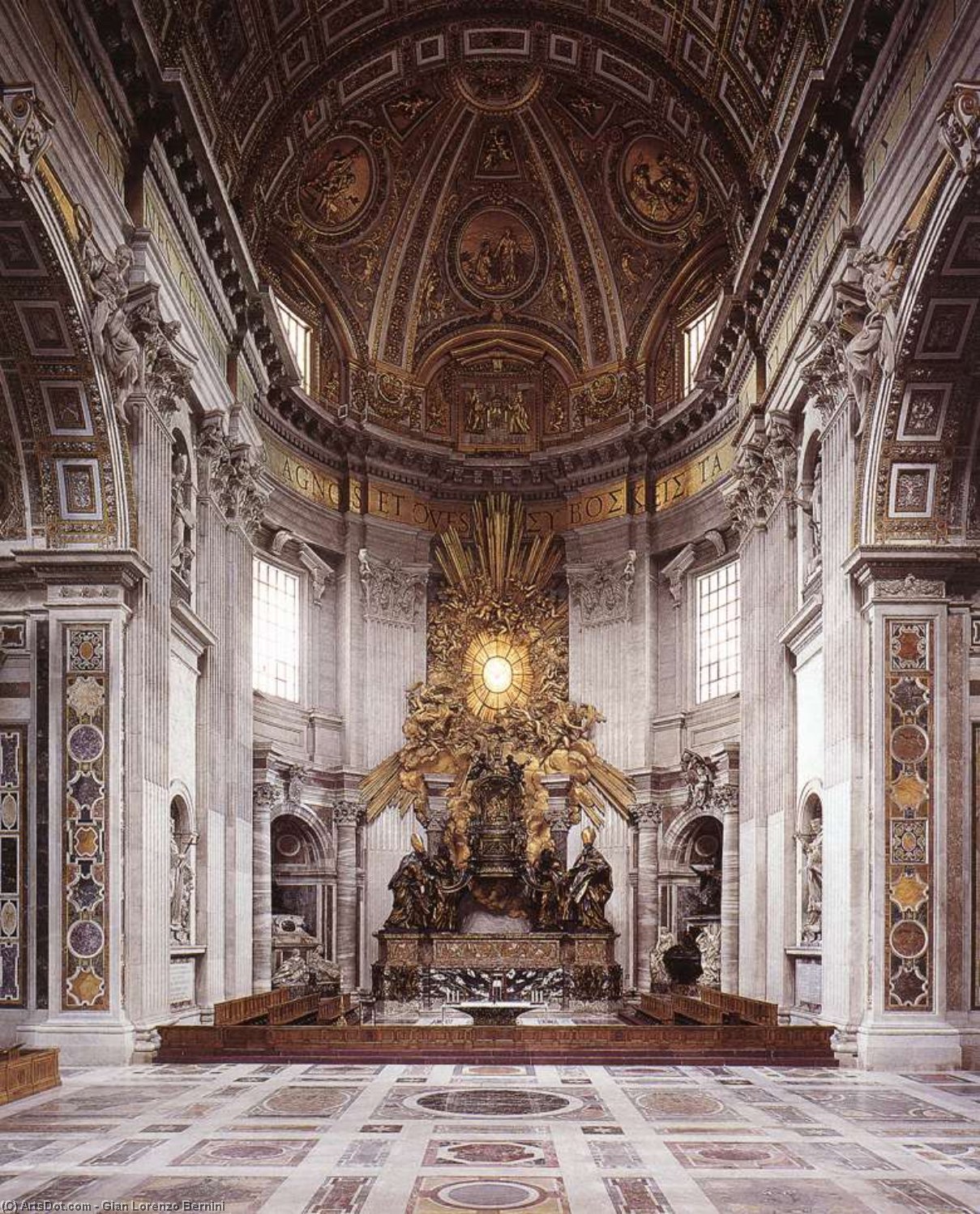
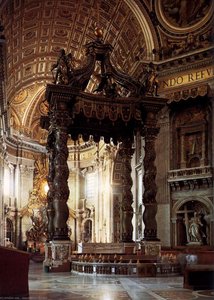
Within the hallowed, echoing expanse of St. Peter’s Basilica, where the air itself seems heavy with centuries of prayer, resides one of the most breathtaking triumphs of the Baroque era: Gian Lorenzo Bernini’s The Throne of Saint Peter. This is not merely a seat of authority, but a celestial event captured in metal and stone. Completed in 1653, the work serves as a monumental declaration of faith, designed to overwhelm the senses and lift the soul toward the heavens. As one approaches this masterpiece, the boundary between the earthly and the divine begins to blur, replaced by a symphony of gilded bronze, translucent alabaster, and an almost supernatural use of light that defines the very essence of Bernini’s genius.
The composition is a masterclass in theatrical illusionism, a hallmark of the Baroque style. Bernini did not simply create a sculpture; he staged a divine revelation. The throne is held aloft by four colossal figures representing the great Doctors of the Church—Saint Ambrose, Saint Augustine, Saint Gregory Nazianzus, and Saint Jerome. These figures, rendered with profound anatomical realism and emotional intensity, act as the earthly pillars supporting the weight of spiritual truth. Their muscular forms and dynamic poses create a sense of upward movement, guiding the viewer's gaze from the heavy, grounded reality of the marble toward the radiant, ethereal center where the throne itself resides.
The Alchemy of Material and Symbolism
Bernini’s technical mastery is most evident in his ability to manipulate disparate materials to achieve a singular, unified vision. The use of gilded bronze provides a warm, opulent glow that catches the flickering candlelight of the basilica, while the delicate alabaster casing offers a soft, translucent quality that suggests the purity of divine grace. This interplay of textures—the hardness of metal against the ethereal lightness of stone—creates a visual tension that keeps the observer perpetually engaged. The throne is not just an object; it is a vessel for light, designed to interact with the architecture of the cathedral to create a sense of infinite space.
Every element of the Cathedra Petri is laden with profound symbolic meaning. Representing the seat of Saint Peter, the first Pope, the throne serves as a powerful emblem of papal authority and the continuity of the Church. The swirling clouds of bronze and the rays of light emanating from the Holy Spirit above the chair symbolize the direct descent of divine will upon the earthly realm. For the collector or lover of fine art, this piece represents the pinnacle of horror vacui—the Baroque tendency to fill every inch of space with intricate detail—yet it never feels cluttered; rather, it feels overflowing with life and spiritual energy.
An Eternal Legacy for the Discerning Eye
To contemplate Bernini’s Throne is to experience the emotional height of the Counter-Reformation, a period when art was used as a powerful tool to inspire awe and reaffirm religious devotion. The sheer scale and complexity of the work demand a deep appreciation for the artist's ability to blend sculpture, architecture, and light into a single, cohesive narrative. It is a piece that speaks to the grandeur of human creativity and the enduring power of spiritual aspiration.
For those seeking to bring a sense of historical majesty and classical elegance into a curated space, a high-quality reproduction of this Baroque masterpiece offers more than just decoration. It provides a focal point of profound intellectual and aesthetic depth. Whether placed in a grand library, a formal gallery, or a sophisticated study, the imagery of Bernini’s throne invites contemplation, serving as a timeless reminder of an era when art was used to touch the very edges of the infinite.
Похожие произведения
Биография художника
Gian Lorenzo Bernini: The Architect of Baroque Emotion
Gian Lorenzo Bernini, a name synonymous with the height of 17th-century artistry, was more than just a sculptor; he was a visionary architect, painter, and theatrical designer—a true *uomo universale* who fundamentally reshaped the aesthetic landscape of Rome. Born in Naples in 1598, his journey to becoming one of history’s most celebrated artists began within the workshop of his father, Pietro Bernini, a respected sculptor already known for his skill. This early immersion in the craft, combined with an intense study of classical antiquity and the artistic legacy of Michelangelo, laid the foundation for Bernini's revolutionary approach to art—one that prioritized emotional expression and dramatic narrative above all else.The Genesis of Baroque: Sculpting a New Language
Bernini’s genius truly blossomed under the patronage of Cardinal Maffeo Barberini, who later ascended to the papacy as Urban VIII. This relationship proved pivotal, providing Bernini with unprecedented opportunities to develop his distinctive style—a style that would become inextricably linked with the rise of the Baroque period. Unlike the idealized forms and serene beauty favored by Renaissance sculptors, Bernini sought to capture the raw energy of human experience. His works weren’t merely representations; they were visceral embodiments of emotion, imbued with a sense of movement, theatricality, and psychological depth. Consider *Apollo and Daphne*, where the transformation into a laurel tree is rendered not as a static event but as a dynamic struggle—the nymph's terror, Apollo’s pursuit, and the blossoming leaves all contributing to a single, breathtaking moment. Similarly, in *The Ecstasy of Saint Teresa*, Bernini masterfully manipulates light, texture, and gesture to create an experience that transcends mere representation, plunging the viewer directly into the saint’s mystical encounter.Beyond Stone: Architecture and Urban Transformation
Bernini's artistic vision extended far beyond the confines of sculpture. He was a remarkably versatile architect who played a crucial role in transforming the cityscape of Rome. His designs weren’t isolated creations; they were integrated with his sculptural work, creating unified artistic experiences that blurred the boundaries between disciplines. The monumental Baldacchino above the high altar of St. Peter's Basilica stands as perhaps the most spectacular example of this holistic approach—a soaring bronze canopy that dominates the space and draws the eye upwards in awe. Beyond this grand masterpiece, Bernini designed numerous churches, chapels, and public spaces, each infused with his characteristic dynamism and theatrical flair. His redesign of Piazza Navona, culminating in the *Fountain of Four Rivers*, is a testament to his ability to create engaging urban environments—a vibrant spectacle that captivated visitors and redefined the concept of public space.The Influence of Patronage and Artistic Evolution
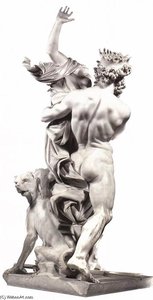
Bernini’s career was profoundly shaped by the patronage of powerful figures, most notably Cardinal Scipione Borghese and Pope Urban VIII. These patrons provided him with commissions that allowed him to experiment with new techniques and explore ambitious projects. Early works like *Aeneas, Anchises, and Ascanius Fleeing Troy* demonstrated a nascent interest in dramatic narrative, while later pieces such as *Pluto and Proserpina* showcased Bernini’s mastery of form and his ability to convey complex emotions through the interplay of figures. The influence of Michelangelo is undeniable—Bernini admired the Florentine master's anatomical precision and dynamic compositions, but he ultimately forged his own distinct style—one characterized by a heightened sense of emotional intensity and theatricality.A Lasting Legacy: Bernini’s Enduring Impact
Gian Lorenzo Bernini’s impact on Western art is immeasurable. He didn't simply imitate classical forms; he synthesized them with a new sense of dynamism and emotional intensity, creating something entirely original. His innovations in sculpture—particularly his use of *contrapposto* (a technique for creating dynamic poses) and his mastery of marble texture—established the Baroque style as a dominant force in European art for over a century. He influenced generations of artists with his dramatic compositions, technical virtuosity, and commitment to capturing the full spectrum of human emotion. As Howard Hibbard famously noted, Bernini’s influence was so profound that he stands as “the greatest sculptor of the 17th century.” His works continue to inspire awe and admiration, solidifying his place as one of history's most important artists—a true *uomo universale* whose legacy continues to resonate today.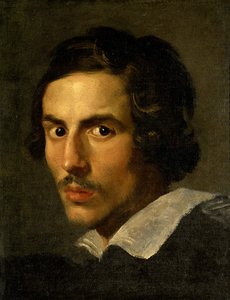
Джан Лоренцо Бернини
1598 - 1680 , Италия
Основные сведения
- Artistic Movement Or Style: Барокко
- Artists Or Movements Influenced By This Artist:
- Барокко скульптура
- Европейское искусство
- Artists Who Influenced This Artist:
- Пьетро Бернини
- Микеланджело
- Date Of Birth: 7 декабря 1598
- Date Of Death: 28 ноября 1680
- Full Name: Gian Lorenzo Bernini
- Nationality: Итальянец
- Notable Artworks:
- Святоотеческая радость
- Аполлон и Дафна
- Давид
- Фонтан Четырех рек
- Валлабольдино
- Place Of Birth: Неаполь, Италия
Похожие статьи
Theatricality & Triumph: Baroque Drama in Painting & Sculpture
Explore the dramatic world of Baroque art! Discover its history, defining characteristics, & lasting influence on painting & sculpture. Expert insights into Caravaggio, Zurbarán, and Bernini – plus high-quality reproductions at ArtsDot.

The Enduring Form: Exploring Themes & Techniques in Sculpture Across Historical Periods
Explore the rich history of sculpture from ancient masterpieces to contemporary innovations. Discover key techniques, influential artists & investment potential for discerning art collectors.
Gian Lorenzo Bernini: Sculpting Baroque Emotion & the Roman Imagination
Explore the life & revolutionary art of Gian Lorenzo Bernini, the master sculptor of the Baroque era. Discover his iconic works like David and Ecstasy of Saint Teresa – a journey into Roman artistic genius.

10 легендарных бронзовых скульптур, изменивших искусство навсегда | ArtsDot
Погрузитесь в мир великих бронзовых скульптур! От Давида Микеланджело до работ Родена – история искусства, техники и вдохновения. Купите репродукции шедевров для вашего интерьера на ArtsDot.com

The Enduring Form: Sculpture Across History, Technique & Emotional Resonance
Explore the rich history of sculpture with ArtsDot. Discover key techniques, influential artists & investment potential for discerning collectors. Expert insights into valuing and collecting timeless masterpieces.