 Предпросмотр
 Поделиться
 Поделиться
 Детали произведения

 Скачать
 Похожие работы
 Рентгенография
 Слайд-шоу
 Статистика
the source (detail)


 Читать далее
Масляная репродукция ручной работы
Картина маслом на холсте в выбранном вами размере и раме, написанная на заказ нашими художниками. ( Перейти к печати Перейти к цифровым изображениям)




P118B $10

P118H $10

P118W $10

P438Z $10

P508JH $12

P508YH $12

P805H $10

P805Z $10

P919BZ $10

P919G $10

P919XJ $10

P959ZH $10

P968JZ $12

W106C $8

W218G $10

W218JH $8

W218Y $10

W307PJ $10

W316G $10

W316PJ $8

W316Y $10

W398PJ $8

W4111J $10

W500HY $15

W500JH $15

W692G $12

W849H $8

W940BG $15

W953PJ $8




Выберите один из наших стандартных размеров, соответствующих оригинальным пропорциям произведения искусства.

Вы можете указать собственные размеры, чтобы картина идеально вписалась в выбранную раму или пространство. Если выбранный вами размер не соответствует пропорциям оригинала, мы либо обрежем полотно, либо расширим его за счет дополнительных элементов, написанных вручную. Цифровой макет будет отправлен вам на утверждение перед началом производства.
Обратите внимание, что предварительный просмотр на экране не отражает фактическую обрезку или расширение. Только макет точно покажет окончательную композицию.
Хотя доступны индивидуальные размеры, мы рекомендуем выбирать вариант из предопределенного списка, чтобы сохранить исходные пропорции.
После оформления заказа команда ArtsDot.com свяжется с клиентом по электронной почте для уточнения деталей и предоставит предварительный макет
Доставка по всему миру () за 3–4 недели вместо стандартных 5 недель. (10 Сентябрь). Без компромиссов в качестве.

Бесплатная экспресс-доставка по всему миру

Высококачественный льняной холст

Полное страхование доставки

Гарантия возмещения таможенных пошлин

Гарантия точного соответствия цветов

100-дневная политика возврата (только при обнаружении дефектов)

Гарантия возврата 100% средств

Предложение оптовых скидок
 Вариант со стеклом доступен только для размеров менее 110 см

the source (detail)
Техника репродукции
Размер репродукции
-


Итоговая стоимость
$ 263
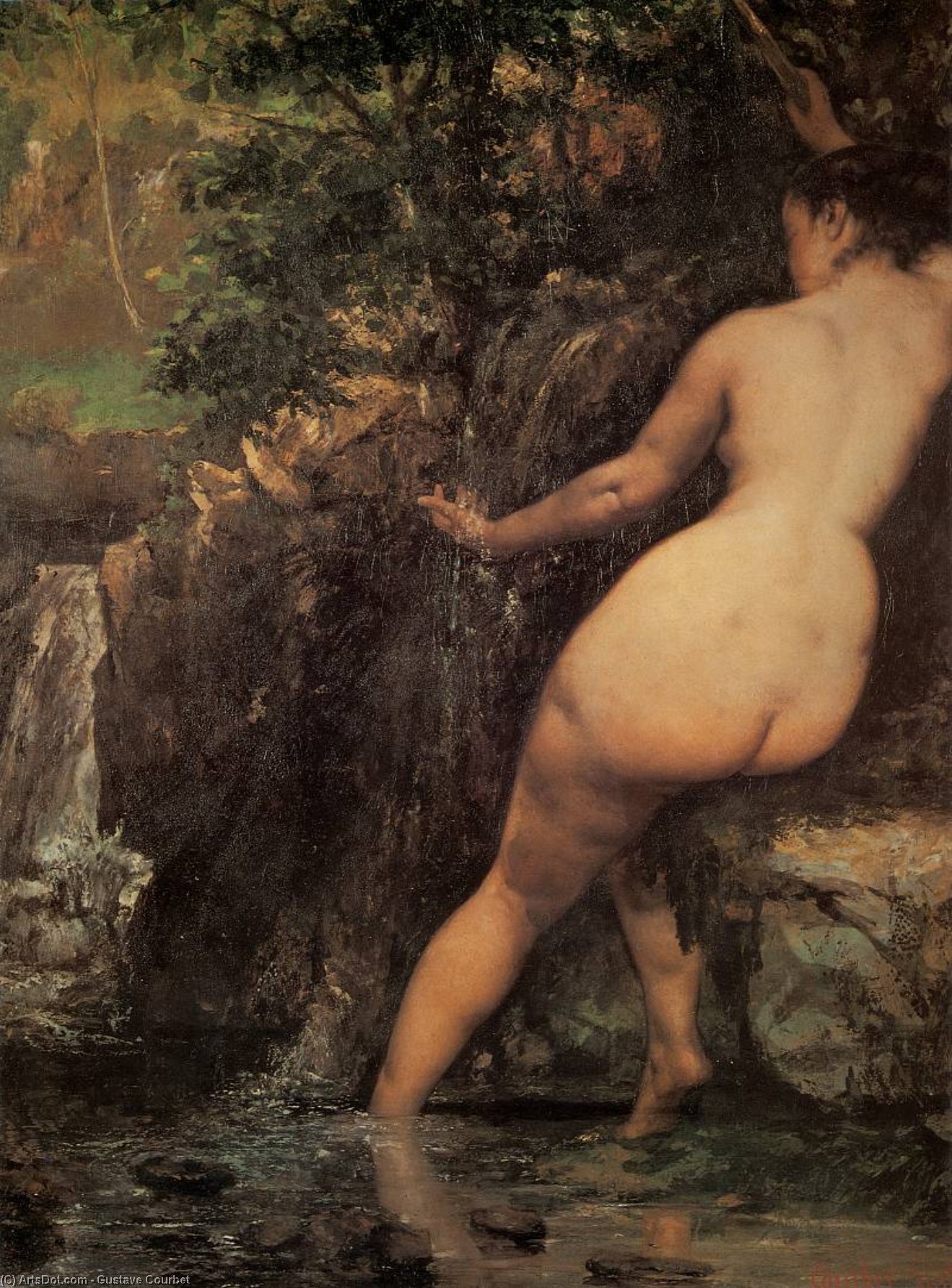
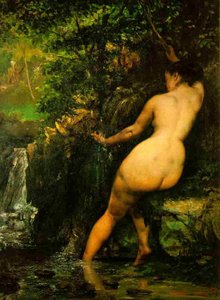
The Quiet Majesty of Nature and Reflection
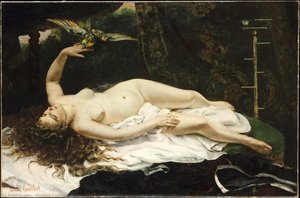
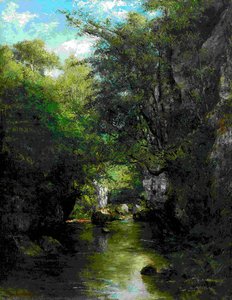
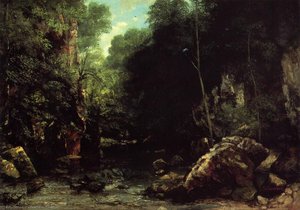
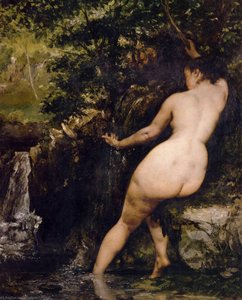
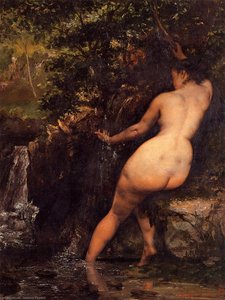
This evocative painting transports the viewer to a moment suspended between human contemplation and the enduring power of the natural world. At its heart stands a solitary female figure, her back gracefully turned to us, suggesting a private communion with the landscape unfolding before her. She is positioned near the dynamic embrace of a waterfall or rushing river, a confluence of raw energy meeting serene observation. The composition masterfully frames this interaction: the lush, rocky terrain anchors the foreground, while the background deepens into a tapestry of verdant trees under an open sky. It is a scene that whispers of journeys taken and moments savored in profound solitude.
Courbet's Vision of Unvarnished Reality
To understand this piece is to appreciate the spirit of its creator, Gustave Courbet. A painter who famously rejected academic polish for the grit of lived experience, Courbet insisted on depicting life unidealized—the monumental in the mundane, and the profound in the everyday encounter. This work carries that signature commitment to realism; there is nothing overly romanticized here, only the palpable weight of the air, the cool spray of the water, and the quiet dignity of the human form set against an untamed backdrop. The inclusion of a small bird fluttering near the upper right corner serves as a delicate counterpoint to the woman's stillness, injecting a fleeting note of wild life into the otherwise meditative atmosphere.
Symbolism of the Landscape Encounter
The elements within this painting are rich with symbolic resonance. Water, perpetually moving, often symbolizes the passage of time and emotional flux, while the waterfall itself represents unstoppable natural force. The woman, facing away, becomes an archetype—a figure caught in a moment of introspection. She is not posing for us; she is absorbed by the view, inviting the collector to project their own moments of quiet epiphany onto her stillness. It speaks to that universal human need to step away from the noise and find clarity at the edge of something powerful, be it nature or deep thought.
Bringing the Outdoors In: Decorating with Depth
For the discerning collector or interior designer, this reproduction offers more than mere decoration; it offers an emotional anchor. Imagine this piece gracing a sunlit study or a tranquil living space. Its earthy tones—the deep greens of the foliage contrasting with the cool greys and browns of the rock—will ground any room, adding a sophisticated, natural patina. The scale and composition allow it to function beautifully as a focal point, drawing the eye into its narrative depth while maintaining an air of understated elegance that complements both rustic charm and refined modernism.
Похожие произведения
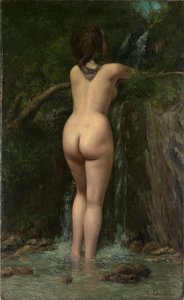
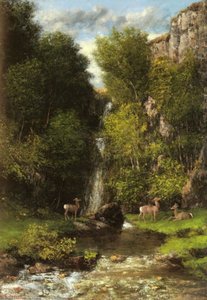

Биография художника
A Rebel’s Brush: The Life and Legacy of Gustave Courbet
Jean Désiré Gustave Courbet (1819-1877) stands as a monumental figure in the history of art, recognized unequivocally as the progenitor of Realism – a movement that irrevocably altered the trajectory of 19th-century painting. More than simply capturing visual impressions; his artistic endeavor was driven by a profound conviction: to depict the world precisely as he perceived it—unvarnished, brutally honest, and imbued with an unwavering regard for its tangible reality. His journey began in Ornans, France, a modest village that nurtured within him a spirit of defiance against the prevailing artistic dogma of his era.Early Life and Artistic Training
Courbet’s upbringing instilled in him a certain independence and intellectual curiosity—qualities that would prove instrumental in shaping his artistic vocation. Encouraged by his mother to pursue his passions, he embarked on formal training at the École des Beaux-Arts in Paris in 1839, yet swiftly recognized the limitations imposed by the academy’s adherence to Romantic idealism. While acknowledging influences from luminaries like Eugène Delacroix and Théodore Géricault—artists who wrestled with grand narratives of heroism and emotion—Courbet resolutely forged his own path, prioritizing observation over imaginative embellishment and truthfulness above convention. He wasn't seduced by the allure of mythological tales or idealized portraits; instead, he turned his gaze toward the everyday lives of ordinary individuals – laborers, peasants, and rural landscapes – subjects largely ignored by the artistic establishment of his time.The Birth of Realism: A Revolutionary Vision
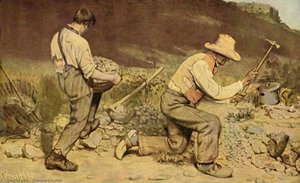
Courbet’s artistic breakthrough arrived with a deliberate rejection of Romantic conventions. He eschewed the theatrical grandeur favored by Delacroix and Géricault, opting for a starkly realistic portrayal of human experience. This decision wasn't merely stylistic; it represented a fundamental assertion about the dignity inherent in portraying commonplace existence. His early canvases explored landscapes and portraits, but soon focused on scenes of working-class life—executed on monumental scales traditionally reserved for historical or religious paintings. Consider The Stone Breakers (1849), tragically destroyed during World War II – an image that encapsulates Courbet’s revolutionary ethos. The painting depicts two laborers engaged in arduous toil, their faces obscured by exhaustion and grime; Courbet deliberately avoided romanticizing their plight, presenting them with unflinching honesty—a bold departure from the idealized depictions prevalent in academic circles. This uncompromising commitment to realism established him as a champion of artistic integrity and challenged the prevailing aesthetic sensibilities of his time.Notable Works and Artistic Philosophy
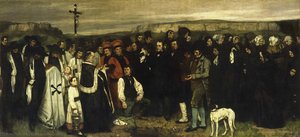
Courbet’s oeuvre is marked by an extraordinary range of subjects and stylistic approaches, reflecting his unwavering belief in the transformative power of art. Among his most celebrated paintings are A Burial at Ornans (1850-51), a monumental canvas depicting a rural funeral—a scene rendered with meticulous detail and devoid of sentimental embellishment. Its sheer scale—typically reserved for grand historical canvases—served as a deliberate provocation, signaling Courbet’s refusal to conform to artistic expectations. He championed the use of *impasto*, applying paint thickly onto the canvas surface, thereby emphasizing its materiality and capturing the textures of the natural world with remarkable accuracy. Similarly, The Painter's Studio (1855) is an allegorical masterpiece—a self-portrait that embodies Courbet’s artistic convictions and engages in a dialogue with contemporary social issues. He sought to convey not merely what he saw but also *how* he perceived the world—a perspective informed by his unwavering belief in the importance of truthful representation.Legacy and Influence
Gustave Courbet's impact on subsequent generations of artists is undeniable. His pioneering spirit ignited the flame of Realism, inspiring Impressionists and Post-Impressionists to liberate themselves from academic constraints and explore new avenues for artistic expression. He championed social justice through his art—a stance that resonated deeply with artists committed to confronting societal inequities. Courbet’s legacy extends beyond stylistic innovation; it embodies a profound philosophical commitment: the conviction that art should serve as a mirror reflecting the complexities of human experience, unafraid to confront uncomfortable truths and challenge prevailing ideologies. He died in 1877, leaving behind an artistic corpus that continues to captivate audiences worldwide—a testament to his enduring influence on the history of art and its ongoing capacity to provoke contemplation and inspire change.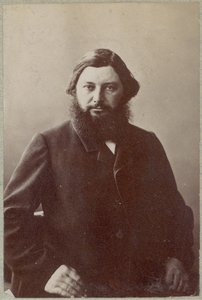
Курбе
1819 - 1877 , Франция
Основные сведения
- Artistic Movement Or Style: Реализм
- Artists Or Movements Influenced By This Artist:
- Импрессионизм
- Послеимпрессионизм
- Artists Who Influenced This Artist:
- Эжен Делакруа
- Теодор Жерико
- Date Of Birth: 10 июня 1819 г.
- Date Of Death: 31 декабря 1877 г.
- Full Name: Gustave Courbet
- Nationality: Французский
- Notable Artworks:
- Сбор камней
- Похороны в Орнане
- Художественная мастерская
- Place Of Birth: Орланс, Франция
Похожие статьи

Romantic Realism's Finest: 10 Masterpieces for Your Home | ArtsDot
Explore 10 defining masterpieces of Romantic Realism! Discover Courbet, Millet & Daumier's powerful paintings—capturing emotion and social realities. Find museum-quality reproductions for your home at ArtsDot.com.
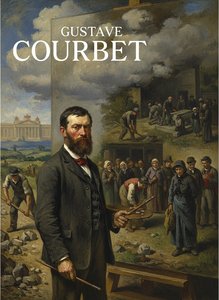
Gustave Courbet: Realism's Revolutionary Vision & the Social Canvas of 19th-Century France
Explore the revolutionary art of Gustave Courbet, pioneer of Realism. Discover his iconic paintings, social commentary, and lasting impact on 19th-century French art history. Expert analysis & insights.
25 Шедевров Густава Климта: Искусство, Декор и Золотой Век Австрийского Модерна
Погрузитесь в мир Густава Климта! 25 шедевров австрийского модерна, символизма и золотой живописи. Узнайте истории создания знаменитых картин Климта и вдохновитесь для декора интерьера. Репродукции музейного качества на ArtsDot.com.

25 Шедевров Поля Сезанна: Открывая Новую Эру в Искусстве | ArtsDot
Откройте для себя 25 величайших шедевров Поля Сезанна! Узнайте истории создания картин импрессионизма и постимпрессионизма, технику художника и вдохновение для вашего интерьера. Репродукции картин Сезанна высокого качества на ArtsDot.com.
Реализм в живописи: 10 шедевров, изменивших искусство | ArtsDot.com
Погрузитесь в мир реализма! 10 шедевров Курбе, Милле, Мане и других великих художников. Узнайте историю создания культовых картин и вдохновитесь для интерьера с ArtsDot.com – музейное качество репродукций.