


 Предпросмотр
 Поделиться
 Поделиться
 Детали произведения

 Скачать
 Похожие работы
 Рентгенография
 Слайд-шоу
 Статистика
Officers and other civic guardsmen of the XIth District of Amsterdam, under the command of Captain Geurt Dircksz van Beuningen and Lieutenant Pieter Martensz Hoeffijser, Jan Tengnagel, 1613
 1613
1613 153.0 x 265.0 cm
 Читать далее
Масляная репродукция ручной работы
Картина маслом на холсте в выбранном вами размере и раме, написанная на заказ нашими художниками. ( Перейти к печати Перейти к цифровым изображениям)
































Выберите один из наших стандартных размеров, соответствующих оригинальным пропорциям произведения искусства.

Вы можете указать собственные размеры, чтобы картина идеально вписалась в выбранную раму или пространство. Если выбранный вами размер не соответствует пропорциям оригинала, мы либо обрежем полотно, либо расширим его за счет дополнительных элементов, написанных вручную. Цифровой макет будет отправлен вам на утверждение перед началом производства.
Обратите внимание, что предварительный просмотр на экране не отражает фактическую обрезку или расширение. Только макет точно покажет окончательную композицию.
Хотя доступны индивидуальные размеры, мы рекомендуем выбирать вариант из предопределенного списка, чтобы сохранить исходные пропорции.
После оформления заказа команда ArtsDot.com свяжется с клиентом по электронной почте для уточнения деталей и предоставит предварительный макет
Доставка по всему миру () за 3–4 недели вместо стандартных 5 недель. (17 Сентябрь). Без компромиссов в качестве.

Бесплатная экспресс-доставка по всему миру

Высококачественный льняной холст

Полное страхование доставки

Гарантия возмещения таможенных пошлин

Гарантия точного соответствия цветов

100-дневная политика возврата (только при обнаружении дефектов)

Гарантия возврата 100% средств

Предложение оптовых скидок
 Вариант со стеклом доступен только для размеров менее 110 см

Officers and other civic guardsmen of the XIth District of Amsterdam, under the command of Captain Geurt Dircksz van Beuningen and Lieutenant Pieter Martensz Hoeffijser, Jan Tengnagel, 1613
Техника репродукции
Размер репродукции
-


Итоговая стоимость
$ 263
Похожие произведения






Биография художника
A Shadowy Master of the Golden Age
Jan Tengnagel, born in Amsterdam in 1584, remains a hauntingly beautiful yet shadowy figure within the vast annals of seventeenth-century Dutch painting. While history often reserves its brightest spotlights for luminaries such as Rembrandt or Vermeer, Tengnag nagel’s contribution to the burgeoning visual culture of the Dutch Golden Age deserves a profound and renewed appreciation. He was an artist whose life and work were defined by a delicate balance of local tradition and international inspiration, leaving behind a modest but deeply evocative oeuvre that speaks to the spiritual and social complexities of his era.
Though much of his personal history remains veiled by time, scholars believe Tengnagel’s artistic foundation was laid in the workshops of Amsterdam, likely receiving instruction under Frans Badens. This early training in allegorical painting and humanist ideals provided him with a sophisticated vocabulary of symbols and compositions. His work would later become deeply rooted in the stylistic currents of Pieter Lastman's workshop, a prestigious circle that shaped the trajectory of Dutch history painting. Through this lineage, Tengnagel developed a distinctive sensitivity to biblical narratives and religious iconography, allowing him to transform sacred stories into palpable, human experiences.
The Roman Pilgrimage and Stylistic Synthesis
A transformative chapter in Tengnagel’s life began in 1608, when he embarked on a journey to Rome. This pilgrimage was a rite of passage for many Dutch artists of the period, offering an immersive encounter with the grandeur of the papal court and the enduring legacies of the Italian Renaissance. In the sun-drenched streets of Rome, Tengnagel’s artistic vision underwent a significant evolution. He moved beyond the rigid structures of his early training to absorb the atmospheric nuances and meticulous realism found in the works of masters like Hans Memling and Pieter Steenwyck.
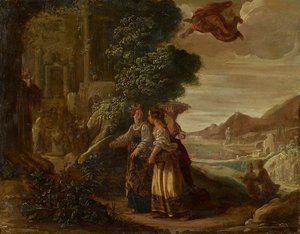
The influence of these encounters is woven into the very fabric of his later paintings. One can discern the quiet, meticulous detail characteristic of Northern realism blended with a new, Italianate sense of light and space. This synthesis allowed him to create works that were both intellectually rigorous and emotionally resonant. His ability to adapt foreign innovations to the Dutch sensibility is perhaps most evident in his mythological and religious subjects, where he captures moments of profound intimacy—such as the tender, whispered encounter between Vertumnus and Pomona—with a grace that feels both eternal and fleeting.
Legacy and the Art of the Civic Guard
Beyond his religious and mythological explorations, Tengnagel played a vital role in documenting the social fabric of Amsterdam. His involvement with the civic guards is immortalized in his 1613 portrait of the officers and guardsmen of the XIth District. This work serves as more than a mere record of faces; it is a vibrant window into the communal spirit and political prestige of the era. In these group portraits, Tengnagel demonstrated a remarkable ability to balance individual character with collective identity, capturing the pride of men like Captain Geurt Dircksz van Beuningen within a cohesive, celebratory composition.
Tengnagel’s life was also marked by significant personal connections that intertwined his destiny with the prominent families of Amsterdam. His marriage in 1611 to Meijnsje Simonsdr. Pynas, the sister of the celebrated painters Jan and Jacob Pynas, placed him at the very heart of the Dutch artistic elite. While his total output may be limited, the significance of his work lies in its quality and its role as a bridge between the late Renaissance and the height of the Dutch Golden Age. He remains a testament to the many "forgotten" masters whose subtle hands helped paint the magnificent tapestry of art history.
Jan Tengnagel
1584 - 1631 , Netherlands
Основные сведения
- Artistic Movement Or Style: Early Seventeenth Century Dutch Painting
- Artists Or Movements Influenced By This Artist: ['Hans Memling']
- Artists Who Influenced This Artist:
- Frans Badens
- Pieter Lastman
- Date Of Birth: Amsterdam, Netherlands (1584)
- Date Of Death: 1631
- Full Name: Jan Tengnagel
- Nationality: Dutch
- Notable Artworks:
- Vertumnus and Pomona
- Officers and other civic guardsmen of the XIth District of Amsterdam
- Place Of Birth: Amsterdam