

 Предпросмотр
 Поделиться
 Поделиться
 Детали произведения

 Скачать
 Похожие работы
 Рентгенография
 Слайд-шоу
 Статистика
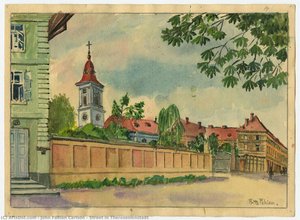
Street in Theresesienstadt
 Watercolor
- WallArt
- Impressionism
 1944
1944- Modern
 30.0 x 22.0 cm
 Leo Baeck Institute
 Читать далее
Масляная репродукция ручной работы
Картина маслом на холсте в выбранном вами размере и раме, написанная на заказ нашими художниками. ( Перейти к печати Перейти к цифровым изображениям)




P118B $10

P118H $10

P118W $10

P438Z $10

P508JH $12

P508YH $12

P805H $10

P805Z $10

P919BZ $10

P919G $10

P919XJ $10

P959ZH $10

P968JZ $12

W106C $8

W218G $10

W218JH $8

W218Y $10

W307PJ $10

W316G $10

W316PJ $8

W316Y $10

W398PJ $8

W4111J $10

W500HY $15

W500JH $15

W692G $12

W849H $8

W940BG $15

W953PJ $8




Выберите один из наших стандартных размеров, соответствующих оригинальным пропорциям произведения искусства.

Вы можете указать собственные размеры, чтобы картина идеально вписалась в выбранную раму или пространство. Если выбранный вами размер не соответствует пропорциям оригинала, мы либо обрежем полотно, либо расширим его за счет дополнительных элементов, написанных вручную. Цифровой макет будет отправлен вам на утверждение перед началом производства.
Обратите внимание, что предварительный просмотр на экране не отражает фактическую обрезку или расширение. Только макет точно покажет окончательную композицию.
Хотя доступны индивидуальные размеры, мы рекомендуем выбирать вариант из предопределенного списка, чтобы сохранить исходные пропорции.
После оформления заказа команда ArtsDot.com свяжется с клиентом по электронной почте для уточнения деталей и предоставит предварительный макет
Доставка по всему миру () за 3–4 недели вместо стандартных 5 недель. (13 Сентябрь). Без компромиссов в качестве.

Бесплатная экспресс-доставка по всему миру

Высококачественный льняной холст

Полное страхование доставки

Гарантия возмещения таможенных пошлин

Гарантия точного соответствия цветов

100-дневная политика возврата (только при обнаружении дефектов)

Гарантия возврата 100% средств

Предложение оптовых скидок
 Вариант со стеклом доступен только для размеров менее 110 см

Street in Theresesienstadt
Техника репродукции
Размер репродукции
-


Итоговая стоимость
$ 263
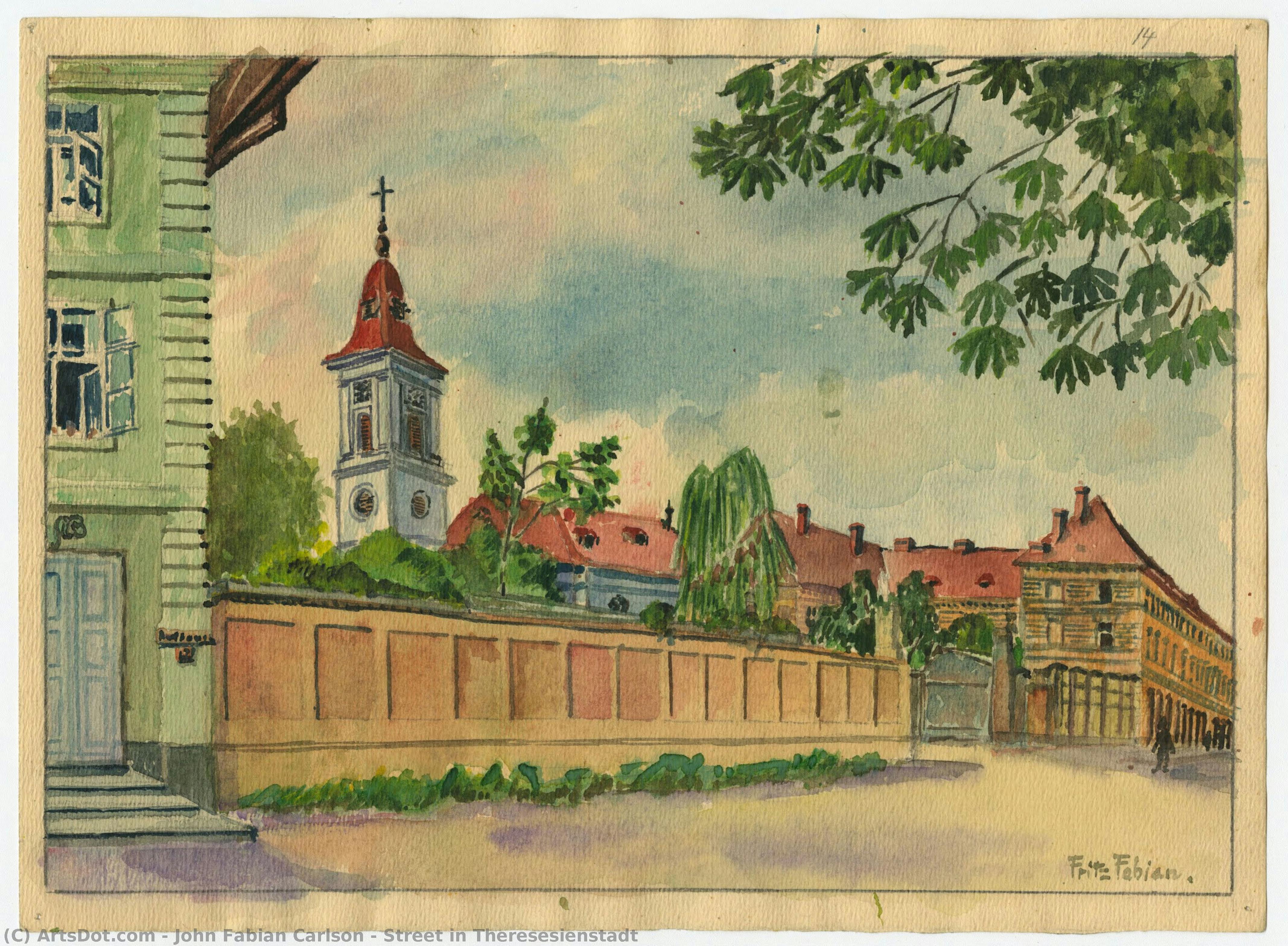
A Somber Glimpse into History: Street in Theresesienstadt
In the delicate, translucent layers of John Fabian Carlson’s 1944 watercolor, Street in Theresesienstadt, we encounter a scene that transcends mere landscape painting to become a profound historical witness. While Carlson is celebrated as a master of luminous winter landscapes and the ethereal glow of American Impressionism, this particular work carries a weight far heavier than the soft snowfall of his more famous compositions. The watercolor captures a street scene within the confines of the Theresienstadt concentration camp, presenting a view that is simultaneously mundane and hauntingly significant. Through his expert command of the medium, Carlson invites the viewer to walk alongside the figures in the street, navigating a world defined by both architectural permanence and human fragility.
The composition is structured around the stark reality of enclosure, where a formidable brick wall serves as a boundary between the town and the unknown. A church rises above the skyline, its presence offering a silent, spiritual sentinel over the inhabitants below. Carlson utilizes the fluid nature of watercolor to create a sense of atmosphere that feels both airy and oppressive. The light, though captured with his signature impressionistic touch, does not merely illuminate; it exposes the quiet movement of people traversing the cobblestones. Small details, such as the two birds caught in flight and the subtle presence of a clock in the lower corner, ground the piece in a fleeting moment of time, reminding us that even within the most harrowing historical contexts, life continues its rhythmic, albeit shadowed, progression.
Technically, the painting showcases Carlson’s ability to balance fine detail with broad, emotive washes. The way the pigment settles into the paper creates a textured depth that mimics the grit of the street and the weathered surfaces of the architecture. For the collector or interior designer, this piece offers more than just aesthetic beauty; it provides a conversational centerpiece that demands reflection. It is an artwork of immense emotional gravity, suitable for spaces dedicated to contemplation, history, or the preservation of memory. To possess a reproduction of this work is to hold a fragment of a difficult truth, rendered with the grace and technical mastery of a pioneer of the American Impressionist movement.
Похожие произведения
Биография художника
The Luminous Silence: The Life and Legacy of John Fabian Carlson
In the quietude of a frozen landscape, where the world seems to hold its breath beneath a heavy blanket of white, one finds the true essence of John Fabian Carlson. A Swedish-born American Impressionist, Carlson possessed a rare, meditative ability to translate the biting chill of winter into a visual symphony of light and texture. Born on May 5, 1874, in the pastoral landscapes of Kolsebo, Sweden, his early years were steeped in the folklore and rugged natural beauty of his homeland. This foundational connection to the earth would later manifest in his American works as a profound sensitivity to the atmospheric shifts of the seasons, particularly the ethereal, crystalline moments that define the winter solstice.
After emigrating to the United States in 1884 and settling in Buffalo, New York, Carlson began a rigorous artistic journey that would bridge European tradition with American innovation. His education at the Art Students League of Buffalo under Lucius Wolcott Hitchcock—a student of the great masters Renoir and Degas—provided him with a meticulous foundation in observation. This training instilled in him a lifelong dedication to capturing the fleeting nuances of light. As his talent blossomed, Carlson sought further refinement, eventually securing a scholarship to the Byrdcliffe Colony in Woodstock, New and York. It was within this vibrant artistic community, alongside luminaries such as Robert Henri, that Carlson’s fascination with the grandeur of nature solidified, setting the stage for his emergence as a master of the landscape.
A Mastery of Light and Texture
Carlson’s technical prowess lay in his ability to manipulate medium and movement to evoke the tactile reality of snow and ice. Whether working in the fluid, translucent layers of watercolor or the robust, impasto textures of oil, his work remained anchored in the Tonalist tradition. He did not merely paint a scene; he built an atmosphere. His technique often involved layering thin washes of color to create depth, followed by vigorous, textured brushstrokes that mimicked the uneven crust of a snow-covered mountainside or the delicate frost clinging to a woodland branch.
His repertoire was as diverse as the landscapes he traversed. While most celebrated for his serene, snow-laden vistas, Carlson also explored the rugged majesty of the Canadian Rockies and the sweeping expanses of the American Far West. His ability to balance fine detail with broad, emotive washes allowed him to capture both the microscopic beauty of a frozen leaf and the overwhelming scale of a mountain range. This duality made his work deeply engaging, inviting viewers to wander through his compositions, discovering quiet details hidden within the vast, white silence.
The Educator and the Historical Witness
Beyond the canvas, Carlson was a pivotal figure in the American art landscape as a teacher and author. He was a co-founder of the Woodstock School of Landscape Painting and established his own namesake school, leaving an indelible mark on generations of aspiring artists. His 1928 publication, Elementary Principles of Landscape Painting (later known as Carlson's Guide to Landscape Painting), remains a testament to his deep understanding of the mechanics of light, color, and composition.
Yet, there is a poignant depth to Carlson’s legacy that extends beyond the tranquil beauty of his winter scenes. In the twilight of his life, his work took on a somber, historical weight. His 1944 watercolor, Street in Theresesienstadt, serves as a haunting departure from his usual pastoral themes. In this piece, the artist’s mastery of light is used to expose the stark reality of a concentration camp street, where the architectural permanence of brick walls meets the fragile movement of human life. This ability to pivot from the sublime beauty of nature to the profound gravity of human history cements John Fabian Carlson not just as a painter of landscapes, but as a profound witness to the enduring complexity of the human experience.
Основные сведения
- Artistic Movement Or Style: Impressionism
- Artists Or Movements Influenced By This Artist: ['American Impressionism']
- Artists Who Influenced This Artist: ['Lucius Wolcott Hitchcock']
- Date Of Birth: May 5, 1874
- Date Of Death: May 19, 1945
- Full Name: John Fabian Carlson
- Nationality: Swedish-American
- Notable Artworks:
- Winter, Woodstock
- Snowy Waters
- Street in Theresesienstadt
- Place Of Birth: Kolsebo, Sweden
Похожие статьи

Ephemeral Visions: Exploring the Artistic Legacy & Contemporary Practice of Watercolor Painting
Explore the captivating world of watercolor painting! Discover its rich history, essential techniques, influential artists & collecting tips. A comprehensive guide for art enthusiasts from ArtsDot.

Топ-10 легендарных акварелей, изменивших искусство навсегда | ArtsDot
Погрузитесь в мир акварели! Откройте топ-10 легендарных картин Turner, Monet и других великих художников. История искусства, техники живописи и вдохновение для вашего интерьера. Репродукции музейного качества на ArtsDot.com.

Джон Сингер Сарджент: 25 шедевров портретной живописи для вашего интерьера | ArtsDot
Погрузитесь в мир Джона Сингера Сарджента! 25 шедевров импрессионизма и реализма, раскрывающих элегантность эпохи Gilded Age. Купите репродукции картин Сарджента музейного качества для вашего интерьера на ArtsDot.com.
Ephemeral Visions: Exploring the History & Emotional Resonance of Watercolor Painting
Explore the captivating history of watercolor painting, from ancient techniques to modern masters like Kandinsky & Blake. Discover essential artists, collecting tips & the emotional power of this luminous medium. Expert insights for art enthusiasts.

Джон Констебль: 25 шедевров английского пейзажа для вашего интерьера
Погрузитесь в мир английского пейзажа с Джоном Констеблом! 25 шедевров романтизма, история создания картин и вдохновение для вашего интерьера. Репродукции высокого качества на ArtsDot.com – искусство для ценителей.