


 Предпросмотр
 Поделиться
 Поделиться
 Детали произведения

 Скачать
 Похожие работы
 Рентгенография
 Слайд-шоу
 Статистика
George Puleston ( )
 1625
1625 76.0 x 64.0 cm
 Читать далее
Жикле / Арт-принт
Печать (жикле) или холст музейного качества с быстрыми сроками изготовления и широким выбором вариантов отделки. ( Купить картину ручной работы Перейти к цифровым изображениям)




































Выберите один из наших стандартных размеров, соответствующих оригинальным пропорциям произведения искусства.

Вы можете указать свои собственные размеры, чтобы репродукция идеально подошла под конкретную раму или пространство. Если выбранный вами размер не будет соответствовать пропорциям оригинала, мы либо обрежем произведение, либо дополним изображение зеркальным отражением краев или однотонной заливкой. Перед началом производства вам будет отправлен цифровой макет для утверждения.
Пожалуйста, обратите внимание, что предварительный просмотр на экране не отображает фактическую обрезку или расширение изображения. Только макет точно покажет финальную композицию.
Несмотря на возможность заказа индивидуальных размеров, мы рекомендуем выбирать размер из предопределенного списка, чтобы сохранить оригинальные пропорции.
Доставка по всему миру () за 2 недели вместо стандартных 4/5 недель. (15 Сентябрь)

Бесплатная экспресс-доставка по всему миру

Высококачественный льняной холст

Полное страхование доставки

Гарантия возмещения таможенных пошлин

Гарантия точного соответствия цветов

100-дневная политика возврата (только при обнаружении дефектов)

Гарантия возврата 100% средств

Предложение оптовых скидок
 Вариант со стеклом доступен только для размеров менее 110 см

George Puleston ( )
Жикле / Арт-принт
Размер репродукции
-


Итоговая стоимость
$ 62
Похожие произведения








Биография художника
The Heraldic Legacy of John Souch
In the quiet, storied landscapes of early seventeenth-century England, few artists captured the intersection of social prestige and human vulnerability as poignantly as John Souch. Born around 1593 in the region of Lancashire, Souch emerged not merely as a painter of faces, but as a chronicler of identity. His life and work represent a vital bridge between the rigid, symbolic traditions of heraldic art and the burgeoning emotional depth of the Baroque movement. To look upon a Souch portrait is to witness a moment where the formal requirements of lineage meet the tender, often tragic, realities of mortal existence.
Souch’s artistic journey began in the disciplined atmosphere of a master's workshop. In 1607, at the tender age of fourteen, he was apprenticed to Randle Holme I, the renowned Chester herald painter and antiquary. This apprenticeship was far more than a technical education; it was an immersion into the visual language of power. Under Holme’s guidance, Souch mastered the intricate art of heraldry—the meticulous rendering of coats of arms, lozenges, and hatchments that served as the essential shorthand for nobility and status in the North West of England. This foundation in precision and symbolic detail would later infuse his portraiture with a unique sense of gravity and historical weight.
A Wandering Eye and the Baroque Spirit
While his training was rooted in the stationary traditions of the Chester painters' guild, Souch himself possessed a nomadic spirit. He did not confine his talents to a single studio but instead traversed a wide expanse of the English Northwest, from the borders of Shropshire to the rugged reaches of Yorkshire. This itinerant lifestyle allowed him to encounter a diverse array of patrons and artistic currents, most notably the subtle yet profound influences of Dutch painting. As he traveled, Souch began to move beyond the flat, decorative requirements of heraldic banners toward a more sophisticated exploration of light, shadow, and psychological depth.
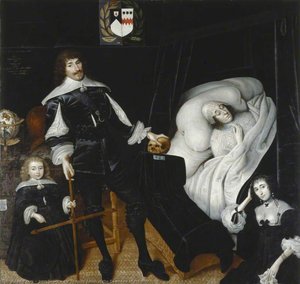
This evolution is perhaps most breathtakingly realized in his ability to infuse Baroque drama into intimate settings. His masterpiece, 'Sir Thomas Aston at the Deathbed of His Wife' (1635), stands as a testament to this mastery. In this work, Souch transcends the role of a mere craftsman; he becomes a dramatist of the human condition. Through the use of chiaroscuro—the dramatic interplay of light and dark—he captures the heavy atmosphere of grief, the stillness of loss, and the profound dignity of a family in mourning. The painting is not just a record of an event, but an emotional landscape that utilizes rich textures and symbolic elements to evoke a visceral response from the viewer.
Artistic Significance and Enduring Memory
The significance of John Souch lies in his ability to embody the role of art within the local life of the seventeenth century. He was a painter who understood that a portrait was both a personal keepsake and a public statement of continuity. His works, ranging from the 'Portrait of an Unknown Couple' to more specific historical likenesses like those attributed to the Hutchinson family, served to anchor families within their own histories. He captured the very essence of the English gentry, documenting births, betrothals, and deaths with a reverence that honored both the individual and their lineage.
Though his life ended in 1645, leaving behind a legacy etched into the annals of British Baroque, Souch’s influence remains palpable. He represents a pivotal era where the technical rigors of the medieval guild system met the expressive possibilities of the modern age. His ability to blend the heraldic precision learned from Holme with a burgeoning interest in naturalism and emotion ensures his place as a vital figure in the history of English portraiture. Through his brush, the fleeting moments of life were granted a permanent, dignified, and deeply moving immortality.
john souch
1593 - 1645
Основные сведения
- Artistic Movement Or Style: Dutch Influence Art
- Artists Who Influenced This Artist: ['Randle Holme I']
- Date Of Birth: 1593
- Date Of Death: 1645
- Full Name: John Souch
- Nationality: English
- Notable Artworks:
- Deathbed of Wife
- Sir Thomas Aston at the Deathbed of His Wife
- Portrait of a Woman (traditionally said to be Lucy Hutchinson)
- Portrait of a Man (traditionally said to be Colonel John Hutchinson)
- Place Of Birth: Ormskirk, Lancashire