 Поделиться
 Поделиться
 Детали произведения

 Скачать
 Похожие работы
 Слайд-шоу
 Статистика
The Fourteen Points Obverse


 Читать далее
Масляная репродукция ручной работы
Картина маслом на холсте в выбранном вами размере и раме, написанная на заказ нашими художниками. ( Перейти к печати Перейти к цифровым изображениям)




































Выберите один из наших стандартных размеров, соответствующих оригинальным пропорциям произведения искусства.

Вы можете указать собственные размеры, чтобы картина идеально вписалась в выбранную раму или пространство. Если выбранный вами размер не соответствует пропорциям оригинала, мы либо обрежем полотно, либо расширим его за счет дополнительных элементов, написанных вручную. Цифровой макет будет отправлен вам на утверждение перед началом производства.
Обратите внимание, что предварительный просмотр на экране не отражает фактическую обрезку или расширение. Только макет точно покажет окончательную композицию.
Хотя доступны индивидуальные размеры, мы рекомендуем выбирать вариант из предопределенного списка, чтобы сохранить исходные пропорции.
После оформления заказа команда ArtsDot.com свяжется с клиентом по электронной почте для уточнения деталей и предоставит предварительный макет
Доставка по всему миру () за 3–4 недели вместо стандартных 5 недель. (11 Сентябрь). Без компромиссов в качестве.

Бесплатная экспресс-доставка по всему миру

Высококачественный льняной холст

Полное страхование доставки

Гарантия возмещения таможенных пошлин

Гарантия точного соответствия цветов

100-дневная политика возврата (только при обнаружении дефектов)

Гарантия возврата 100% средств

Предложение оптовых скидок
 Вариант со стеклом доступен только для размеров менее 110 см

The Fourteen Points Obverse
Техника репродукции
Размер репродукции
-


Итоговая стоимость
$ 263
A Monument to Peace: Decoding Wilson's Fourteen Points
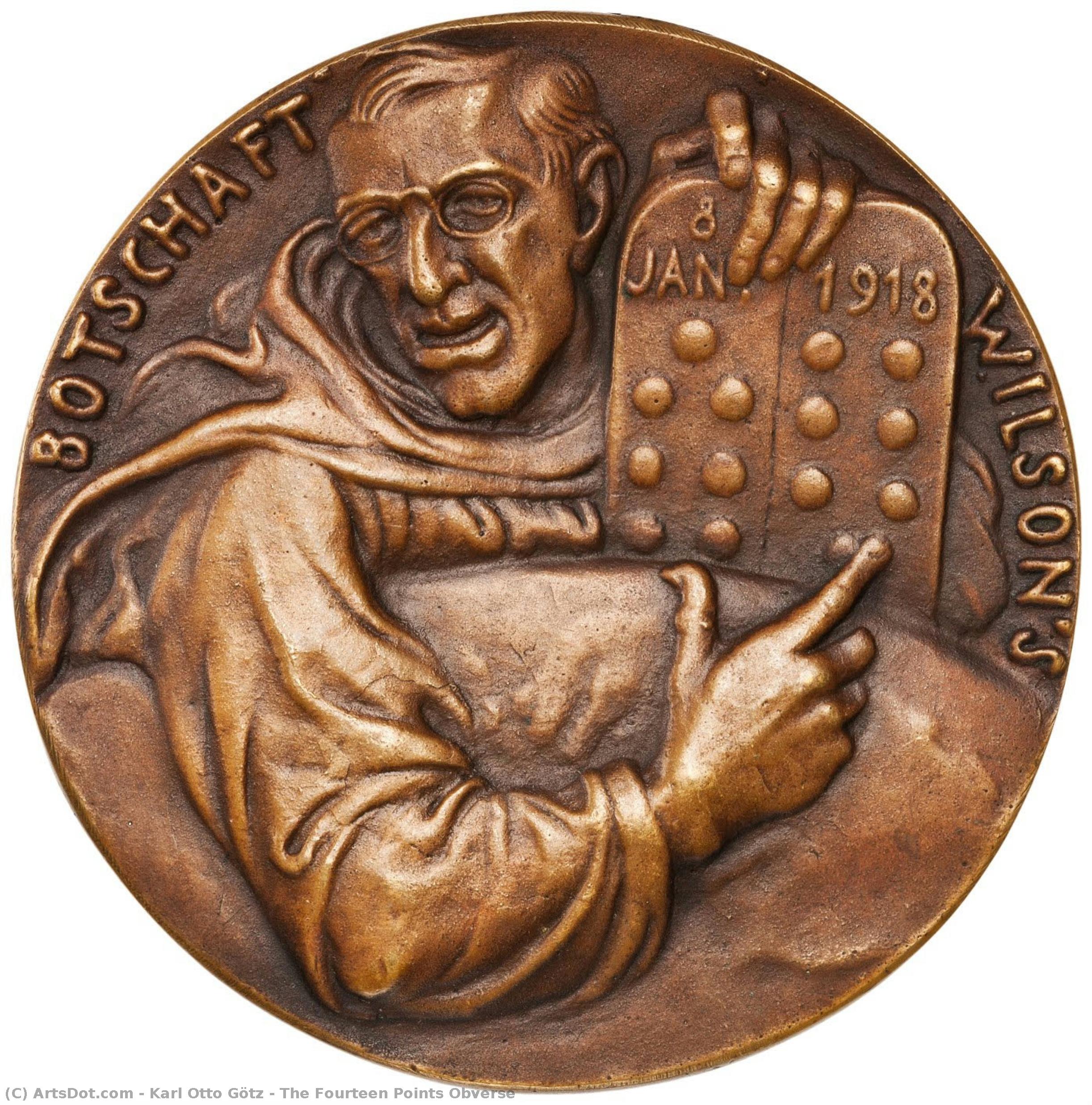
To gaze upon this commemorative piece is to step directly into the charged atmosphere of history’s turning point. This artwork, echoing the bronze medal struck in 1918, is far more than a mere depiction; it is a tangible artifact of profound geopolitical yearning. It captures the moment when the world paused, breathless, awaiting the blueprint for lasting tranquility after the cataclysm of global conflict. The central figure, reminiscent of Moses guiding his people, embodies Woodrow Wilson—a man whose oratory shaped the very contours of modern international relations. His bearing, coupled with the symbolic tablets he holds aloft, speaks volumes about the weight of ideals and the monumental task of rebuilding civilization upon a foundation of shared principles.
Symbolism Woven in Bronze: The Promise of Association
The iconography here is rich with potent symbolism. The very concept of the Fourteen Points—a series of diplomatic aims designed to forestall future wars through collective security and self-determination—is distilled into this metalwork. Notice the careful arrangement of dots or circles on the shield; these are not random markings but represent the enumerated principles themselves, each dot a commitment, each grouping a facet of global cooperation. The inscription "8 JAN 1918" anchors the piece to a specific historical breath, while the overall presentation evokes the solemnity and permanence associated with official state commendations. It invites contemplation on what it means for nations to agree upon a shared vision for humanity’s future.
Artistic Echoes: The Hand of Karl Otto Götz
While the subject matter is rooted in early 20th-century political ephemera, the reproduction style channels the powerful, expressive energy often associated with masters like Karl Otto Götz. Although Götz himself was known for his explosive abstract forms within German Art Informel, this piece translates that sense of monumental historical weight into a more figurative, yet equally charged, medium. The texture suggested by the bronze—its patina, its aged gleam—lends an immediate gravitas. It suggests that even in moments of rigid political declaration, there exists an underlying artistic and emotional resonance waiting to be rediscovered.
Bringing History Home: Decorating with Conscience
For the discerning collector or designer, this piece offers a unique opportunity to infuse a space not just with decoration, but with narrative depth. Imagine it displayed in a study, a library, or an entryway—a silent testament to idealism and human aspiration. The deep tones of the reproduction material pair exquisitely with rich wood paneling or muted, sophisticated textiles. It serves as a powerful conversation starter, prompting viewers to consider the enduring struggle between national ambition and universal peace. Owning this piece is acquiring a piece of articulated hope.
ARTWORK_CODE: NoneПохожие произведения


Биография художника
The Explosive Legacy of Karl Otto Götz
Karl Otto Götz (1914 – 2017) stands as an unparalleled figure in the annals of twentieth-century art, a creator whose remarkable longevity—reaching over a century—was matched only by the sheer intensity and complexity of his artistic vision. Born in Aachen, Germany, Götz was far more than a mere painter; he was a filmmaker, draughtsman, printmaker, writer, and professor who profoundly shaped the artistic landscape of his era. His career was defined by explosive abstract forms that earned him international acclaim, most notably during his appearance at Documenta II in 1959, which cemented his place as one of the most vital members of the German Art Informel movement.
His journey began amidst the avant-garde currents of his youth, where he cultivated a deep fascination with Surrealism and Expressionism. The works of masters such as Max Ernst, Juan Gris, Wassily Kandinsky, and Paul Klee served as crucial early inspirations, shaping his initial stylistic explorations. While attending the School of Applied Arts in Aachen between 1932 and 1933, he honed the technical skills that would later serve his more radical experiments. However, the looming shadow of Nazism cast a profound darkness over his early trajectory; because the regime viewed abstract art with intense disapproval, Götz was banned from exhibiting. Yet, in an act of quiet defiance, he persevered, secretly continuing to create works that challenged the ideological constraints of the time.
The Spirit of Art Informel and Spontaneous Gesture
The post-war era brought a resurgence of artistic experimentation in Germany, fueled by a widespread disillusionment with traditional aesthetics and a desperate yearning for new forms of expression. It was within this fertile ground that Götz emerged as a pivotal champion of Deutsches Informel, or German Informal Art. This movement prioritized the raw power of gesture and spontaneity over the meticulous, controlled representation of the past. Götz’s work became a vessel for this energy, characterized by a rhythmic, almost frenetic application of paint that captured the psychological turbulence of the post-war period.
His mastery extended beyond the canvas into diverse mediums, where he explored the intersection of movement and image. His contributions to television art and his ability to translate the kinetic energy of painting into other formats demonstrated a relentless pursuit of innovation. This period of his life was marked by a refusal to be tethered to a single style, as he moved fluidly between:
- Abstract Expressionism: Utilizing rapid, gestural strokes to convey emotion.
- Printmaking and Medallion Work: Creating symbolic bronze pieces that reflected historical tensions and political symbolism.
- Experimental Film: Exploring the temporal dimension of visual abstraction.
Historical Significance and Lasting Influence
The significance of Karl Otto Götz lies not only in his individual achievements but in his role as a bridge between the early twentieth-century avant-garde and the contemporary era. His work provided a vital link for subsequent generations of artists, influencing titans of German art such as Sigmar Polke and Gerhard Richter. By championing an aesthetic that embraced the unpredictable and the unrefined, he helped redefine the boundaries of what painting could achieve in a modern, fractured world.
Even when working in more structured mediums, such as his striking bronze medallions, Götz infused his subjects with the bold, symbolic language of Art Informel. Whether depicting historical figures or commemorating naval incidents through powerful, symbolic imagery, his hand remained unmistakably his own—dynamic, authoritative, and deeply connected to the pulse of history. His legacy remains a testament to the power of artistic resilience, proving that even under the most restrictive regimes, the impulse toward abstract freedom can never be truly extinguished.

karl otto götz
1914 - 2017 , Germany
Основные сведения
- Artistic Movement Or Style: Art Informel
- Artists Or Movements Influenced By This Artist:
- Sigmar Polke
- Nam June Paik
- Gerhard Richter
- Artists Who Influenced This Artist:
- Max Ernst
- Juan Gris
- Wassily Kandinsky
- Paul Klee
- Date Of Birth: February 22nd, 1914
- Date Of Death: August 19th, 2017
- Full Name: Karl Otto Götz
- Nationality: German
- Notable Artworks:
- The King Stephen Incident Obverse
- The Sinking of the Lusitania Obverse
- German U-boats in America
- Place Of Birth: Aachen, Germany
Похожие статьи

10 легендарных бронзовых шедевров, изменивших искусство | ArtsDot
Погрузитесь в мир великих бронзовых шедевров! От Давида Донателло до Мыслителя Родена – узнайте историю создания, технику и значение легендарных скульптур. Вдохновение для интерьера и музейное качество репродукций на ArtsDot.com.
The Enduring Legacy of Bronze: History, Technique & Artistic Expression for the Collector
Explore the rich history & enduring appeal of bronze sculpture with expert insights for collectors at ArtsDot. Learn about casting techniques, iconic artists, and collecting tips.
Искусство Престижа: Роль Качественных Репродукций в Современной Практике Элитных Галерей
Узнайте о роли высококачественных репродукций в элитных галереях и искусстве премиум-класса. Экспертный анализ технологий, юридических аспектов и будущего рынка. Создайте свой шедевр!
The Enduring Legacy of Bronze Sculpture: Technique, Symbolism & Cultural Impact
Explore the rich history & enduring appeal of bronze sculpture with expert insights for collectors. Learn about casting techniques, iconic artists, collecting tips & contemporary interpretations at ArtsDot.

The Enduring Legacy of Bronze: A Historical & Artistic Exploration for the Collector
Explore the rich history & enduring appeal of bronze sculpture with expert insights for collectors at ArtsDot. Learn about casting techniques, iconic artists, collecting tips & contemporary interpretations.