 Предпросмотр
 Поделиться
 Поделиться
 Детали произведения

 Скачать
 Похожие работы
 Рентгенография
 Слайд-шоу
 Статистика
Ложки в цепях
 Assemblage Sculpture
 1994
1994 22.0 x 10.0 cm
 Souls Grown Deep
 Читать далее
Жикле / Арт-принт
Печать (жикле) или холст музейного качества с быстрыми сроками изготовления и широким выбором вариантов отделки. ( Купить картину ручной работы Перейти к цифровым изображениям)




P118B $10

P118H $10

P118W $10

P438Z $10

P508JH $12

P508YH $12

P805H $10

P805Z $10

P919BZ $10

P919G $10

P919XJ $10

P959ZH $10

P968JZ $12

W106C $8

W218G $10

W218JH $8

W218Y $10

W307PJ $10

W316G $10

W316PJ $8

W316Y $10

W398PJ $8

W4111J $10

W500HY $15

W500JH $15

W692G $12

W849H $8

W940BG $15

W953PJ $8




Выберите один из наших стандартных размеров, соответствующих оригинальным пропорциям произведения искусства.

Вы можете указать свои собственные размеры, чтобы репродукция идеально подошла под конкретную раму или пространство. Если выбранный вами размер не будет соответствовать пропорциям оригинала, мы либо обрежем произведение, либо дополним изображение зеркальным отражением краев или однотонной заливкой. Перед началом производства вам будет отправлен цифровой макет для утверждения.
Пожалуйста, обратите внимание, что предварительный просмотр на экране не отображает фактическую обрезку или расширение изображения. Только макет точно покажет финальную композицию.
Несмотря на возможность заказа индивидуальных размеров, мы рекомендуем выбирать размер из предопределенного списка, чтобы сохранить оригинальные пропорции.
Доставка по всему миру () за 2 недели вместо стандартных 4/5 недель. (13 Сентябрь)

Бесплатная экспресс-доставка по всему миру

Высококачественный льняной холст

Полное страхование доставки

Гарантия возмещения таможенных пошлин

Гарантия точного соответствия цветов

100-дневная политика возврата (только при обнаружении дефектов)

Гарантия возврата 100% средств

Предложение оптовых скидок
 Вариант со стеклом доступен только для размеров менее 110 см

Ложки в цепях
Жикле / Арт-принт
Размер репродукции
-


Итоговая стоимость
$ 62
A Silent Dialogue Between Rust and Reflection: Exploring Lonnie Holley’s “Spoons in Chains”
Lonnie Holley’s sculpture, "Spoons in Chains," transcends mere assemblage art; it embodies a profound meditation on memory, resilience, and the enduring legacy of Black experience. Born February 10, 1950, in Birmingham, Alabama, Holley's artistic journey began amidst challenging circumstances—a childhood marked by foster care and itinerant labor—experiences that irrevocably shaped his distinctive visual language. These formative years weren’t simply biographical fodder; they fueled an unwavering dedication to self-expression, propelling him toward a globally recognized practice rooted in repurposing discarded materials into evocative narratives.Composition and Technique: Embracing Organic Texture
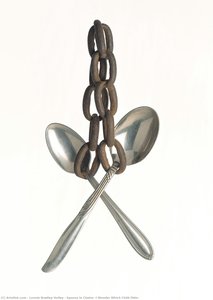
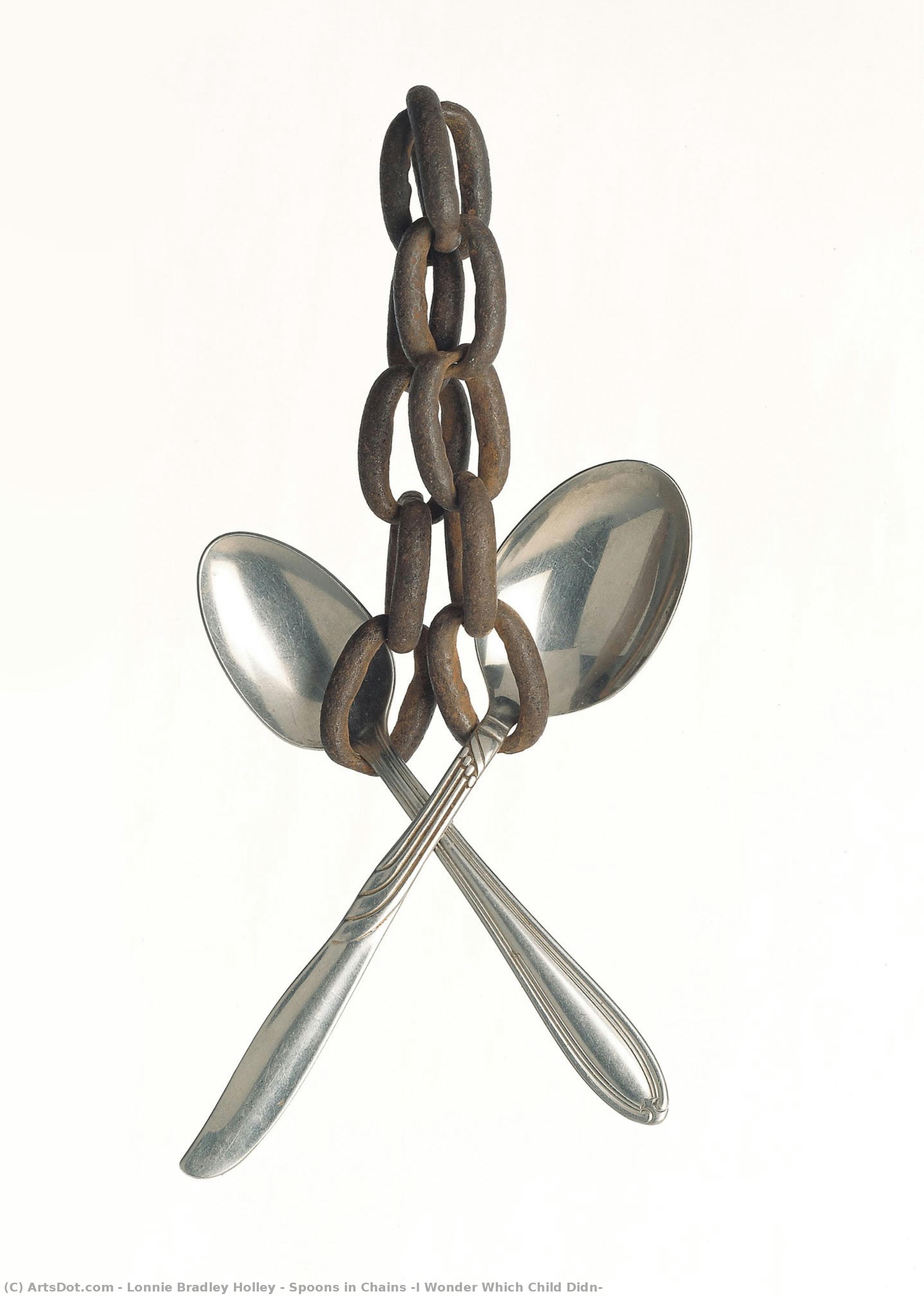
The artwork itself is deceptively simple—three silverware objects – two spoons and one fork – interconnected by a rusty chain – yet brimming with layered significance. Photographed against a stark white backdrop, the composition prioritizes textural contrast. The smooth, polished surfaces of the spoons juxtapose sharply with the rough, corroded texture of the chain, creating an immediate visual tension that draws the viewer’s eye inward. Holley skillfully employs assemblage techniques, meticulously arranging and fusing disparate elements to forge a cohesive whole. Lighting plays a crucial role, illuminating the reflective qualities of the metal while subtly revealing the intricate surface irregularities of the chain—a deliberate choice mirroring the artist's own exploration of lived experience. Lines are defined by the curves of the spoons and the circular links of the chain, generating a dynamic interplay that contributes to the sculpture’s overall movement.Symbolism Beyond Utility: Chains of Remembrance
Beyond its formal elements, “Spoons in Chains” operates on multiple symbolic levels. The chained spoons evoke themes of restriction—a palpable representation of hardship endured during Holley's youth—but also convey a sense of interconnectedness and shared vulnerability. The chain’s rust symbolizes time passing, decay, yet simultaneously represents the enduring bonds forged through adversity. As Holley himself eloquently describes it, “Spoons in Chains” "liberates" longing from the dichotomy of “freedom versus bondage.” The artist utilizes the humble spoon—a commonplace utensil—to symbolize nourishment and sustenance, subtly hinting at themes of survival and resilience. Furthermore, the sculpture’s title itself – “I Wonder Which Child Didn't Eat Today” – adds another layer of emotional depth, prompting contemplation about hunger, deprivation, and the pervasive impact of societal inequities.A Reflection on Signification: The X as Marker of Uncertainty
Holley’s artistic vision extends beyond mere visual representation; it delves into philosophical inquiry. Drawing inspiration from thinkers like Heidegger and Derrida, Holley examines how objects can carry unspoken meanings—the “X,” the most overdetermined mark available, representing the signifier spinning at crossroads, scratching its head, returning there forever but also always leaving. This conceptual framework underscores the sculpture’s ability to provoke introspection about the nature of signification itself and the profound difficulties inherent in confronting historical trauma. The artwork serves as a powerful reminder that true understanding requires acknowledging the complexities of experience—the scars etched onto our souls—and recognizing that even seemingly insignificant objects can hold narratives far richer than their surface appearance suggests.Concluding Thoughts: Lonnie Holley’s Legacy
“Spoons in Chains” stands as a testament to Holley's unwavering commitment to transforming discarded materials into vehicles for artistic expression and social commentary. It exemplifies the artist’s ability to distill profound ideas into deceptively simple forms—a hallmark of his distinctive style—and invites viewers to engage in a dialogue about memory, resilience, and the enduring power of art to illuminate the human condition. Its enduring appeal lies not only in its aesthetic beauty but also in its capacity to resonate with audiences on an emotional level, prompting reflection on themes of vulnerability, connection, and the transformative potential of confronting difficult truths.Похожие произведения




Биография художника
Lonnie Holley: The Sand Man – A Life Sculpted From Found Materials
Lonnie Holley, born February 10, 1950, in Birmingham, Alabama, is more than just an artist; he’s a testament to the resilience of the human spirit and the transformative power of creativity. His journey, deeply rooted in the complexities of the Jim Crow South, has blossomed into a globally recognized artistic practice encompassing assemblage sculpture, immersive environments, and profoundly moving music—a narrative sculpted by hardship, loss, and an unwavering commitment to self-expression. He’s not one for formal training or privileged access; his story is a chronicle etched by circumstance, fueled by instinct, and illuminated by an incandescent inner voice.Early Life: From Foster Homes to Whiskey Houses
Lonnie Bradley Holley's childhood was marked by instability—a formative experience shaped by the turbulent realities of post-war Alabama. At five years old, he entered the foster care system after his mother placed him in the temporary care of a woman working as a burlesque dancer at a carnival. This initial upheaval continued as Holley moved between several foster homes, encountering diverse caregivers and navigating unfamiliar environments—picking up trash at drive-in theaters, washing dishes, cooking—and finding refuge in unconventional places like a whiskey house on the state fairgrounds and the Alabama Industrial School for Negro Children ("Mt. Meigs"). These experiences weren’t merely biographical details; they became the bedrock of his artistic vision, imbuing his sculptures with an authenticity that resonates deeply with viewers—a visceral understanding born from confronting adversity firsthand. He recounted tales of being struck by a car at 12 years old and subsequently incarcerated for violating curfew, highlighting the formative impact of societal pressures on his young life. These early encounters instilled in him a profound appreciation for resourcefulness and a determination to forge his own path despite obstacles.The Genesis of Creation: Grief and Stone
A pivotal moment arrived in 1979 when Holley began carving tombstones for his sister’s children who tragically perished in a fire—an act of mourning that unexpectedly unlocked his artistic vocation. Driven by grief, he embarked on a quest to honor their memory using readily available materials: sandstone-like remnants from a local foundry—a byproduct of Birmingham's industrial heritage. He described this discovery as “something like divine intervention,” attributing it to a guiding hand leading him toward a new form of expression. This wasn’t simply finding a medium; it was encountering a voice waiting to be unleashed—the intuitive impulse to transform raw material into something beautiful and meaningful. The act of shaping these stones into memorials became a catalyst for broader artistic exploration, transforming discarded objects into powerful expressions of remembrance and loss. He approached the sandstone not with preconceived notions but allowed its texture and form to dictate his creative process—a technique that would become central to his distinctive sculptural style.Assemblage Art: Transforming Waste Into Wonder
Holley’s artistic practice is fundamentally rooted in assemblage – the art of constructing sculptures from disparate found objects. Metal scraps, weathered wood fragments, discarded stones, everyday detritus—these aren't merely materials to Holley; they are vessels carrying stories, memories, and echoes of past lives. His process isn’t about imposing a vision onto these objects but rather allowing them to reveal their potential through intuitive arrangement and connection. He eschews meticulous planning, instead responding directly to the inherent qualities of each material—its color, texture, weight, and history—creating sculptures that are as much about process as they are about outcome. This improvisational approach extends beyond sculpture into his musical endeavors as well—a reflection of his belief in embracing spontaneity and honoring the unpredictable rhythms of life. His music blends spoken word, improvisation, and blues influences, crafting sonic landscapes as evocative and emotionally resonant as his sculptures.Recognition and Legacy: A Voice From The South
Lonnie Holley’s work has garnered significant acclaim within the art world—recognized for its uncompromising honesty and its profound engagement with themes of grief, memory, racial injustice, and spiritual contemplation. His sculptures are held in collections of major museums across the United States, including the Birmingham Museum of Art, The Halsey Institute of Contemporary Art, The Metropolitan Museum of Art, and The National Gallery of Art—a testament to his enduring influence on contemporary art. He is associated with Thornton Dial, Ronald Lockett, and Joe Minter, fellow self-taught artists who share a similar aesthetic sensibility and thematic focus within the American South’s artistic landscape. Holley's story exemplifies the transformative power of creativity—demonstrating how art can emerge from hardship and how authenticity can transcend conventional boundaries. He stands as an inspiring figure for aspiring artists everywhere—a beacon for those who find their voice through unconventional methods and perspectives, reminding us that beauty can be born from unexpected sources.
Ло́нни Хо́лли
1950 - , США
Основные сведения
- Artistic Movement Or Style: Фольклорное искусство; Ассамбляж
- Artists Who Influenced This Artist:
- Райнхольд Диал
- Рональд Локетт
- Date Of Birth: 1950-02-10
- Full Name: Lonnie Bradley Holley
- Nationality: Американский
- Notable Artworks:
- Just Before Music
- Mith
- National Freedom
- Place Of Birth: Birmingham, USA
Похожие статьи

The Enduring Form: Sculpture Across History, Technique & Emotional Resonance
Explore the rich history of sculpture with ArtsDot. Discover key techniques, influential artists & investment potential for discerning collectors. Expert insights into valuing and collecting timeless masterpieces.

The Enduring Form: Exploring Themes & Techniques in Sculpture Across Historical Periods
Explore the rich history of sculpture from ancient masterpieces to contemporary innovations. Discover key techniques, influential artists & investment potential for discerning art collectors.

Топ-10 знаменитых картин в черных тонах: шедевры искусства для вашего интерьера
Погрузитесь в мир темных шедевров! Топ-10 знаменитых картин в черных тонах от Гойи, Рембрандта и Мунка. История искусства, техники живописи и вдохновение для вашего интерьера. Купите репродукции высокого качества на ArtsDot.com

10 легендарных бронзовых шедевров, изменивших искусство | ArtsDot
Погрузитесь в мир великих бронзовых шедевров! От Давида Донателло до Мыслителя Родена – узнайте историю создания, технику и значение легендарных скульптур. Вдохновение для интерьера и музейное качество репродукций на ArtsDot.com.

10 легендарных бронзовых скульптур, изменивших искусство навсегда | ArtsDot
Погрузитесь в мир великих бронзовых скульптур! От Давида Микеланджело до работ Родена – история искусства, техники и вдохновения. Купите репродукции шедевров для вашего интерьера на ArtsDot.com