


 Предпросмотр
 Поделиться
 Поделиться
 Детали произведения

 Скачать
 Похожие работы
 Рентгенография
 Слайд-шоу
 Статистика
French Revolution
 Painting
 2010
2010- Modern
 397.0 x 56.0 cm
 Государственная галерея искусств и Галерея современного искусства (QAGOMA)
 Читать далее
Жикле / Арт-принт
Печать (жикле) или холст музейного качества с быстрыми сроками изготовления и широким выбором вариантов отделки. ( Купить картину ручной работы Перейти к цифровым изображениям)




P118B $10

P118H $10

P118W $10

P438Z $10

P508JH $12

P508YH $12

P805H $10

P805Z $10

P919BZ $10

P919G $10

P919XJ $10

P959ZH $10

P968JZ $12

W106C $8

W218G $10

W218JH $8

W218Y $10

W307PJ $10

W316G $10

W316PJ $8

W316Y $10

W398PJ $8

W4111J $10

W500HY $15

W500JH $15

W692G $12

W849H $8

W940BG $15

W953PJ $8




Выберите один из наших стандартных размеров, соответствующих оригинальным пропорциям произведения искусства.

Вы можете указать свои собственные размеры, чтобы репродукция идеально подошла под конкретную раму или пространство. Если выбранный вами размер не будет соответствовать пропорциям оригинала, мы либо обрежем произведение, либо дополним изображение зеркальным отражением краев или однотонной заливкой. Перед началом производства вам будет отправлен цифровой макет для утверждения.
Пожалуйста, обратите внимание, что предварительный просмотр на экране не отображает фактическую обрезку или расширение изображения. Только макет точно покажет финальную композицию.
Несмотря на возможность заказа индивидуальных размеров, мы рекомендуем выбирать размер из предопределенного списка, чтобы сохранить оригинальные пропорции.
Доставка по всему миру () за 2 недели вместо стандартных 4/5 недель. (11 Сентябрь)

Бесплатная экспресс-доставка по всему миру

Высококачественный льняной холст

Полное страхование доставки

Гарантия возмещения таможенных пошлин

Гарантия точного соответствия цветов

100-дневная политика возврата (только при обнаружении дефектов)

Гарантия возврата 100% средств

Предложение оптовых скидок
 Вариант со стеклом доступен только для размеров менее 110 см

French Revolution
Жикле / Арт-принт
Размер репродукции
-


Итоговая стоимость
$ 62
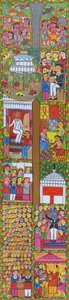
A Tapestry of Turmoil and Tradition
In the breathtaking scroll painting French Revolution, master artist Madhu Chitrakar orchestrates a profound visual symphony that bridges the gap between European historical upheaval and the ancient, rhythmic storytelling traditions of India. This expansive work, measuring an impressive 397 x 56 cm, is far more than a mere depiction of political revolt; it is a cinematic experience captured on cloth. Utilizing the venerable Patachitra technique from West Bengal, Chitrakar transforms the chaotic energy of the French Revolution into a structured, epic narrative that mirrors the grandeur of the Ramayana. The painting functions as a continuous scroll of human emotion, where every frame serves as a heartbeat in a larger story of power, justice, and the inevitable tides of change.
The composition is a masterful collage of life and movement, featuring at least thirteen distinct figures that populate this historical landscape. At first glance, the viewer is struck by the vibrant, saturated palette that breathes life into the intricate patterns of the subjects' attire. The artist employs a layered approach, where figures overlap in a way that suggests both the density of a crowd and the complexity of historical memory. A prominent clock positioned in the upper right corner acts as a silent, watchful sentinel, reminding the observer of the relentless march of time and the fleeting nature of even the most monumental political eras. This temporal element anchors the swirling chaos, providing a focal point that invites contemplation on the permanence of history versus the transience of human life.
Symbolism and the Art of Patachitra
Beyond its historical subject matter, the artwork is deeply rooted in the spiritual and communal traditions of the Patua artists. Chitrakar utilizes the classical structure of the scroll to establish a hierarchy of importance; much like traditional religious scrolls begin with an enthroned deity, this piece introduces the king and queen in an initial frame, setting the stage for the drama to follow. However, the true brilliance lies in the artist's reimagining of the guillotine. Rather than presenting it as a cold, mechanical instrument of death, Chitrakar renders it as a mythic creature—a symbolic entity that delivers justice or retribution with a supernatural weight. This infusion of myth into history elevates the painting from a historical record to a legendary epic, making the political struggle feel like a cosmic battle between order and chaos.
For the discerning collector or interior designer, this piece offers an unparalleled opportunity to introduce a conversation starter into any sophisticated space. The sheer scale and the meticulous detail of the hand-painted patterns demand attention, making it an ideal centerpiece for a gallery wall or a grand salon. The work does not merely decorate a room; it commands it, offering a rich texture of cultural fusion that appeals to those who appreciate art with deep intellectual and historical layers. To possess a reproduction of such a significant work is to hold a fragment of a living tradition, bringing the evocative power of Indian folk storytelling and the dramatic weight of European history into the modern home.
Похожие произведения



Биография художника
Edward Hopper: A Portrait of American Solitude
Edward Hopper, born in Nyack, New York, on July 22, 1882, remains one of America’s most enduring and enigmatic figures in the art world. His paintings, characterized by stark realism, evocative lighting, and a profound sense of loneliness, have captivated audiences for over eight decades. While often categorized as an American realist, Hopper's work transcends simple representation; he meticulously crafted scenes that explored the complexities of human experience within the rapidly changing landscape of early 20th-century America. His career, though initially marked by slow progress and relative obscurity, ultimately blossomed into widespread recognition, solidifying his place as a pivotal voice in American art.Early Life and Artistic Training
Hopper’s artistic journey began modestly, influenced significantly by his family's background and the encouragement of his parents. Born into a comfortable middle-class family with Dutch ancestry, he received an early education that fostered a love for visual arts. Initially, Hopper briefly studied illustration at the Correspondence School of Illustrating in New York City (1899–1900), seeking to establish a foundation in commercial art. However, his true passion lay in fine art, leading him to enroll in classes at the New York School of Art under the tutelage of William Merritt Chase and Robert Henri. These influential mentors instilled in him a commitment to capturing the essence of everyday life and exploring the emotional resonance of his subjects—a philosophy that would become central to his artistic vision. Hopper’s time with Henri, particularly, emphasized painting “from life,” encouraging students to observe and depict the realities of their own surroundings.Themes and Style: Isolation and Modernity
Hopper's art is deeply rooted in exploring themes of isolation, loneliness, and the alienation inherent in modern urban and rural settings. His paintings frequently feature solitary figures—often lost in thought or engaged in mundane activities—set against vast, impersonal spaces. These scenes, meticulously rendered with a precise attention to detail and dramatic use of light and shadow, evoke a sense of quiet melancholy and introspection. The influence of Edgar Degas and Édouard Manet is readily apparent in Hopper’s compositions – particularly their cropped perspectives and focus on capturing fleeting moments of urban life. However, Hopper's work transcends mere imitation; he imbued these familiar subjects with a uniquely American sensibility, reflecting the anxieties and uncertainties of a nation undergoing rapid industrialization and social change. His use of color was deliberate and restrained, often employing muted tones to heighten the sense of mood and atmosphere.Key Works and Recognition
Throughout his career, Hopper produced a remarkable body of work encompassing oil paintings, watercolors, and etchings. *Nighthawks* (1942), arguably his most famous painting, perfectly encapsulates his signature style—a stark depiction of three late-night figures in an all-night diner, bathed in the artificial glow of fluorescent lights. Other notable works include *Automat* (1927), a poignant portrayal of a solitary woman in a near-empty diner; *Chop Suey* (1929), a scene of urban anonymity and fleeting connection; and *Office in a Small City* (1953), which captures the quiet desperation of office life. Despite facing initial challenges, Hopper’s work gained increasing recognition throughout the 1920s, culminating in his first one-person exhibition at the Whitney Studio Club in 1920. The success of this exhibition paved the way for further acclaim and commercial success, establishing him as a significant figure in American art.Legacy and Influence
Edward Hopper’s impact on American art is undeniable. His ability to capture the emotional complexities of modern life—particularly the sense of isolation and alienation—continues to resonate with viewers today. His work has profoundly influenced generations of artists, filmmakers, and writers, shaping our understanding of the American experience. Hopper's meticulous attention to detail, evocative use of light and shadow, and exploration of universal themes have cemented his place as a master of American Realism and a truly iconic figure in the history of art. His paintings remain powerful testaments to the beauty and melancholy inherent in everyday life, inviting viewers to contemplate the quiet dramas unfolding within the seemingly ordinary moments of our existence.
madhu chitrakar
1967 - , India
Основные сведения
- Artistic Movement Or Style: Realism, American Realism
- Artists Or Movements Influenced By This Artist:
- Edgar Degas
- Édouard Manet
- Artists Who Influenced This Artist:
- William Merritt Chase
- Robert Henri
- Date Of Birth: July 22, 1882
- Date Of Death: May 15, 1967
- Full Name: Edward Hopper
- Nationality: American
- Notable Artworks:
- Nighthawks
- Automat
- Chop Suey
- Place Of Birth: Nyack, New York, USA
Похожие статьи
Raja Ravi Varma: Bridging Tradition & Modernity in 19th-Century Indian Art
Explore the life & art of Raja Ravi Varma, a pioneer who fused European techniques with Indian iconography. Discover his iconic paintings, lasting legacy, and influence on modern Indian art at ArtsDot.
Shadow Catcher: Edward S. Curtis & the Ethnographic Portraiture of a Vanishing West
Explore the life & work of Edward S. Curtis, the 'Shadow Catcher,' and his groundbreaking photographic documentation of Native American cultures. Discover iconic images from *The North American Indian* and a critical look at his lasting legacy.
George Catlin: Witnessing & Representing Indigenous Life on the American Frontier
Explore the captivating art of George Catlin, renowned for his vivid portraits & landscapes documenting Native American life on the frontier. Discover a vanishing world through stunning paintings and historical context.
Panoramic Visions of Empire: The Daniells’ Artistic Collaboration & Legacy
Explore the captivating 'Oriental Scenery' by Thomas & William Daniell. Discover their pioneering aquatint prints of India, imperial context, artistic collaboration, and lasting legacy. A deep dive for history lovers.
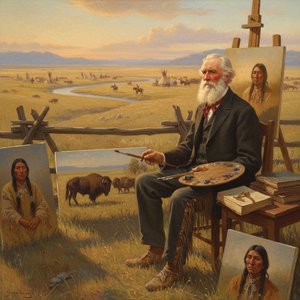
Joseph Henry Sharp: Capturing the Spirit of the Plains – Life, Art & Legacy
Explore the life & art of Joseph Henry Sharp, a founding member of the Taos Society of Artists renowned for his realistic depictions of Native American culture and Western landscapes. Discover his legacy with ArtsDot.