


 Предпросмотр
 Поделиться
 Поделиться
 Детали произведения

 Скачать
 Похожие работы
 Рентгенография
 Слайд-шоу
 Статистика
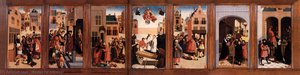
Memorial Panel with Eight Male Portraits, probably Willem Jelysz van Soutelande and Family, with Saint James the Greater and the Van Soutelande Family Crest, inner left wing of an altarpiece, Master of Alkmaar, c. 1515 - c. 1520
 1520
1520 101.0 x 36.0 cm
 Читать далее
Приобретите цифровое изображение высокого разрешения в улучшенном качестве, которое значительно превосходит онлайн-превью.
Каждый файл тщательно подготавливается нашими специалистами с использованием передовых инструментов и экспертной ручной ретуши. Мы гарантируем исключительную четкость, точную цветопередачу и детальную проработку каждого изображения.
Финальный файл доставляется по электронной почте в течение 72 часов и оптимизирован для немедленного использования в профессиональной среде, при верстке и печати. Это тот же уровень качества, которому доверяют ведущие дизайнерские студии, издательства и галереи.
Цифровое изображение
Скачайте файл высокого разрешения для личного использования, печати и творческих проектов. ( Перейти к печати Купить картину ручной работы)
Включено в каждый заказ цифровых изображений
Гарантия экспертной цифровой доставки
Выбирая ArtsDot.com, вы получаете не просто изображение — вы приобретаете профессионально обработанное цифровое произведение искусства, созданное с безупречной точностью и под защитой гарантии качества. Вот всё, что автоматически входит в ваш заказ:

Мгновенная доставка по e-mail
Ваш цифровой файл в высоком разрешении будет отправлен вам по электронной почте в течение 72 часов после оформления заказа — и сразу станет доступен для использования.

Цифровой файл с ИИ-улучшением
Ваше произведение искусства проходит профессиональную оптимизацию с использованием передовых инструментов ИИ и ручной обработки, что гарантирует максимальную детализацию, четкость и точность цветопередачи.

Бессрочная бесплатная повторная доставка
Случайно удалили или потеряли файл? Не беспокойтесь — мы отправим его вам повторно в любое время и совершенно бесплатно.

Без импортных пошлин — навсегда
Наслаждайтесь вашим произведением искусства мгновенно без таможенных пошлин, сборов или затрат на доставку — цифровые загрузки всегда не облагаются налогом.

Гарантия точности цветопередачи
Мы гарантируем, что ваше цифровое изображение максимально точно передает оригинальные цвета благодаря использованию профессиональных инструментов и систем управления цветом.

Гарантия удовлетворенности 100 дней
Если вы не будете удовлетворены своим цифровым изображением, мы внесем правки или вернем 100% стоимости в течение 100 дней — без лишних вопросов.

100% Гарантия возврата средств
Не удовлетворены покупкой? Получите полный возврат средств в течение 100 дней после получения цифрового файла — без лишних вопросов.

Скидки на оптовые заказы
Купите 3 изображения, сэкономьте 10% — Купите 5, сэкономьте 15% — Купите 10+, сэкономьте 20%. Отличное решение для творческих проектов, галерей и агентств.
Похожие произведения










Биография художника
The Enigmatic Master of Alkmaar: A Portrait in Faith and Form
The identity of the Master of Alkmaar remains one of art history's most enduring mysteries, a phantom presence etched into the very fabric of Northern Netherlandish tradition. Active primarily during the early sixteenth century, this Dutch painter produced a remarkable body of work characterized by exquisitely detailed religious scenes and meticulously crafted book illustrations. While his name survives only as an artistic pseudonym, his legacy is anchored in the historic heart of Alkmaar, with much of his surviving oeuvre linked to The Regional Archive and the sacred spaces of the church of Saint Lawrence. Despite the lack of biographical certainties, scholars have painstakingly reconstructed a life through stylistic analysis, revealing a figure deeply rooted in the transition from Gothic piety to the burgeoning humanism of the Renaissance.
Little is known of the Master’s formative years, yet traces of his existence suggest a man born around 1480, likely within the thriving maritime atmosphere of Alkmaar itself. His artistic training appears to have been shaped under the tutelage of Jacob Cornelisz van Oosts, a prominent painter of the Alkmaarschool who championed stylistic innovations flowing from Florence and Rome. This profound influence is palpable throughout the Master’s canvases; one can observe a masterful use of perspective and chiaroscuro—techniques borrowed from the giants of the Italian Renaissance, such as Leonardo da Vinci and Michelangelo. Through this synthesis, the artist demonstrated an impressive grasp of humanist principles, blending established Northern conventions with the sophisticated light and shadow of the South.
A Symphony of Color and Devotional Detail
The Master's distinctive style is immediately recognizable by its remarkable precision and a luminous color palette that seems to glow from within. He eschewed the flattened, stylized depictions favored by some of his contemporaries, opting instead for a painstakingly rendered realism. His brush captured the subtle nuances of heavy drapery folds, the delicate textures of skin, and the profound depth of facial expressions. His compositions are often dominated by serene landscapes—frequently viewed through arched windows—which serve to create an atmosphere of contemplative piety, inviting the viewer into a world where the divine and the earthly intersect.
His technical achievements are perhaps most evident in his celebrated religious panels, such as The Seven Works of Mercy (1504). In these works, the artist displays a unique ability to balance narrative complexity with emotional clarity. While some scholars note that certain figures bear the stylistic stamp of Geertgen tot Sint Jans—characterized by bright colors and occasionally exaggerated, caricatured features—the Master’s ability to weave these elements into a cohesive theological message is unparalleled. His work often functions as a visual sermon, where every detail, from a palm frond held by a pilgrim to the specific crest of a donor family, serves a higher narrative purpose.
Legacy and Historical Significance
The historical significance of the Master of Alkmaar lies in his role as a bridge between eras. He stood at the crossroads of the late Middle Ages and the dawn of the modern age, capturing the spiritual intensity of the Gothic period while embracing the structural innovations of the Renaissance. His contributions to the art of North Holland are monumental, leaving behind a trail of altarpieces and memorial panels that continue to fascinate historians and devotees alike.
To understand his impact is to look at the breadth of his surviving influence:
- Iconographic Richness: His ability to translate complex biblical narratives, such as the Dispute with the Doctors, into accessible visual storytelling.
- Regional Identity: His role in establishing Alkmaar as a significant center for artistic production during the early sixteenth century.
- Technical Mastery: The integration of Italianate light and shadow with the meticulous, textural realism characteristic of the Netherlandish tradition.
Though his true name may remain lost to the archives, the Master of Alkmaar lives on through the vibrant, breathing landscapes and the soulful, prayerful faces that populate his panels. He remains a silent witness to a transformative era in European history, an artist whose work continues to illuminate the intersection of faith, form, and human emotion.
master of alkmaar
Netherlands
Основные сведения
- Artistic Movement Or Style: Proto-Renaissance
- Artists Or Movements Influenced By This Artist: ['Northern Netherlandish']
- Artists Who Influenced This Artist: ['Giotto']
- Nationality: Dutch
- Notable Artworks: ['The Seven Works of Mercy']
- Place Of Birth: Alkmaar, Netherlands