

 Предпросмотр
 Поделиться
 Поделиться
 Детали произведения

 Скачать
 Похожие работы
 Рентгенография
 Слайд-шоу
 Статистика
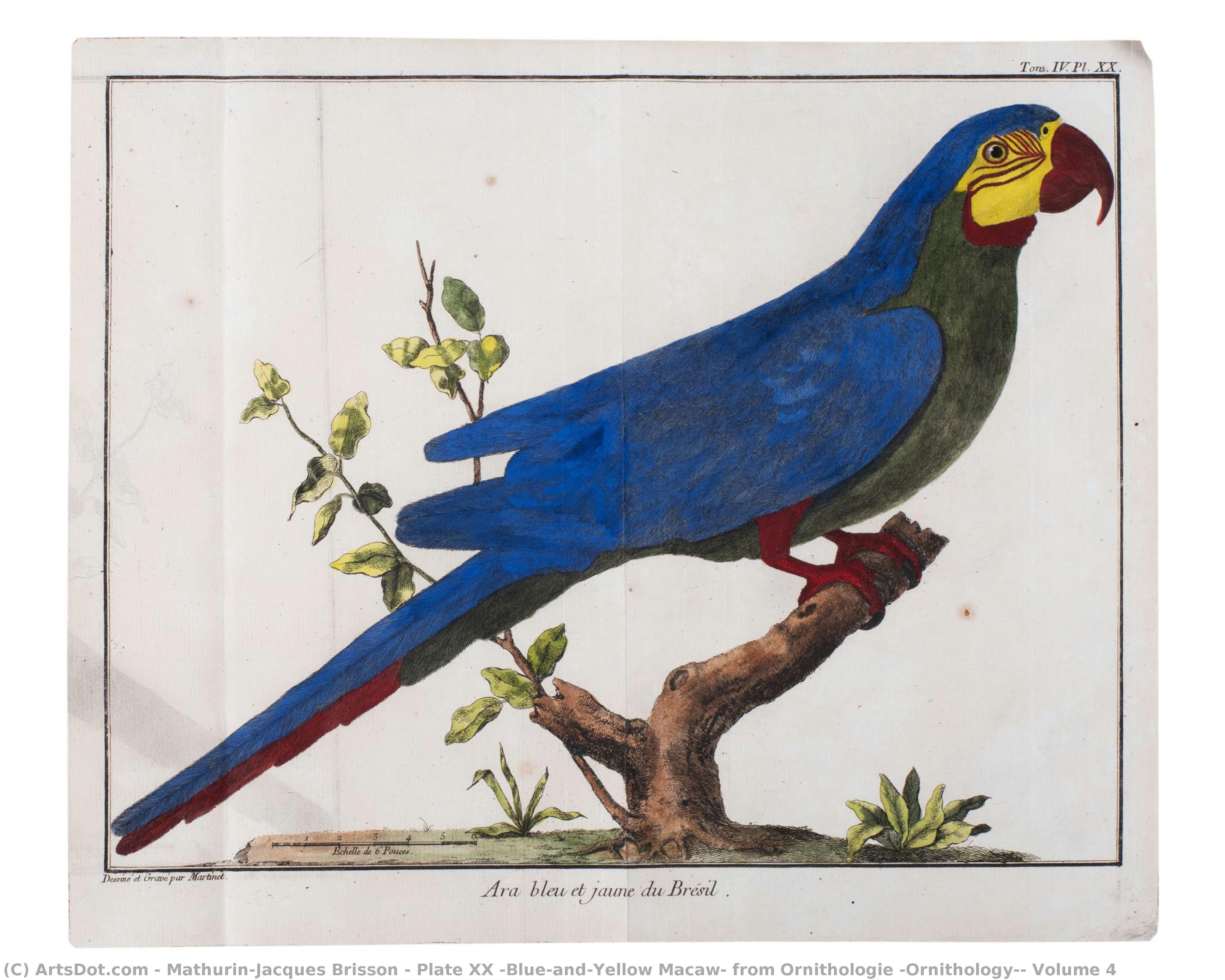
Plate XX (Blue-and-Yellow Macaw) from Ornithologie (Ornithology), Volume 4
 Acrylic
- WallArt
- Rococo
 1760
1760 25.0 x 19.0 cm
 Toledo Museum of Art
 Читать далее
Приобретите цифровое изображение высокого разрешения в улучшенном качестве, которое значительно превосходит онлайн-превью.
Каждый файл тщательно подготавливается нашими специалистами с использованием передовых инструментов и экспертной ручной ретуши. Мы гарантируем исключительную четкость, точную цветопередачу и детальную проработку каждого изображения.
Финальный файл доставляется по электронной почте в течение 72 часов и оптимизирован для немедленного использования в профессиональной среде, при верстке и печати. Это тот же уровень качества, которому доверяют ведущие дизайнерские студии, издательства и галереи.
Цифровое изображение
Скачайте файл высокого разрешения для личного использования, печати и творческих проектов. ( Перейти к печати Купить картину ручной работы)
Включено в каждый заказ цифровых изображений
Гарантия экспертной цифровой доставки
Выбирая ArtsDot.com, вы получаете не просто изображение — вы приобретаете профессионально обработанное цифровое произведение искусства, созданное с безупречной точностью и под защитой гарантии качества. Вот всё, что автоматически входит в ваш заказ:

Мгновенная доставка по e-mail
Ваш цифровой файл в высоком разрешении будет отправлен вам по электронной почте в течение 72 часов после оформления заказа — и сразу станет доступен для использования.

Цифровой файл с ИИ-улучшением
Ваше произведение искусства проходит профессиональную оптимизацию с использованием передовых инструментов ИИ и ручной обработки, что гарантирует максимальную детализацию, четкость и точность цветопередачи.

Бессрочная бесплатная повторная доставка
Случайно удалили или потеряли файл? Не беспокойтесь — мы отправим его вам повторно в любое время и совершенно бесплатно.

Без импортных пошлин — навсегда
Наслаждайтесь вашим произведением искусства мгновенно без таможенных пошлин, сборов или затрат на доставку — цифровые загрузки всегда не облагаются налогом.

Гарантия точности цветопередачи
Мы гарантируем, что ваше цифровое изображение максимально точно передает оригинальные цвета благодаря использованию профессиональных инструментов и систем управления цветом.

Гарантия удовлетворенности 100 дней
Если вы не будете удовлетворены своим цифровым изображением, мы внесем правки или вернем 100% стоимости в течение 100 дней — без лишних вопросов.

100% Гарантия возврата средств
Не удовлетворены покупкой? Получите полный возврат средств в течение 100 дней после получения цифрового файла — без лишних вопросов.

Скидки на оптовые заказы
Купите 3 изображения, сэкономьте 10% — Купите 5, сэкономьте 15% — Купите 10+, сэкономьте 20%. Отличное решение для творческих проектов, галерей и агентств.
A Window into Enlightenment Ornithology: Mathurin Jacques Brisson’s Plate XX
Mathurin Jacques Brisson's “Plate XX” from his monumental ornithological work, *Ornithologie*, Volume 4 represents more than just a depiction of a vibrant blue-and-yellow macaw; it embodies the spirit of scientific inquiry and artistic innovation that characterized the Enlightenment era. Executed in 1760, this meticulously crafted watercolor illustration stands as a testament to Brisson’s pioneering efforts in zoological classification and his unwavering commitment to capturing the beauty of the natural world with unprecedented accuracy.
The Artist's Vision: Ferchault de Réaumur’s Influence
Brisson’s artistic journey began under the mentorship of René Antoine Ferchault de Réaumur, a wealthy naturalist who recognized Brisson’s talent and fostered his burgeoning passion for scientific observation. Their collaboration established a cornerstone of French natural history illustration, prioritizing detailed anatomical studies alongside aesthetically pleasing compositions. Réaumur championed a humanist approach to science—one that sought not only to understand the workings of nature but also to elevate its grandeur before the eyes of educated observers.
Technique and Detail: Watercolor Precision
The artwork’s remarkable realism stems from Brisson's masterful application of watercolor technique. Layers of translucent washes build up to create a luminous surface that captures the iridescent sheen of the macaw’s feathers—a feat achieved through careful blending and precise color mixing. The artist’s meticulous attention to detail extends beyond the bird itself, encompassing subtle nuances in the texture of the tree branch and the scattered leaves, contributing to an immersive portrayal of its habitat.
Symbolism Within Observation: Representing Biodiversity
Beyond mere visual representation, “Plate XX” carries symbolic weight. As a product of the Enlightenment’s fascination with taxonomy—the systematic categorization of organisms—it reflects the burgeoning scientific understanding of biodiversity and interconnectedness. The macaw, native to Central America and South America, served as an emblem of exotic beauty and intellectual curiosity during Brisson's time, symbolizing the expanding horizons of knowledge.
Emotional Resonance: Capturing Nature’s Majesty
Ultimately, Brisson’s “Plate XX” transcends its technical merits to evoke a profound emotional response. The painting’s serene composition—coupled with the vibrant colors and exquisite detail—captures the majesty of the natural world, inviting viewers to contemplate the wonders of ornithology and appreciating the transformative power of artistic observation.
Похожие произведения

Биография художника
The Visionary of the Natural World: The Life of Mathurin Jacques Brisson
In the heart of the Enlightenment, a period defined by an insatiable hunger for knowledge and the systematic categorization of the universe, Mathurin Jacques Brisson emerged as a luminous figure. Born on April 30, 1723, in the tranquil French town of Fontenay-le-Comte, Brisson’s early years were marked by a tension between tradition and discovery. Though his path was initially directed toward the solemnity of ecclesiastical studies, the call of the natural world proved far more compelling. In 1747, he made the courageous decision to abandon the clergy, choosing instead to dedicate his intellect to the boundless complexities of life itself. This pivot from the spiritual to the empirical would eventually lead him to become one of the most significant contributors to zoological science and scientific illustration in history.
The trajectory of Brisson’s career was irrevocably altered through his profound association with René Antoine Ferchault de Réaumur. Joining the service of this esteemed French naturalist in 1749, Brisson found himself immersed in an environment of unparalleled scientific rigor. Under Réaumur’s mentorship, he gained access to a vast and diverse collection of specimens, which served as both his laboratory and his inspiration. This period of apprenticeship instilled in him a deep reverence for anatomical precision and the necessity of direct observation. It was here that Brisson began to refine the meticulous eye that would later define his artistic and scientific legacy, learning to see beyond mere surface beauty to the structural truths of the animal kingdom.
A Masterpiece of Empirical Artistry
The pinnacle of Brisson’s life work arrived in 1760 with the publication of his monumental six-volume treatise, Ornithologie. This work was not merely a book of descriptions; it was a revolutionary manifesto of scientific accuracy. At a time when many naturalists relied on secondhand accounts or dried, unrecognizable specimens, Brisson pioneered a methodology rooted in direct engagement. He insisted upon personally examining each bird before committing its likeness and characteristics to paper. This commitment to empirical truth transformed the nature of ornithological documentation, bridging the gap between fine art and rigorous science.
The illustrations within Ornithologie remain some of the most breathtaking examples of natural history art ever produced. Each plate serves as a window into a vibrant, living world, characterized by:
- Exquisite Detail: A profound focus on the texture of plumage, the curvature of beaks, and the delicate structure of talons.
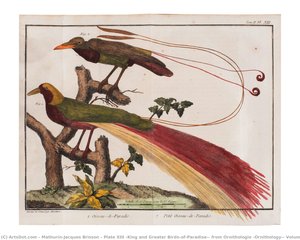
- Vibrant Coloration: The use of pigments that capture the iridescent sheen of tropical species, such as the majestic King and Greater Birds-of-Paradise.
- Anatomical Integrity: A seamless blend where aesthetic beauty serves the purpose of scientific identification, seen clearly in works like his stunning depiction of the Blue-and-Yellow Macaw.
Legacy and Historical Significance
Beyond the visual splendor of his plates, Brisson’s contribution to the foundation of modern taxonomy cannot be overstated. His systematic approach to classifying animals provided a crucial framework that influenced subsequent generations of naturalists, including the likes of Carl Linnaeus. By emphasizing the importance of observable physical traits and detailed anatomical study, he helped move biology away from folklore and toward a disciplined, evidence-based science.
Mathurin Jacques Brisson passed away in 1806, leaving behind a legacy that continues to resonate in both the halls of scientific institutions and the galleries of art historians. His work remains a testament to the era's belief that through careful observation and artistic dedication, the mysteries of the natural world could be brought into the light of human understanding. Today, his illustrations are cherished not only as historical documents but as timeless masterpieces of scientific illustration, capturing the fleeting elegance of nature with an enduring, soulful precision.
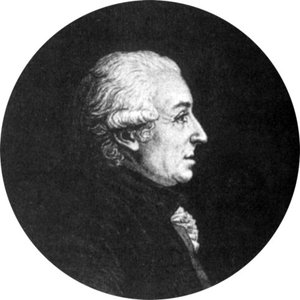
mathurin-jacques brisson
1723 - 1806 , France
Основные сведения
- Artistic Movement Or Style: Naturalism
- Artists Or Movements Influenced By This Artist: ['']
- Artists Who Influenced This Artist:
- Carl Linnaeus
- Jacob Theodor Klein
- Date Of Birth: April 30, 1723
- Date Of Death: June 23, 1806
- Full Name: Mathurin Jacques Brisson
- Nationality: French
- Notable Artworks: ['Plate XX (Blue-and-Yellow Macaw) from Ornithologie']
- Place Of Birth: Fontenay-le-Comte, France