
The Vertical Revolution: Why Designers are Looking Upward
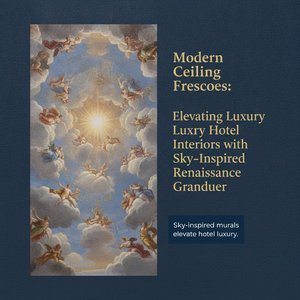 The Modern Ceiling Fresco: Reimagining Renaissance Grandeur for Contemporary Spaces
A Resurgence of Ornament: Why Ceiling Art is Back For decades, ceilings were often treated as mere afterthoughts – blank canvases awaiting a simple coat of paint. However, a significant shift is underway in the world of interior design. We are witnes...
For decades, the ceiling has been relegated to a mere structural boundary—a blank, white expanse awaiting a simple coat of paint. In the high-stakes world of luxury hospitality design, however, this oversight is being corrected by a profound shift in perspective. We are witnessing a remarkable resurgence of ornate ceiling art, where the upward gaze becomes the primary driver of atmosphere. This movement is not merely about decoration; it is about reclaiming the untapped potential of the architectural envelope to transform functional corridors into breathtakingly artistic experiences. When a designer treats the ceiling as a canvas rather than an afterthought, they unlock a new dimension of visual richness that commands attention and elevates the very soul of a space.
This vertical revolution stems from a deep-scale yearning for historical grandeur and a desire to create immersive environments that transcend the ordinary. In prestigious hotel lobbies and private suites, the ceiling serves as the ultimate architectural punctuation mark. By introducing depth through muralism, designers can manipulate the perceived volume of a room, turning intimate spaces into soaring cathedrals of light or expansive halls into intimate, starlit retreats. The modern designer understands that while walls define a room's boundaries, it is the ceiling that defines its spirit.
Skyline & Celestial Narratives: Curating Atmospheric Impact
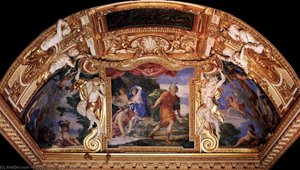 Ceiling decoration
A Celestial Narrative in Fresco Gazing upon this magnificent ceiling decoration by Giovanni Francesco Romanelli transports the viewer beyond the confines of earthly walls into a realm of painted allegory and divine interaction. Created in 1655, this ...
The most potent use of this upward gaze lies in the curation of celestial and skyline narratives. Imagine a guest entering a lounge and, instead of meeting a flat plaster surface, finding themselves beneath an expansive, painted sky that breathes life into the room. These sky-inspired murals act as a window to the infinite, providing a sense of liberation from the confines of earthly walls. Whether it is the soft, ethereal glow of a Renaissance dawn or the sharp, dramatic silhouette of a modern metropolitan skyline, these motifs serve a singular purpose: to evoke emotion and provide a sense of profound communion with the environment.
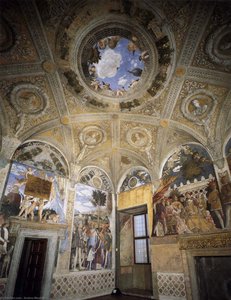
The power of such imagery lies in its ability to tell a story without words. A celestial canopy can transport a viewer through time, using light and shadow to suggest divine interaction or tranquil stillness. In contemporary luxury settings, these narratives are often used to create a "destination" within a destination. By integrating elements like the luminous golden medallions found in Mannerist works or the sweeping, allegorical clouds of the Baroque era, designers can craft a bespoke atmosphere that is both personalized and timeless. The goal is to move beyond mere wallpapering and toward a true architectural tapestry that weaves together the history of art with the modern desire for escapism.
From Renaissance Grandeur to Modern Minimalism: Adapting the Fresco Aesthetic
 Sistine Chapel ceiling
The Sistine Chapel ceiling (Italian: Soffitto della Cappella Sistina), painted in fresco by Michelangelo between 1508 and 1512, is a cornerstone work of High Renaissance art. The Sistine Chapel is the large papal chapel built within the Vatican betwe...
To master the modern ceiling fresco, one must understand its prestigious lineage. The history of this medium is inextricably linked to the Italian Renaissance, a period where techniques like buon fresco—applying pigment directly onto wet lime plaster—allowed art to become an integral part of the building's very structure. From the monumental anatomical mastery of Michelangelo’s Sistine Chapel to the delicate, courtly elegance of Agnolo Bronzino’s Mannerist sketches, the ceiling has long been a site for displaying power, grace, and divine narrative. These historical precedents provide a rich vocabulary of texture, color, and composition that can be reimagined for today's aesthetic.
The contemporary challenge—and opportunity—lies in the "remixing" of this grandeur. We are no longer bound by the strict religious or political mandates of the 16th century; instead, we can adapt these classical techniques to suit a minimalist or even a pop-art sensibility. A designer might take the dramatic, elongated forms of Mannerism and strip them down to bold, graphic outlines that complement a sleek, modern hotel suite. Alternatively, one can embrace the heavy, textured brushstrokes of an impasto style to bring a sense of tactile history to a high-tech environment. The essence remains: using the weight of art history to provide a foundation for contemporary luxury.
Architectural Integration: Seamless Installation of Large-Format Murals
 Fresco
Fresco (pl. frescos or frescoes) is a technique of mural painting executed upon freshly laid ("wet") lime plaster. Water is used as the vehicle for the dry-powder pigment to merge with the plaster, and with the setting of the plaster, the painting be...
The execution of such ambitious visions requires a departure from traditional painting methods toward sophisticated architectural engineering. For the professional designer, the logistical challenge of large-scale ceiling work is often met through the use of massive, high-quality canvas rolls. These are not mere prints; they are meticulously crafted works of art that can be shipped globally and installed with the precision of high-scale wallpaper. This method allows for the recreation of legendary ceilings—such as the intricate, figure-heavy designs of Giovanni Francesco Romanelli—within any modern architectural context.
This approach ensures that the artwork feels like a permanent, structural element rather than an applied layer. When executed correctly, the transition between the wall and the ceiling becomes seamless, creating a continuous narrative that wraps around the room. This level of integration is essential for achieving the "monumental ambition" required in luxury hospitality. By utilizing advanced materials and professional installation techniques, designers can achieve the durability and vibrancy of ancient frescoes while maintaining the flexibility needed for modern construction timelines.
The Designer’s Toolkit: Customization, Scale, and Bespoke Color Matching
 Modern Ceiling Frescoes: Reimagining Renaissance Grandeur for Contemporary Luxury Interiors
The Celestial Canopy: A Resurgence of Ornate Ceiling Design in Luxury Interiors The Modern Ceiling Fresco: Elevating Interiors with Sky-Inspired Art and Renaissance Grandeur The Celestial Canopy: A History of Grandeur from the Sistine Chapel to Impre...
In the realm of high-end design, true luxury is defined by personalization. The modern ceiling fresco offers unparalleled opportunities for customization that standard decor cannot match. This includes the ability to manipulate scale—splitting a single, breathtaking image across three, four, or even five panels to cover wide staircases or expansive lobbies. Such "multi-panel" trends allow for a cohesive, modern architectural look that flows seamlessly across complex surfaces, ensuring that the brushstrokes and color gradients are perfectly aligned with the room's geometry.
Furthermore, the ability to perform "Period Shifts" allows designers to tailor art to a specific brand identity. A project coordinator can work alongside artists to adjust color palettes for perfect matching with existing upholstery or to transform a modern photographic element into a 17th-century masterpiece. Whether it is through digital mockups that allow for unlimited revisions before the first drop of paint hits the canvas, or the use of specialized finishes like craquelure to add an aged, prestigious patina, the toolkit available to the contemporary designer is limitless. This level of bespoke service ensures that every ceiling becomes a unique, signature element of the property's architectural legacy.