
The Gastronomic Stage: Restaurant Design as Narrative Framework
 The Gastronomic Stage: Interior Design as Narrative Framework in the Contemporary Restaurant Experience
The Evolving Narrative: From Functional Space to Immersive Experience For centuries, the restaurant existed primarily as a practical necessity – a place to refuel. But the modern appetite extends far beyond sustenance; it craves connection, story, an...
For centuries, the restaurant existed primarily as a practical necessity—a functional space designed for the singular purpose of refueling the weary traveler. However, in the contemporary era, the modern appetite has evolved far beyond mere sustenance; it craely craves connection, story, and atmosphere. We have entered an age where dining is no longer just a meal, but a performance, and the restaurant itself has become a stage. This transformation is not merely a matter of aesthetic preference but a fundamental shift in how we perceive and interact with food, driven by a profound human desire for experiences that resonate on an emotional level.
To view a dining room as a narrative framework is to understand that every element, from the weight of the cutlery to the texture of the walls, contributes to a larger story. Much like the principles of scenography used in theatrical design, a successful restaurant orchestrates a cohesive world that transports guests away from the mundane. This holistic approach requires an understanding of how spatial arrangement and architectural design establish expectations before the first course even arrives. When a space is thoughtfully curated, it ceases to be a mere room and becomes an immersive environment where the cuisine is elevated by the very air the guests breathe.
Chromatic Appetizers: The Psychology of Color in Dining Environments
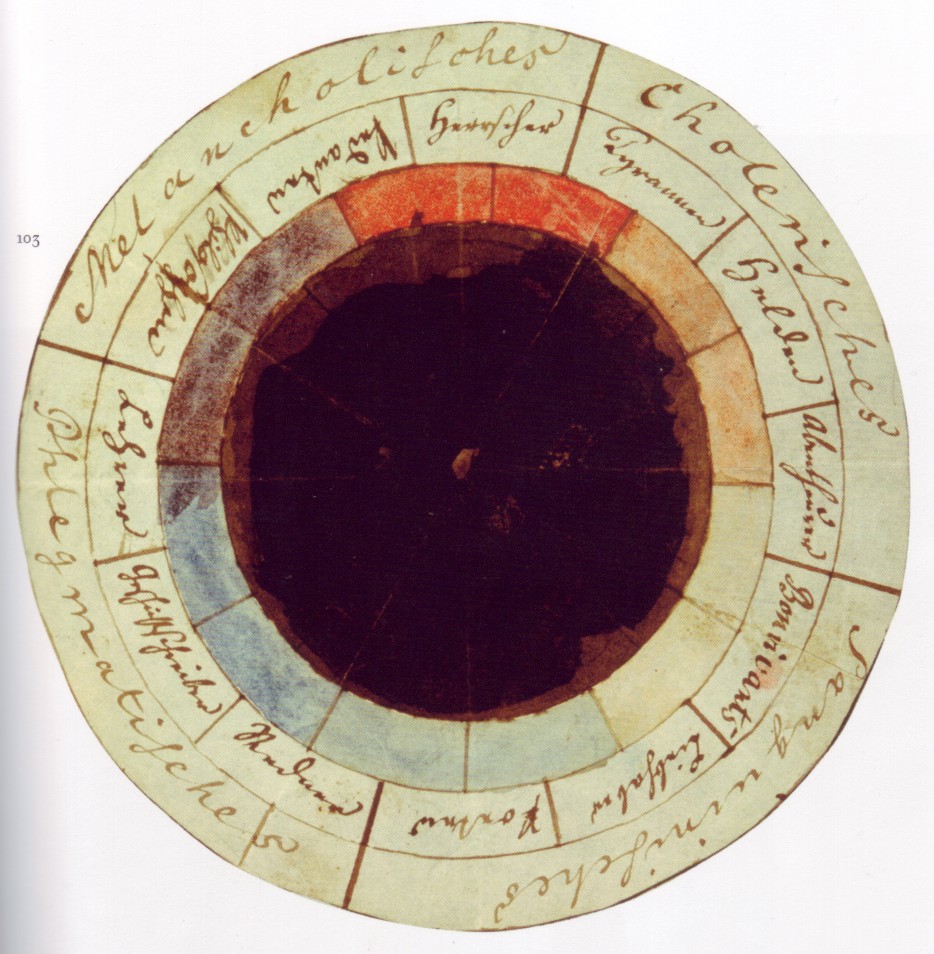 Color psychology
Color psychology is the study of colors and hues as a determinant of human behavior. Color influences perceptions that are not obvious, such as the taste of food. Colors have qualities that may cause certain emotions in people. How color influences i...
Color is perhaps the most immediate and visceral tool at a designer's disposal. It is a silent language that influences perceptions that are often not consciously realized, even affecting the perceived taste of the food itself. Through the lens of color psychology, we understand that hues act as determinants of human behavior and emotion. As the pioneer Carl Jung suggested, colors are the mother tongue of the and the subconscious; they bypass our rational defenses to speak directly to our instincts.
Consider the strategic use of a warm, saturated palette. In Vincent van Gogh’s 1887 masterpiece, Interior of a Restaurant, the artist utilizes deep reds and ochres to create an inviting, almost theatrical atmosphere of conviviality. These tones suggest warmth and energy, stimulating the appetite and fostering social interaction. Conversely, cooler blues and greens can introduce a sense of repose or even isolation, depending on their application. Even the subtle presence of yellow can evoke serenity, while certain lightings in the blue spectrum may enhance alertness. For the restaurant owner, selecting a color palette is an act of emotional engineering, shaping the very mood of the clientele from the moment they cross the threshold.
Composition and Perspective: Orchestrating Spatial Flow and Intimacy
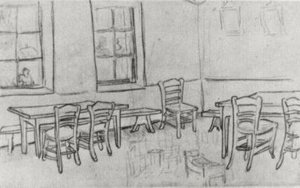 Interior of a Restaurant
A Moment of Quiet Observation: Van Gogh’s Interior of a Restaurant This evocative sketch, tentatively attributed to Vincent van Gogh, offers a poignant glimpse into the artist's early explorations of capturing everyday scenes with an intensely person...
Beyond the surface level of color lies the structural integrity of composition. In art, as in interior design, the arrangement of forms dictates how an eye—or a guest—moves through a space. A masterful use of perspective can create an illusion of depth, making a compact bistro feel expansive and airy, or conversely, using converging lines to anchor a central focal point that draws diners into the heart of the room. This is seen in the early sketches of Van Gogh, where meticulous pencil strokes define forms and utilize perspective to guide the viewer’s gaze toward the window, creating a sense of contemplative depth.
The orchestration of spatial flow is a delicate balance between openness and intimacy. A well-designed restaurant utilizes the arrangement of tables and furniture as compositional elements to create "zones" of experience. Just as an artist uses hatching and cross-hatching to build volume and texture, a designer uses partitions, greenery, or even the placement of large-scale art to define boundaries without sacrificing the sense of community. The goal is to achieve a rhythmic balance where the movement of servers and the stillness of diners coexist in a choreographed harmony, ensuring that every guest feels both part of the larger scene and tucked into their own private moment.
Luminous Textures: The Interplay of Mood Lighting and Artistic Surface
 Mood lighting
Mood lighting is the use of specific colours or brightness in ambient illumination with the intention of promoting a specific, temporary state of mind or feeling. While not specific to indoor settings, it is most commonly used in indoor environments....
Lighting is the soul of ambiance. It is the medium through which color is revealed and texture is felt. Mood lighting—the intentional use of specific brightness and color temperatures—is a powerful tool for promoting temporary states of mind. Research in environmental psychology has demonstrated that even subtle shifts in light can impact cognition and mood; for instance, warm light sources can enhance problem-solving abilities and feelings of comfort, while cooler, blue-enriched lighting may increase alertness.
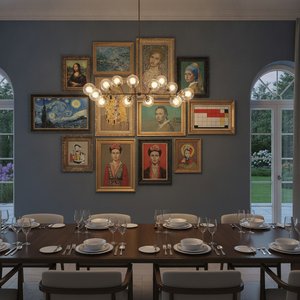
However, the true magic occurs when light interacts with the physical surfaces of the room. When light falls upon a hand-painted oil reproduction, it reveals the impasto—the thick, tactile layers of paint that create shadows and highlights. The visible brushstrokes of a masterpiece provide a sense of movement and life that a flat print simply cannot replicate. This interplay between illumination and texture adds a layer of sensory richness to the dining experience. A well-placed spotlight on a textured canvas can transform a wall from a mere boundary into a dynamic, breathing element of the room’s decor, much like the way light dances across the surfaces in a Post-Impressionist painting.
Curating the Experience: Integrating Masterpieces into Modern Hospitality
 Framed Hospitality: The Psychological Impact of Presentation on Perceived Value & Aesthetic Coherence in Restaurant Interiors
Introduction: The Holistic Dining Experience – Beyond Taste The modern diner is not merely seeking sustenance; they crave an experience, a carefully constructed narrative woven from atmosphere, service, and, crucially, design. For decades, the restau...
For the discerning restaurant owner, the integration of fine art is not merely about decoration; it is about framed hospitality. The presence of museum-quality art increases the perceived value of the environment and provides a point of intellectual engagement for the guest. By selecting works that resonate with the restaurant's culinary narrative—perhaps a maritime scene for a seafood establishment or a vibrant, colorful landscape for a modern fusion bistro—one creates a sense of aesthetic coherence.
At ArtsDot.com, we specialize in helping restaurateurs and collectors bring this vision to life through our exquisite hand-painted reproductions. We offer more than just copies; we offer the ability to "remix" history. Our artists can transform a modern photograph into an oil painting in the expressive style of Van Gogh, or even perform "Period Shifts," reimagining contemporary imagery as 17th-century masterpieces. Whether you require a single focal point or a multi-panel arrangement to cover a grand staircase, our bespoke service ensures that every piece is a testament to academic excellence and craftsmanship.
The Legacy of Light: Lessons from Impressionist and Post-Impressionist Interiors
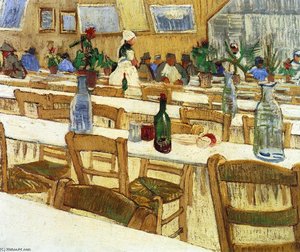 Interior of a Restaurant
A Captivating Glimpse into Parisian Life: Vincent van Gogh’s “Interior of a Restaurant” Vincent van Gogh's "Interior of a Restaurant," painted in 1887, isn’t merely a depiction of a bustling eatery; it’s a vibrant snapshot of everyday life imbued wit...
As we look back at the evolution of dining spaces, the Impressionist and Post-Impressionist masters offer the most profound lessons. Their obsession with capturing the fleeting essence of light and the emotional weight of everyday life provides a blueprint for modern hospitality. They taught us that an interior is not a static thing, but a living entity shaped by the sun, the shadows, and the human presence within it.
By studying how Van Gogh or Kandinsky approached the "interior" of a room—focusing on the energy of the subjects and the vibrancy of the palette—we learn that the most successful spaces are those that embrace emotional intensity. To dine in a space adorned with such historical depth is to participate in a long tradition of human connection. It invites the guest to slow down, to observe, and to savor not just the food, but the very atmosphere of history and art that surrounds them.