
The Enlightenment's Aesthetic Response: Moving Beyond Rococo Excess
 Illuminating the Enlightenment: Art & Sociopolitical Context of the 18th Century
The Rococo Spirit: Aristocratic Indulgence & Artistic Playfulness Wikipedia: Rococo Rococo, less commonly Roccoco ( rə-KOH-koh, US also ROH-kə-KOH; French: [ʁɔkɔko] or [ʁokoko] ), also known as Late Baroque, is an exceptionally ornamental and dramati...
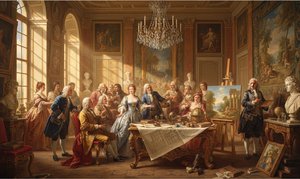
To truly grasp the profound impact of Neoclassicism, one must first envision a world emerging from the ornate, often overwhelming excesses of the Rococo period. For much of the early 18th century, European taste was captivated by the whimsical, the asymmetrical, and the overtly decorative. The Rococo style, with its swirling pastel flourishes and lighthearted subject matter, celebrated the ephemeral and the sensual, finding its home within the intimate, gilded salons of the French aristocracy. It was an era of playfulness, where art served as a backdrop for social indulgence and aristocratic leisure.
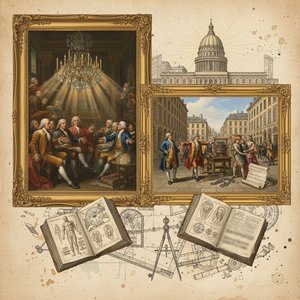
However, as the intellectual currents of the Enlightenment began to reshape the landscape of Europe, a new aesthetic hunger arose—a longing for clarity, restraint, and the unadorned truth found in the ancient worlds of Greece and Rome. This was not merely a change in decorative preference; it was a profound philosophical shift. As thinkers like Locke, Rousseau, and Voltaire championed logic over emotion and civic responsibility over aristocratic indulgence, art responded by seeking a more permanent, universal language. The movement sought to strip away the frivolous flourishes of the previous century, replacing them with a disciplined pursuit of truth through the lens of order and reason.
The Rediscovery of Antiquity: Pompeii, Herculaneum, and the Archaeological Spark
 The Revival of Antiquity: Exploring the Ideals & Innovations of Neoclassical Art
The Historical Context: Enlightenment Ideals & Archaeological Discoveries Wikipedia: Grand Tour The Grand Tour was the principally 17th- to early 19th-century custom of a traditional trip through Europe, with Italy as a key destination, undertaken by...
While the intellectual foundations of Neoclassicism were being laid by philosophers, the physical inspiration for the movement was unearthed from the very earth. The latter half of the eighteenth century witnessed remarkable archaeological discoveries that would forever alter the Western consciousness. The excavations at Pompeii and Herculaneum in the 1730s and 1740s unveiled entire Roman cities frozen in time, offering an unprecedented glimpse into the daily life, art, and architecture of antiquity. These findings were not merely historical curiosities; they were vibrant, tangible connections to a lost era of perceived perfection.
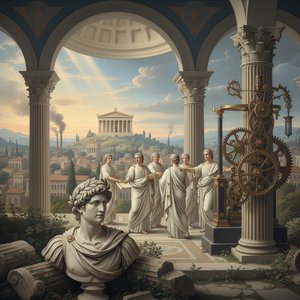
These discoveries ignited a passion for classical forms that spread rapidly across Europe. The sight of remarkably preserved frescoes and intricate mosaics provided concrete examples of a society believed to be governed by harmony and rational principles. This archaeological fever was further fueled by the Grand Tour, a traditional journey through Europe undertaken by upper-class young men. As these travelers returned from Italy with newly rediscovered Greco-Roman ideals, they brought back a renewed fascination with the purity of the ancient past, turning the weathered ruins of antiquity into a living blueprint for modern excellence.
Principles of Neoclassicism: Harmony, Clarity, and Moral Gravity in Art
--- title: Neoclassicism - The Metropolitan Museum of Art author: Cybele Gontar url: https://www.metmuseum.org/essays/neoclassicism hostname: metmuseum.org description: The Neoclassical style arose from first-hand observation and reproduction of anti...
Neoclassicism in the visual arts is defined by an aesthetic attitude that invokes harmony, clarity, and universality. Unlike the dramatic chiaroscuro and emotional turbulence of the Baroque or the lightheartedness of the Rococo, Neoclassical art emphasizes a disciplined pursuit of beauty through structure. The movement drew heavily from the theoretical framework provided by scholars such as Johann Joachim Winckelmann, whose writings championed the "noble simplicity and quiet grandeur" of Greek art. This period marked an era where art was not simply meant to be beautiful; it was intended to instruct, to inspire, and to elevate the viewer toward higher moral ground.
In practice, this manifested as a preference for clean lines, smooth surfaces, and a controlled color palette. Artists sought to minimize visible brushwork to maintain the illusion of perfection and clarity. The subject matter often leaned toward themes of civic virtue, heroism, and sacrifice, reflecting the burgeoning sense of social responsibility within an era of revolution and reform. By focusing on idealized forms and balanced compositions, Neoclassical artists created works that felt timeless, transcending the fleeting fashions of their day to speak to the enduring values of human civilization.
Architectural Grandeur: The Revival of Greek and Roman Structural Ideals
 Neoclassical architecture
Neoclassical architecture, sometimes referred to as Classical Revival architecture, is an architectural style produced by the Neoclassical movement that began in the mid-18th century in Italy, France and Germany. It became one of the most prominent a...
The Neoclassical movement was equally transformative in the realm of architecture, manifesting as a "Classical Revival" that reshaped the skylines of Europe and the Americas. While previous eras like the Renaissance and Baroque had already attempted partial revivals of ancient styles, Neoclassicism aimed to strip away the heavy ornamentation of the Late Baroque to return to a purer, more authentic classical style. This architectural language emphasized the wall rather than dramatic light and shadow, favoring symmetry, simple geometry, and the rhythmic repetition of classical elements.
The influence of this movement can be seen in the use of Doric, Ionic, and Corinthian columns, pediments, and domes that suggest stability and permanence. This style became the preferred language for public buildings, museums, and civic monuments, as it perfectly embodied the ideals of the state: order, strength, and democratic tradition. From the grand facades of European chateaus to the monumental structures of Washington D.C., Neoclassical architecture remains one of the most prominent and enduring architectural legacies in the Western world, projecting an image of authority and intellectual rigor.
Neoclassical Portraiture: Capturing Psychological Depth and Civic Virtue
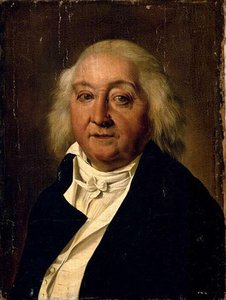 MONSIEUR HUBERT
Monsieur Hubert: A Portrait of Parisian Elegance Louis Léopold Boilly’s “Monsieur Hubert” stands as a quintessential example of Neoclassical portraiture, capturing the spirit of French society during the reign of Louis XVI and embodying an enduring f...
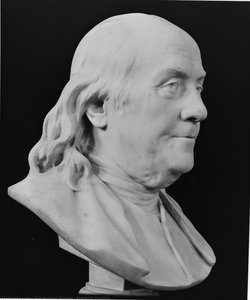
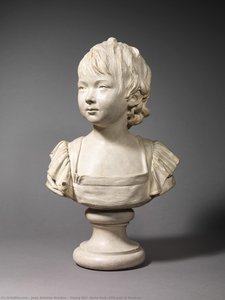
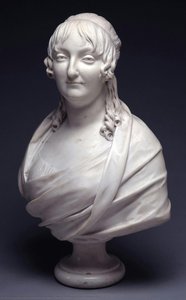
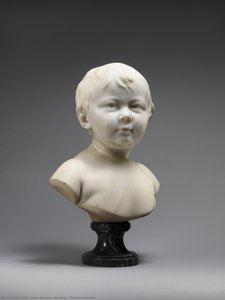
In the realm of portraiture, Neoclassicism achieved a fascinating balance between idealized beauty and profound psychological depth. While the movement sought to emulate the restraint of ancient art, it did not abandon the human element. Instead, it refined it. A quintessential example can be found in the works of artists like Louis Léopold Boilly or the sculptor Jean-Antoine Houdon. In his marble bust of Louis XVI, Houdon moved beyond mere likeness, using meticulously rendered features and subtle modeling to capture the very essence of the subject—his intelligence, his contemplative nature, and the weight of his responsibility.
Neoclassical portraiture often utilized a muted color palette—whites, grays, and beiges accented by subtle tones—to create a serene atmosphere that complemented the dignity of the sitter. Whether depicting the French bourgeoisie or royalty, these portraits prioritized realism and character over aristocratic flamboyance. The goal was to present a subject who embodied the virtues of their era: composure, intellect, and a quiet, dignified strength. This approach allowed the portrait to function as both a personal record and a social statement, capturing a moment suspended between tradition and the transformative forces of change.
The Enduring Legacy of the Classical Ideal in Modern Aesthetics
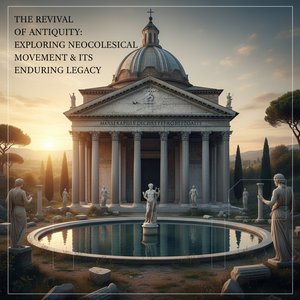 The Revival of Antiquity: Exploring the Neoclassical Movement & its Enduring Legacy
Introduction: The Allure of Classical Ideals Wikipedia: Neoclassicism Neoclassicism, also spelled Neo-classicism, emerged as a Western cultural movement in the decorative and visual arts, literature, theatre, music, and architecture that drew inspira...
The legacy of Neoclassicism extends far beyond the eighteenth century, leaving an indelible mark on the way we perceive beauty, order, and permanence. The movement’s emphasis on fundamental principles—symmetry, proportion, and clarity—continues to influence modern design, from classical revival architecture to contemporary minimalist aesthetics. It taught us that art could serve as a moral compass, a tool for education, and a vessel for the highest human aspirations.
Today, we continue to find inspiration in the disciplined elegance of this era. For those who wish to bring this sense of historical grandeur into their own lives, ArtsDot.com offers an unparalleled collection of museum-quality reproductions. Our master artists, holding degrees from prestigious academies, specialize in recreating these timeless masterpieces on 100% cotton canvas with meticulous attention to the original brushstrokes and tonal ranges. Whether you seek a hand-painted oil reproduction of a Neoclassical portrait or wish to transform a personal memory into a classical masterpiece through our custom services, we provide the bridge between history and your home. Discover the enduring power of order and reason through our curated collection of the world's most famous paintings.