
Introduction
To step into a gallery is to enter a silent dialogue with the masters, where light and pigment perform a delicate dance across the canvas. While some works of art command attention through sheer, overwhelming vibrance, there exists a more profound category of masterpieces: those celebrated for their balanced color intensity . These are the works that do not shout, but rather sing in a perfectly tuned harmony, where no single hue dominates to the point of exhaustion, and every shade serves a structural purpose within the composition.
Throughout art history, from the luminous, layered glazes of the Renaissance to the controlled chromatic experiments of the Impressionist era, the mastery of balance has been the hallmark of the true academic painter. This equilibrium is not merely an aesthetic choice; it is a sophisticated technical achievement. It requires an intimate understanding of color theory—knowing exactly how a muted ochre can anchor a brilliant ultramarine, or how a soft rose can breathe life into a deep, shadowed landscape without disrupting the visual peace.
<- Historical Resonance: These paintings reflect the cultural shifts of their eras, capturing the precise moment when artists moved from symbolic color usage to a more naturalistic, atmospheric perception.
- Enduring Meaning: In our modern, often visually fragmented world, these balanced compositions offer a sanctuary of order and tranquility, proving that stability in color can evoke deep emotional resonance.
As we journey through this curated selection, we will explore ten canonical works that exemplify this chromatic equilibrium. We will examine how the strategic use of saturation and value allows these paintings to remain eternally fresh, inviting the viewer to linger in their depths. Whether you are a student of art history or a collector seeking a centerpiece for your home, these masterpieces serve as the ultimate reference for how color, when mastered, can achieve a timeless, breathtaking stability.
Mona Lisa (La Gioconda) - Leonardo da Vinci
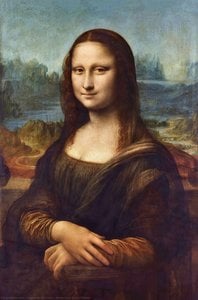 Mona Lisa (La Gioconda) - Leonardo da Vinci
In the realm of balanced color intensity, Leonardo da Vinci’s Mona Lisa stands as the ultimate masterclass in restraint. Rather than relying on jarring pigments, Da Vinci utilized his revolutionary sfumato technique—a smoky blurring of edges—to weave a tapestry of muted, earthy tones that breathe with life. The palette is a sophisticated harmony of soft ochres, deep umbers, and atmospheric blues that recede into a dreamlike distance.
This equilibrium of light and shadow creates a psychological depth where the subject’s enigmatic smile seems to shift with the viewer's gaze. There are no harsh boundaries here; only the delicate transition of translucent glazes that allow light to permeate the layers of oil paint. Owning a reproduction of this masterpiece is not merely a purchase; it is an inheritance of the High Renaissance spirit. At ArtsDot.com, we honor this lineage by offering hand-painted oil recreations that capture every subtle gradation and visible brushstroke, allowing you to bring this timeless legacy of taste directly onto your own walls.
Starry Night (New York, MoMA) - vincent willem van gogh
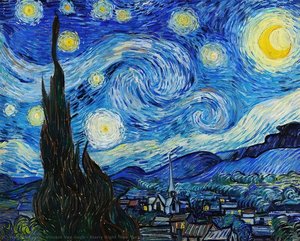 Starry Night (New York, MoMA) - vincent willem van gogh
While gazing through the iron bars of the Saint-Paul-de-Mausole asylum, Vincent van Gogh did not merely observe the night; he felt its pulse. Painted in 1889, Starry Night stands as a pinnacle of the Top 10 Artworks Celebrated for Their 'Balanced' Color Intensity because of its masterful command over chromatic tension. The work achieves a breathtaking equilibrium through the strategic use of complementary colors: the deep, nocturnal ultramarines and cobalt blues are set in vibrant opposition to the radiant, pulsating yellows of the crescent moon and celestial orbs.
This is not a flat depiction but a tactile experience of Post-Impressionist innovation. Through heavy impasto , Van Gogh’s thick, swirling brushstrokes create a rhythmic movement that balances cosmic turbulence with the quiet stability of the sleeping village below. The intense luminosity of the stars provides a focal point of hope amidst the dark, sweeping cypress tree. Bringing such a profound sense of dynamic energy and focused intention into a modern home office or study can inspire a sophisticated atmosphere of creativity and intellectual depth.
The Disintegration of Persistence of Memory, 1952-54 - Salvador Dalí
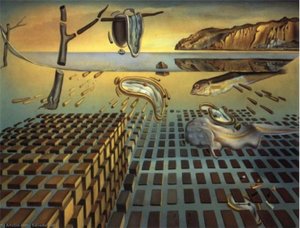 The Disintegration of Persistence of Memory, 1952-54 - Salvador Dalí
To gaze upon The Disintegration of the Persistence of Memory is to witness the very fabric of reality unraveling. Salvador Dalí does not merely paint a scene; he captures the profound, unsettling sensation of time losing its grip on our consciousness. This masterpiece earns its place among the top artworks celebrated for their balanced color intensity through its masterful use of a desaturated, earthy palette. The muted ochres, deep browns, and somber shadows create a heavy, melancholic atmosphere that perfectly mirrors the painting's themes of decay and existential fragmentation.
The brilliance lies in how Dalí balances these low-saturation tones with subtle, luminous highlights on the melting clocks, preventing the composition from sinking into total darkness. It is a visual meditation on stability versus chaos. At ArtsDot.com, we honor this technical precision through our handmade oil reproductions. Our artists utilize meticulous brushwork and authentic textures to ensure that the soft, diffused light and the haunting, balanced intensity of Dalí’s dreamscape are preserved, allowing you to invite this profound piece of Surrealist history into your own sanctuary.
The Scream - Edvard Munch
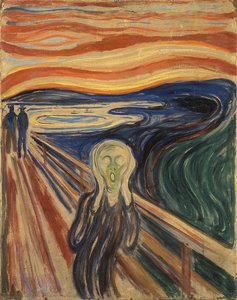 The Scream - Edvard Munch
In Edvard Munch’s 1893 masterpiece, The Scream , color does not merely decorate the canvas; it vibrates with a psychological frequency that defines the very essence of Expressionism. As one of our top 10 artworks celebrated for their balanced color intensity , this piece achieves a profound equilibrium between the fiery, apocalyptic oranges of the sky and the deep, melancholic blues of the fjord. This chromatic tension mirrors the internal struggle of the central figure, whose silent anguish is amplified by the swirling, rhythmic application of oil paint.
Munch’s ability to balance such high-octane warmth against chilling cool tones creates a visual vortex that remains a vital cultural talking point in modern interior curation. In an era often marked by digital noise and social fragmentation, the painting's raw, visceral energy offers a striking focal point for collectors seeking art that speaks to the human condition. Whether you are drawn to its historical significance or wish to bring its transformative energy into your home through a hand-painted oil reproduction , The Scream remains an unparalleled icon of emotional depth and chromatic mastery.
The Birth Of Venus - Sandro Botticelli
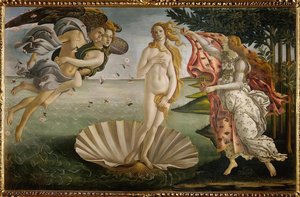 The Birth Of Venus - Sandro Botticelli
Sandro Botticelli’s The Birth of Venus stands as a pinnacle of the Italian Renaissance, offering a profound meditation on rebirth and the Neoplatonic ascent of the soul. The painting is a masterclass in what we define as balanced color intensity; rather than overwhelming the viewer with heavy pigments, Botticelli employs a luminous, ethereal palette. Soft, pastel flesh tones are harmoniously juxtaposed against the cool, translucent blues of the sea and the delicate greens of the shoreline, creating a visual equilibrium that feels both weightless and deeply grounded.
This delicate interplay of light and color avoids the jarring transitions found in more dramatic works, instead utilizing elegant linearity to guide the eye through a rhythmic dance of Zephyrus’s winds and falling rose petals. In modern curated interiors, this specific balance of soft hues and graceful movement serves as a timeless aesthetic anchor, providing a sense of calm sophistication. For those seeking to bring this historical serenity into their own collections, our hand-painted oil reproductions capture every subtle glaze and luminous contour, preserving the masterpiece's legendary spiritual grace.
Olympia - Édouard Manet
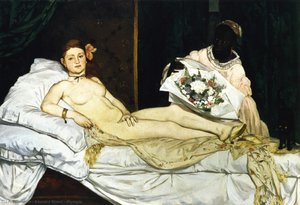 Olympia - Édouard Manet
Édouard Manet’s Olympia stands as a masterclass in what we define as balanced color intensity, where stark contrasts do not overwhelm but rather command the viewer's attention. In this 1863 revolutionary work, Manet eschews the muddy shadows of traditional academicism for a palette that vibrates with life. The luminous, pale tones of Olympia’s skin serve as a brilliant focal point, set against the deep, saturated blacks of her ribbon and the dark, velvety textures of the background.
This equilibrium of light and shadow—a precursor to Impressionism—creates a visual tension that is both unsettling and mesmerizing. The vibrant, multi-colored bouquet held by the attendant provides a necessary burst of organic warmth, preventing the composition from feeling clinical. For the modern collector, this painting offers an unparalleled architectural presence; its bold outlines and controlled tonal range integrate seamlessly into contemporary interiors, bringing a sense of historical weight and sophisticated drama to any curated space. To possess a hand-painted oil reproduction of this masterpiece is to invite a profound dialogue between classical realism and modern edge into your home.
American Gothic - Grant Wood
 American Gothic - Grant Wood
In the quiet, stoic gaze of American Gothic by Grant Wood, time seems to hold its breath, frozen in a moment of profound Midwestern dignity. This masterpiece earns its place among the top 10 artworks celebrated for their balanced color intensity through a masterful use of muted, earth-toned pigments that never overwhelm but instead ground the viewer in a sense of historical permanence. The palette—a sophisticated harmony of somber browns, dusty greens, and weathered grays—whispers of resilience and the steady rhythm of rural life.
Wood’s technique, heavily influenced by the precision of Flemish masters, utilizes light to shape thought, casting soft shadows that define the geometric rigidity of the pitchfork and the Carpenter Gothic window. There is a rhythmic equilibrium here; the intensity of the dark, textured clothing is perfectly offset by the pale, luminous skin tones and the stark white of the farmhouse. In a modern interior, such a balanced composition brings a sense of architectural calm and intellectual depth, offering a window into an era of enduring, quiet strength.
Number 1, 1949 - Paul Jackson Pollock
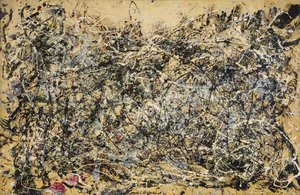 Number 1, 1949 - Paul Jackson Pollock
Acquiring Number 1, 1949 by Jackson Pollock is more than a mere purchase; it is an investment in the very legacy of modernism and a profound statement of refined taste for the discerning collector. As a cornerstone of Abstract Expressionism, this masterpiece exemplifies a rare equilibrium within its chaotic energy. While the "drip" technique suggests unbridled spontaneity, the work achieves a celebrated balance of color intensity through its sophisticated interplay of muted ochres, deep blacks, and sudden, rhythmic pulses of reddish-pink tones.
The painting’s historical provenance and its role in establishing New York as the epicenter of the avant-garde solidify its position among the top 10 most influential works of the 20th century. The dense, tactile layers of impasto create a non-representational landscape that invites endless contemplation. For those curating modern luxury interiors, a high-quality, hand-painted oil reproduction of this scale offers unparalleled aesthetic authority. Much like the original, our museum-grade recreations capture the visceral movement and textured depth of Pollock’s action painting, bringing a sense of monumental status and intellectual gravity to any sophisticated architectural space.
A Sunday Afternoon on the Island of La Grande Jatte - Georges Seurat
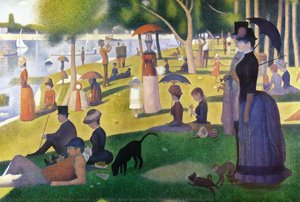 A Sunday Afternoon on the Island of La Grande Jatte - Georges Seurat
To experience A Sunday Afternoon on the Island of La Grande Jatte by Georges Seurat is to witness a scientific marvel rendered in pigment. Up close, the surface reveals not fluid strokes, but a meticulous mosaic of tiny, distinct dots—the essence of Pointillism. This revolutionary technique avoids physical blending, instead relying on optical mixing where the eye perceives a luminous, balanced color intensity from a distance. The soft greens of the parkland and the sun-drenched blues of the Seine emerge from these discrete points of pure color, creating a shimmering, atmospheric light that feels both static and alive.
This delicate interplay of light and shadow makes Seurat’s work a cornerstone of our selection of artworks celebrated for their balanced color intensity. At ArtsDot.com, we strive to preserve this tactile, three-dimensional quality. Our hand-painted oil reproductions utilize heavy impasto techniques to recreate the physical texture of every dot, ensuring that the vibrant, luminous depth of Seurat’s vision is captured with academic precision for your collection.
Adoration of the Trinity (Landauer Altar) - Albrecht Dürer
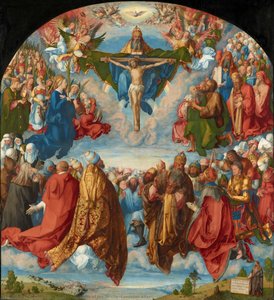 Adoration of the Trinity (Landauer Altar) - Albrecht Dürer
In Albrecht Dürer’s 1511 masterpiece, the Adoration of the Trinity , we witness a profound equilibrium of chromatic weight and spiritual light. This monumental work from the Landauer Altar avoids the overwhelming saturation often found in late Gothic works; instead, it achieves a balanced color intensity through a sophisticated interplay of ethereal golds, deep liturgical reds, and the soft, naturalistic tones of Nuremberg’s earthly figures. Dürer utilizes a luminous, Venetian-inspired palette to bridge the gap between the divine and the human, where the radiant glow surrounding Christ is tempered by the grounded, earthy hues of peasants and saints alike.
Owning a piece of this legacy isn’t merely a purchase; it is an inheritance . To display such a work is to participate in a lineage of taste that spans centuries. At ArtsDot.com, we bring this museum-grade experience to your private collection through meticulous, hand-painted oil reproductions. Every brushstroke on our cotton canvas captures the precise tonal range and symbolic depth of Dürer’s vision, allowing you to host a handshake across centuries right on your own walls.
Conclusion
As the light fades on our journey through these ten masterpieces, we are reminded that a painting’s true power lies not merely in its pigment, but in its ability to hold a delicate equilibrium between tension and peace. These works—defined by their balanced color intensity—do more than occupy space; they breathe within it. They serve as silent, rhythmic pulses of history that continue to move the human heart, bridging the gap between the centuries and our modern lives through a shared language of light and shadow.
For the discerning designer, the architect, or the collector of fine spaces, these canvases offer much more than aesthetic beauty; they provide a foundation for storytelling within the most refined interiors. Whether you are curating the atmosphere of a boutique hotel, a private villa, or a sophisticated corporate lounge, ArtsDot.com acts as your dedicated creative partner. We understand that a project of architectural significance requires more than mere decoration—it requires an artistic statement. Through our professional digital mockup services, we allow you to visualize these historical textures on your specific walls before a single brushstroke is applied, ensuring that every hue and composition aligns perfectly with your vision.
From bespoke multi-panel installations that transform wide staircases into cinematic experiences, to custom commissions that reimagine personal memories through the lens of the masters, our mission is to bring the museum experience into the sanctuary of the home. We invite you to explore our full collection and discover how the enduring harmony of these canonical works can become the soul of your next great design endeavor.