
The Renaissance Dawn: Harmony, Proportion, and the Revival of Classical Ideals
 Timeless Elegance: A Connoisseur's Guide to the Italian Renaissance Art Movement
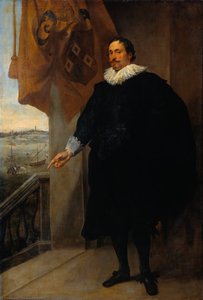
The Dawn of Humanism: Rediscovering Classical Antiquity Renaissance The Renaissance (UK: rin-AY-sənss, US: REN-ə-sahnss) was a European period of history and cultural movement taking place at the end of the Late Middle Ages and the beginning of the e...
To understand the profound resonance of the Italian Renaissance, one must first look back into the shadows of the Middle Ages, an era where art served primarily as a vessel for spiritual instruction rather than an exploration of the human condition. As the 14th century gave way to the 15th, a revolution in perception and expression began to stir within the Italian peninsula. This was the birth of rinascita—a rebirth. Driven by the burgeoning philosophy of Humanism, artists began to turn their gaze toward the beauties of life on earth, rediscovering the lost wisdom of Classical antiquity. This movement was not merely a change in aesthetic preference but a fundamental shift in how humanity viewed its place within the cosmos.
The early Renaissance, flourishing first in the cradle of Florence, sought to anchor itself in the noble traditions of ancient Greece and Rome. Architects and painters alike became obsessed with the principles of symmetry, proportion, and geometry. The works of innovators like Filippo Brunelleschi revolutionized the urban landscape, replacing the irregular profiles of Gothic structures with the orderly arrangements of columns, pilasters, and semicircular arches. This pursuit of mathematical perfection was a conscious effort to mirror the divine order of the universe through human intellect. In this era, beauty was found in balance; every line and every shape was calculated to evoke a sense of stability and eternal truth, creating a visual language that felt both grounded in history and profoundly forward-looking.
High Renaissance Mastery: The Divine Precision of Raphael and Michelangelo
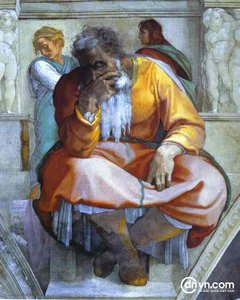 The Prophet Jeremiah
Introduction Michelangelo Buonarroti's The Prophet Jeremiah is a masterpiece of the Italian High Renaissance, painted on the Sistine Chapel ceiling in Vatican City. This article will explore the painting's history, context, and significance, providin...
As the 15th century drew to a close, the artistic landscape reached its apotheosis during the High Renaissance. This brief but brilliant period, spanning roughly from 1490 to 1520, represented a pinnacle of exceptional production where the technical mastery of anatomy, perspective, and light achieved a state of near-perfection. In the heart of Rome, under the ambitious patronage of Pope Julius II, the world witnessed the emergence of titans whose names would become synonymous with greatness itself.
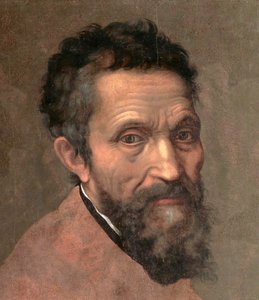
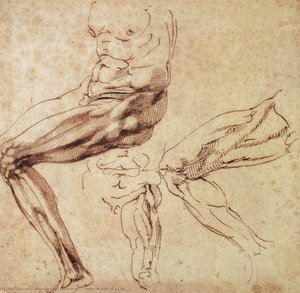
Consider the sublime works of Raphael, whose brushwork embodied the Neoplatonic ideal of human grandeur. Within the Stanze Vaticane, his frescoes—such as the breathtaking The Parnassus—showcase a mastery of composition that feels effortless yet is mathematically rigorous. His ability to blend religious devotion with a serene, classical clarity allowed him to create figures that possessed both physical weight and spiritual grace. Simultaneously, the monumental presence of Michelangelo Buonarroti redefined the limits of human expression. In his depiction of The Prophet Jeremiah on the Sistine Chapel ceiling, we see a profound exploration of the human form. Through the sophisticated use of chiaroscuro—the dramatic interplay of light and shadow—Michelangelo imbued his figures with an anatomical accuracy and emotional depth that could move the soul to tears. His work was not merely a depiction of man, but a celebration of the muscular, spiritual struggle of existence.
Venetian Luminosity: The Poetic Use of Color and Light in the Venetian School
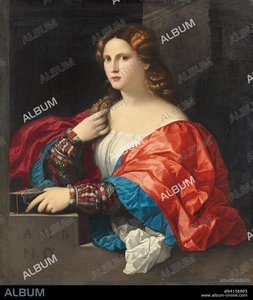 jacopo palma the elder
The Emergence of a Venetian Visionary In the vibrant landscape of the Italian High Renaissance, few figures capture the transition from tradition to innovation as gracefully as Jacopo Palma the Elder. Born in the serene surroundings of Serina Alta, n...
While Rome and Florence pursued the intellectual rigor of line and form, the Venetian Republic cultivated a different, more sensory magic. The Venetian school, led by visionaries such as Jacopo Palma the Elder, moved away from the rigid, disciplined structures of their contemporaries toward a more fluid and emotive style. This was an art of atmosphere, where the very air seemed to shimmer with the moisture of the lagoons.
The mastery of the Venetians lay in their unparalleled command of color and light. Influenced by the luminous stability of Giovanni Bellini and later the revolutionary spirit of Titian, artists like Palma the Elder developed a painterly capacity where pigment itself became a language of emotion. Their works often featured pastoral mythologies and soft, atmospheric landscapes that blended legend with reality. In their portraits, one finds a tantalizing beauty; the skin tones are luminous, and the textures of velvet and silk are rendered with such tactile precision that the viewer can almost feel the warmth of the light. This Venetian approach prioritized the colore over the Florentine disegno, creating a space where beauty and sensuality could coexist in perfect, painterly harmony, inviting the observer into a dreamlike state of contemplation.
The Baroque Revolution: Emotional Intensity and the Drama of Chiaroscuro
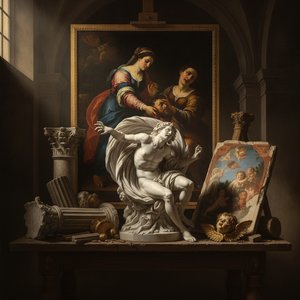 Italian Baroque Unlocked: High-Drama Art That Hits Hard
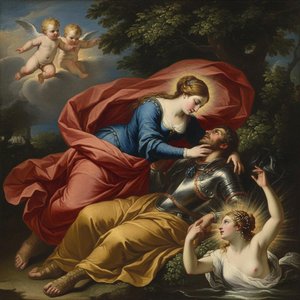
The Great Reset: Moving from Renaissance Calm to Baroque Chaos The Visceral Stage: Exploring Dramatic Narratives & Emotional Intensity in Baroque Art The Baroque Embrace of Emotion: A Shift from Renaissance Rationality Wikipedia: Baroque painting Bar...
If the Renaissance was an era of reason and calm, the Baroque movement was an artistic earthquake that shattered that tranquility. Emerging from 17th-century Rome, the Baroque did not reject the principles of the past but rather expanded them into a realm of high drama and visceral energy. The transition was akin to moving from a perfectly composed, static photograph to a high-intensity cinematic sequence. This was an era defined by the Counter-Reformation and the rise of Absolutism, where art was used to command immediate emotional impact and spiritual awe.
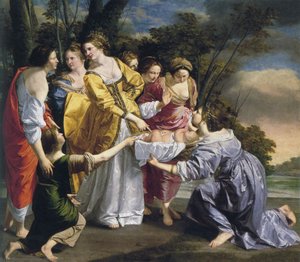
The hallmark of this period is the embrace of tension, movement, and the profound use of tenebrism. The stability of Renaissance proportion gave way to a new aesthetic of psychological crisis. Artists utilized extreme contrasts between deep, swallowing shadows and piercing shafts of light to pull the viewer into the center of the narrative. This technique of chiaroscuro transformed the canvas into a stage, where every brushstroke served to heighten the sense of urgency and drama. The Baroque artist no longer sought to depict a scene that one simply observes; they strived to create an experience that one feels with their entire being, capturing moments of profound transformation, martyrdom, or divine intervention with an intensity that remains unmatched in the history of Western art.
Architectural Grandeur: The Symbiosis of Space, Sculpture, and Painted Splendor
 Renaissance architecture
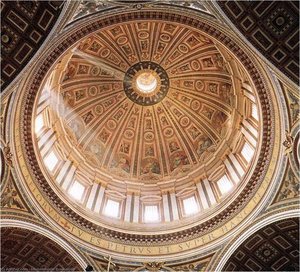
Renaissance architecture is the European architecture of the period between the early 15th and early 16th centuries in different regions, demonstrating a conscious revival and development of certain elements of ancient Greek and Roman thought and mat...
The true majesty of Italian art history is perhaps best experienced when one considers the seamless integration of painting, sculpture, and architecture. In the great palaces and cathedrals of Italy, art was never an isolated ornament; it was a fundamental component of the structural narrative. The architectural triumphs of the era—characterized by domes, columns, and harmonious facades—provided the essential stage for the decorative arts to flourish.
In spaces like the Stanze Vaticane or the magnificent choir stalls of the Cathedral of Barcelona, we see how sculptural programs and fresco cycles work in a symbiotic relationship. The heavy, marble textures of Renaissance sculpture, such as the works inspired by the refined elegance of Bartolomé Ordóñez, provided a physical weight that anchored the ethereal beauty of the ceiling frescoes. This interplay created an immersive environment where every niche, pilaster, and painted cloud contributed to a unified sense of grandeur. For the modern connoisseur, this reminds us that true luxury lies in the cohesion of elements—the way a well-placed sculpture can command a room just as effectively as a sweeping mural, creating a space that feels both historically significant and architecturally profound.
Curating Heritage: Integrating Italian Masterpieces into Modern Luxury Interiors
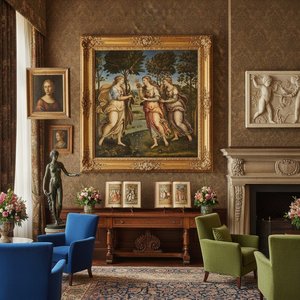 Italian Renaissance Art: A Procurement Guide to Timeless Masterpieces for High-End Hotel Interiors
The Renaissance Aesthetic: Integrating Classical Grandeur into Modern Hospitality Design Renaissance art Renaissance art (1350 – 1620) is the painting, sculpture, and decorative arts of the period of European history known as the Renaissance, which e...
For the discerning interior designer or the affluent homeowner, the legacy of Italian art offers an unparalleled toolkit for creating spaces that transcend mere luxury to achieve true timelessness. Integrating these classical aesthetics into a modern environment is not simply about decoration; it is about establishing a narrative of permanence and cultural sophistication. Whether through the placement of a large-format mural that recreates the splendor of a Renaissance ceiling or the curation of fine oil reproductions that evoke the warmth of the Venetian school, art serves as the silent ambassador of a space's prestige.
In high-end hospitality and residential design, the challenge lies in creating an atmosphere that resonates with a global, sophisticated audience. By selecting works that reflect the Renaissance fascination with antiquity—emphasizing balance, proportion, and humanistic ideals—one can evoke an immediate sense of historical weight. The modern application of these masterpieces can be achieved through various mediums, from bespoke hand-painted oil reproductions on 100% cotton canvas to large-scale architectural frescoes. When art is chosen with intentionality, it transforms a room into a sanctuary of culture, inviting guests and residents alike to participate in a continuous dialogue with the greatest masters of history.