 Pregledaj u prostoru
 Pošalji
 Podeli
 Detalji o delu

 Преузми
 Slični predmeti
 Rendgenski snimak
 Slajdovi
Speak not always of the leaves, op. 15/14
 Akril na platnu
- Umetnost za zidove
- Twelve-tone technique; Expressionism
 1909
1909 25.0 x 34.0 cm
 Arnold Schönberg Center
 Pročitaj više
Giclee štampa / Umetnički otisak
Giclée štampa ili print na platnu muzejskog kvaliteta uz brzu proizvodnju i fleksibilne opcije završne obrade. ( Kupi ručno naslikanu sliku Kupi digitalnu sliku)




P118B $10

P118H $10

P118W $10

P438Z $10

P508JH $12

P508YH $12

P805H $10

P805Z $10

P919BZ $10

P919G $10

P919XJ $10

P959ZH $10

P968JZ $12

W106C $8

W218G $10

W218JH $8

W218Y $10

W307PJ $10

W316G $10

W316PJ $8

W316Y $10

W398PJ $8

W4111J $10

W500HY $15

W500JH $15

W692G $12

W849H $8

W940BG $15

W953PJ $8




Izaberite jednu od naših unapred definisanih veličina koje odgovaraju originalnim proporcijama umetničkog dela.

Možete uneti sopstvene dimenzije kako biste umetničko delo prilagodili specifičnom okviru ili prostoru. Ako odabrani format ne odgovara proporcijama originalne slike, mi ćemo ili iscrtati deo dela ili proširiti sliku pomoću ogledane ivice ili jednobojnog popunjavanja. Digitalni prikaz će vam biti poslat na odobrenje pre početka proizvodnje.
Imajte na umu da pregled na ekranu ne odražava stvarno iscrtavanje ili proširivanje. Samo će prikaz (mockup) precizno pokazati finalnu kompoziciju.
Iako su prilagođene dimenzije dostupne, preporučujemo da odaberete dimenziju sa unapred definisane liste kako biste očuvali originalne proporcije.
Dostava širom sveta () za 2 nedelje umesto uobičajenih 4/5 nedelja. (27 август)

Besplatna ekspresna dostava širom sveta

Visokokvalitetno laneno platno

Kompletno osiguranje transporta

Garancija povraćaja carine i uvoznih dažbina

Garancija vernosti boja

Politika povrata u roku od 60 dana (samo u slučaju nedostataka)

Garancija povrata novca od 100%

Popust pri grupnoj kupovini
 Opcija sa staklom dostupna je samo za dimenzije manje od 110 cm

Speak not always of the leaves, op. 15/14
Giclee štampa / Umetnički otisak
Dimenzije reprodukcije
-


Konačna cena
$ 62
Speak not always of the leaves, op. 15/14 – A Symphony of Loss and Transformation
The Book of the Hanging Gardens stands as an indelible mark on musical history—a defiant proclamation of atonality against the established tonal conventions of its time and a poignant distillation of Stefan George’s melancholic poetry. Composed in 1908-1909 during Arnold Schoenberg's profoundly personal crisis – marked by his separation from Mathilde Gerstl – this fifteen-part song cycle transcends mere musical form; it embodies the composer’s innermost contemplation and disillusionment, mirroring the Expressionist movement’s fervent embrace of emotional intensity.- Historical Context: Schoenberg's artistic trajectory coincided with a seismic shift in European culture. The Expressionist movement challenged bourgeois sensibilities, prioritizing subjective experience and confronting anxieties about societal decay—a spirit that found its musical counterpart in the rejection of tonal harmony. While Schoenberg himself rarely articulated “Expressionism” as an aesthetic label, *Speak not always of the leaves* undeniably embodies its core tenets: a visceral engagement with emotion and a deliberate dismantling of traditional artistic conventions.
- Poetic Inspiration: At the heart of this musical masterpiece lies Stefan George’s poetry—specifically his collection *Die Buecher der Hirten- und Preisgedichte der Sagen und Saenge und der haengenden Gaerten*. These verses chronicle a doomed romance between two adolescent youths amidst the opulent beauty of a garden, culminating in its desolate demise. George's narrative serves as a visual metaphor powerfully translated into musical form—a deliberate echo of Schoenberg’s own emotional turmoil during this pivotal period.
- Musical Technique: Schoenberg’s revolutionary approach to atonality – rejecting tonal harmony altogether – wasn’t merely stylistic experimentation; it represented a fundamental reimagining of musical possibility. Employing twelve-tone technique, he meticulously arranged notes to avoid any dominant key center, creating a sonic landscape mirroring the poem's pervasive sense of decay and fragmentation. This method demanded an uncompromising commitment to dissonance and textural innovation—a characteristic that distinguishes *Speak not always of the leaves* from its predecessors.
- Stylistic Characteristics: The song cycle’s remarkable brevity – consisting solely of fifteen pieces – underscores Schoenberg’s signature aesthetic sensibility for aphoristic expression. Each song operates as an independent musical thought or mood, capturing fleeting moments of emotion with breathtaking precision and distilling the composer's profound artistic vision into condensed sonic gestures.
- Emotional Impact: The music evokes a palpable sense of sorrow and longing—a reflection of George’s poem’s tragic narrative. Sparse textures and dissonant harmonies convey vulnerability and despair, prompting listeners to contemplate themes of loss, transformation, and the ephemeral beauty of existence. It is precisely this emotive resonance that elevates *Speak not always of the leaves*, op. 15/14 beyond mere musical notation—transforming it into a poignant testament to Schoenberg’s artistic genius and his unwavering pursuit of an ideal expression.
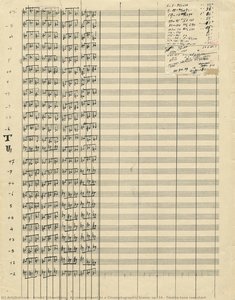
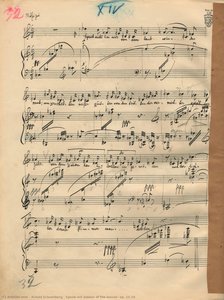
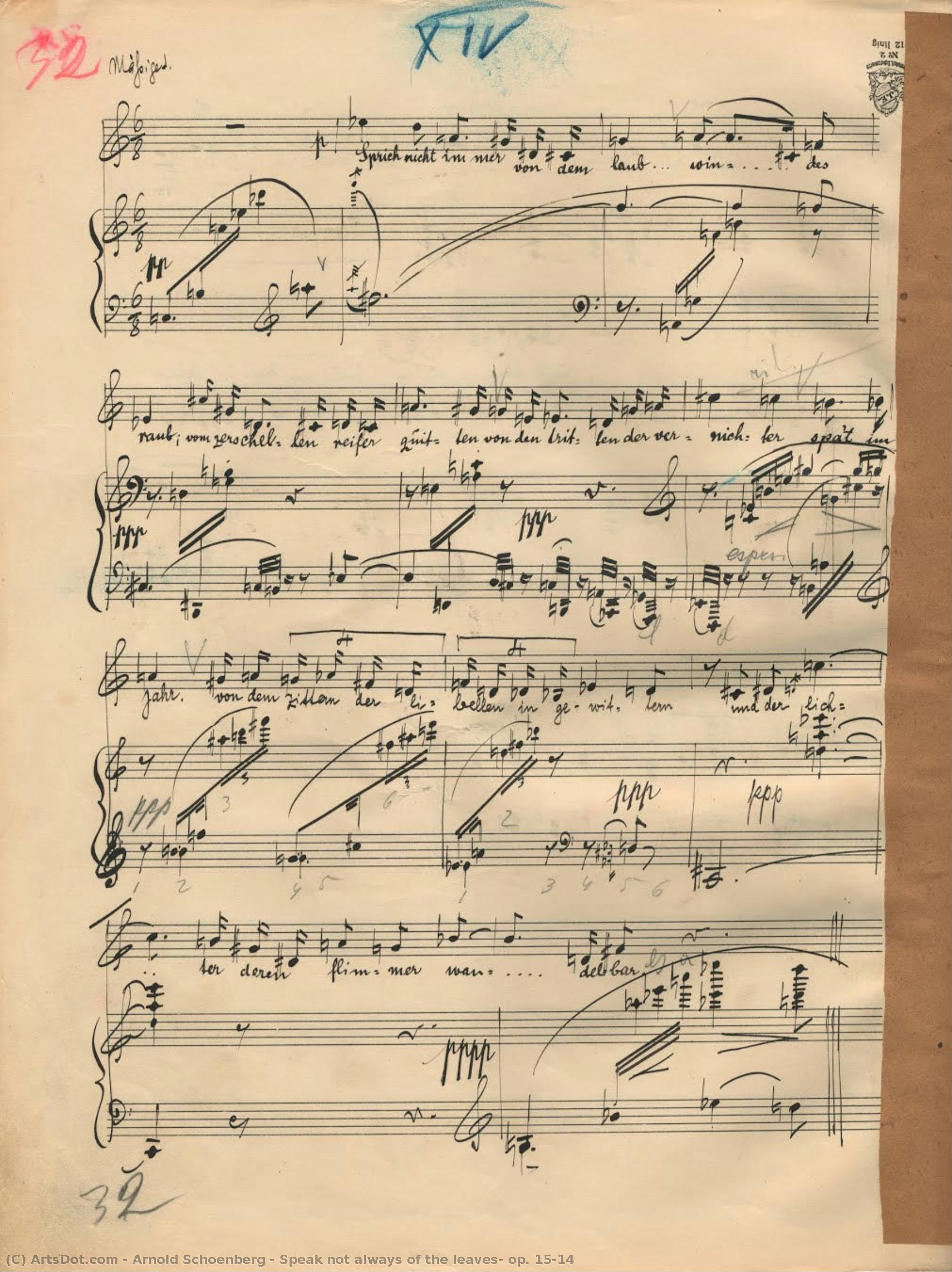
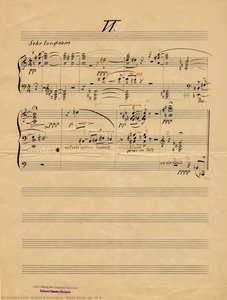
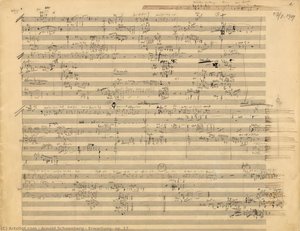
The image accompanying this description – a close-up of a piano sheet music page – exemplifies Schoenberg's meticulous craftsmanship. Handwritten annotations offer insight into his creative process, highlighting the composer’s dedication to achieving an ideal of expression and form that transcended conventional musical conventions.
Measuring 25 x 34 cm, *Speak not always of the leaves*, op. 15/14 is a monumental achievement in musical innovation—a hauntingly beautiful reflection of George’s poetry and Schoenberg's personal journey toward artistic liberation.
Srodna umetnička dela
Biografija umetnika
Rano doba i muzički počeci
Arnold Šonberg, austrijsko-američki kompozitor, rođen je 13. septembra 1874. godine u Beču, u Austriji. Njegovo rano detinjstvo obeležili su skromni počeci, jer je njegov otac bio vlasnik prodavnice obuće. Uprkos tome, Šonbergova urođena strast prema muzici navela ga je da se u toj oblasti uglavnom samobrazuje.Muzička evolucija i značajna dela
Šonbergova rana dela, poput kompozicije Verklärte Nacht (1899), pokazivala su sintezu Brahmsovog i Wagnerovog stila. Kako je napredovao, postao je centralna figura Druge bečke škole, zajedno sa Anton Webernom i Alban Bergom. Njegove kompozicije, uključujući Gudački kvartet br. 2 (1907–1908), Erwartung (1909) i Pierrot Lunaire (1912), predstavljale su njegov inovativni pristup atonality.Podučavanje, emigracija i kasniji život
Šonberg je podneo ostavku iz Pruske akademije umetnosti 1933. godine zbog uspona nacista na vlast, koji su njegovu muziku označili kao „degenerisanu“. Nakon toga je predavao u SAD, uključujući Univerzitet Kalifornije u Los Anđelesu (1936–1944), gde su mnogi objekti nazvani po njemu u znak počasti. [https://ArtsDot.com/@/arnold-sacijaenberg](otkrijte više o Šonbergovom životu i delima na ArtsDot).- Šonberg je istraživao filmsku muziku i pisao tonalniju muziku, završivši svoju kamernu simfoniju br. 2 u 1939. godini.
- Satiričario je fašističke tirane u delu Oda Napoleonu (1942), inspirisan Bajronom.
- Posleratni Beč ponudio mu je počasno građanstvo, ali bio je bolestan, što je prikazano u njegovom gudačkom trio (1946).
Nasleđe i uticaj
Dok je svet saznavao za Holokaust, Šonberg je ovekovečio njegove žrtve u delu Preživeli iz Varšave (1947). Izraelska konzervatorijum i akademija muzike izabrali su ga za počasnog predsednika 1951. godine. [https://ArtsDot.com/@@/a@d3bqc7-the-museum-destroyed-by-fire-(united-states)](saznajte više o uticaju njegovog rada na ArtsDot). Ključne tačke:- Šonbergova inovativna muzika bila je među najuticajnijim i najkontroverznijim delima klasične muzike 20. veka.
- Najmanje tri generacije kompozitora proširilo je njene formalne principe.
- Njegovi estetski i muziko-istorijski stavovi uticali su na muzikologe Teodora W. Adorna i Karla Dahlhausa.
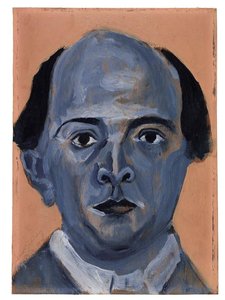
Arnold Šonberg
1874 - 1951 , Austrija
Osnovne informacije
- Artistic Movement Or Style: Dvanaestotonna tehnika; Ekspresionizam
- Artists Or Movements Influenced By This Artist:
- Anton Vebern
- Alban Berg
- Artists Who Influenced This Artist:
- Johannes Brahms
- Richard Wagner
- Date Of Birth: 13. septembar 1874.
- Date Of Death: 1951.
- Full Name: Arnold Šonberg
- Nationality: Austroamerički
- Notable Artworks:
- Svita, op. 29
- Muzička pisaća mašina
- Staffliner
- Place Of Birth: Beč, Austrija
Povezani članci

Georges Braque: 25 Remek-dela Kubizma za Inspirisanje Vašeg Doma | ArtsDot
Istražite 25 remek-dela Georges Braquea, pionira kubizma. Otkrijte priče iza slika, tehnike i inspiraciju za dizajn enterijera. Reprodukcije vrhunskog kvaliteta dostupne na ArtsDot.com! Pronađite savršeno umetničko delo online.

25 Remek-dela Žorža Seurea: Putovanje kroz Svet Tačizma i Impresionističke Revolucije
Istražite 25 remek-dela Žorža Seurea i uronite u svet tačizma i impresionističke revolucije. Otkrijte priče iza slika, tehnike i inspiraciju ovog francuskog umetnika. Reprodukcije vrhunskog kvaliteta dostupne na ArtsDot.com!
John George Brown: Capturing American Life & Sentiment in 19th-Century Genre Painting
Explore the captivating genre paintings of John George Brown, celebrated for his realistic depictions of 19th-century American life. Discover his legacy & find museum-quality reproductions at ArtsDot.
Sir George Clausen: Capturing Edwardian Life & British Impressionism's Nuances
Explore the luminous world of Sir George Clausen, a leading British Impressionist painter. Discover his captivating scenes of Edwardian life, rural England & poignant war art. Learn about his legacy and find high-quality reproductions at ArtsDot.
George Stubbs: Anatomical Precision & Romantic Vision in 18th-Century British Art
Explore the captivating world of George Stubbs, the 18th-century master renowned for his anatomical precision & Romantic animal paintings. Discover his legacy and investment potential.