

 Pregledaj u prostoru
 Pošalji
 Podeli
 Detalji o delu

 Преузми
 Slični predmeti
 Rendgenski snimak
 Slajdovi
The Lunch
 Oil On Canvas
- WallArt
- Nuevo Realismo
 1971
1971- Modern
 210.0 x 400.0 cm
 Colección de Arte Amalia Lacroze de Fortabat
 Pročitaj više
Ručno rađena uljana reprodukcija
Ručno oslikano uljanim bojama na platnu u dimenzijama i okviru po vašem izboru, izrađeno po porudžbini od strane naših umetnika. ( Kupi print Kupi digitalnu sliku)




P118B $10

P118H $10

P118W $10

P438Z $10

P508JH $12

P508YH $12

P805H $10

P805Z $10

P919BZ $10

P919G $10

P919XJ $10

P959ZH $10

P968JZ $12

W106C $8

W218G $10

W218JH $8

W218Y $10

W307PJ $10

W316G $10

W316PJ $8

W316Y $10

W398PJ $8

W4111J $10

W500HY $15

W500JH $15

W692G $12

W849H $8

W940BG $15

W953PJ $8




Izaberite jednu od naših unapred definisanih veličina koje odgovaraju originalnim proporcijama umetničkog dela.

Можете унети сопствене димензије како бисте прилагодили дело одређеном оквиру или простору. Ако одабрана величина не одговара пропорцијама оригинала, слика ће бити исечена или проширена додатним елементима који се ручно насликавају. Дигитални prikaz ће вам бити послат на одобрење пре почетка производње.
Имајте на уму да преглед на екрану не одражава стварно исецање или проширење. Само приказ (mockup) ће тачно приказати коначну композицију.
Иако су доступне прилагођене величине, препоручујемо да одаберете димензију из дефинисане листе како бисте сачували оригиналне пропорције.
Nakon narudžbine, tim ArtsDot.com će klijentu putem e-pošte poslati uputstva i dostaviti prikaz predloženog rešenja
Isporuka širom sveta () za 3/4 nedelje umesto uobičajenih 5 nedelja. (6 септембар). Bez kompromisa po pitanju kvaliteta.

Besplatna ekspresna dostava širom sveta

Visokokvalitetno laneno platno

Kompletno osiguranje transporta

Garancija povraćaja carine i uvoznih dažbina

Garancija vernosti boja

Politika povrata u roku od 100 dana (samo u slučaju nedostataka)

Garancija povrata novca od 100%

Popust pri grupnoj kupovini
 Opcija sa staklom dostupna je samo za dimenzije manje od 110 cm

The Lunch
Tehnika reprodukcije
Dimenzije reprodukcije
-


Konačna cena
$ 263
A Symphony of Domesticity: The Heart of the Gathering
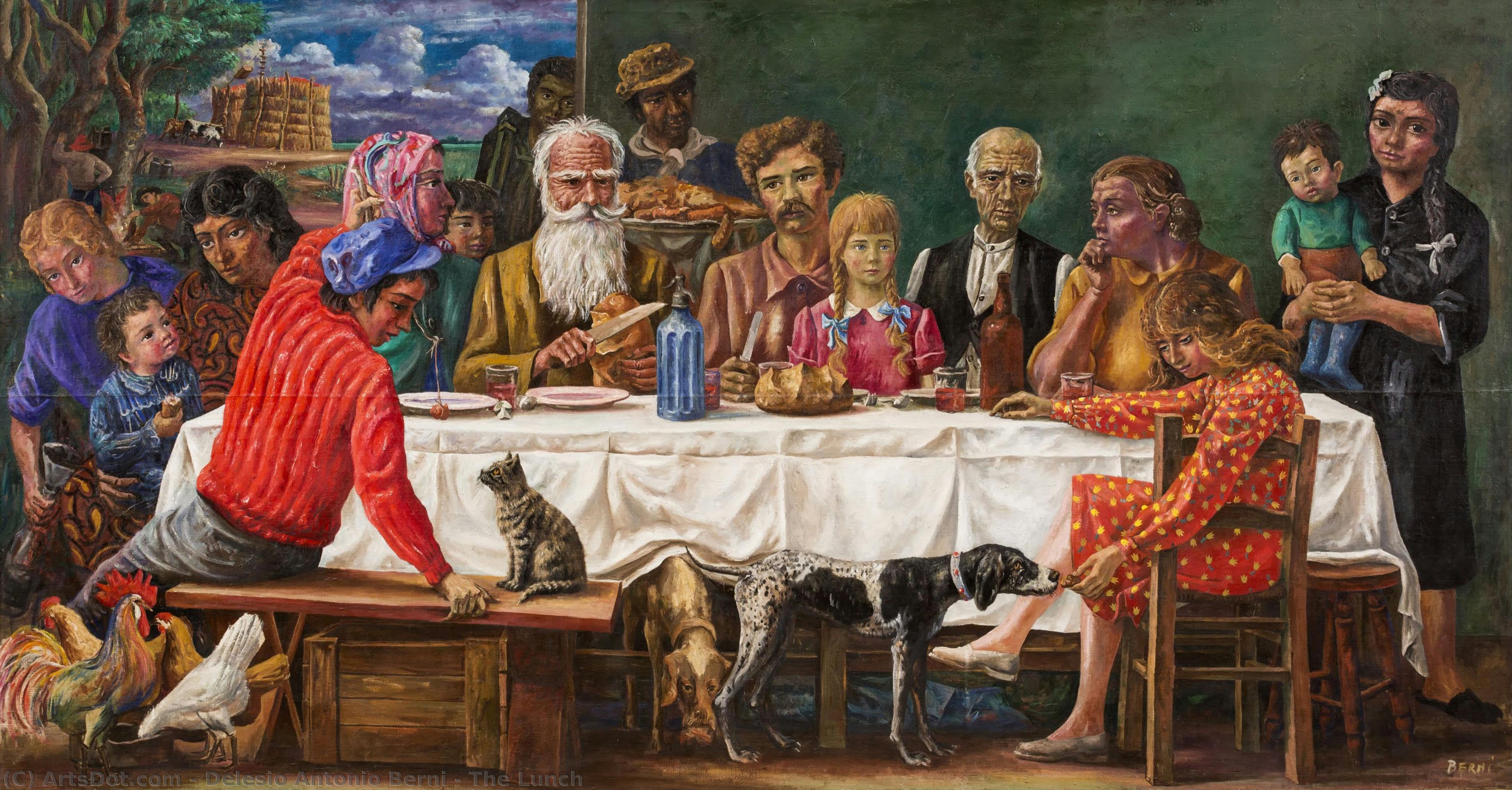
In the sprawling, monumental canvas of The Lunch, we are invited into a moment that feels both profoundly intimate and grandly cinematic. Created in 1971 by the master of Argentine social realism, Delesio Antonio Berni, this work captures a large family gathering that transcends a mere meal to become a celebration of life itself. The scene is teeming with movement; children and adults occupy a long dining table laden with the humble yet essential artifacts of sustenance—plates, cups, bowls, and bottles. As your eyes wander across the 210 x 400 cm expanse, you encounter the quiet observers of this human drama: a cat resting near the table's edge and birds that drift through the composition, one perched precariously on a chair while another soars above the feast. It is a masterpiece of composition that balances the chaotic energy of a crowd with the rhythmic stillness of a domestic ritual.
The atmosphere is thick with warmth, evoking a sense of nostalgia and communal belonging. There is a palpable texture to the air, as if one could smell the shared food and hear the overlapping melodies of conversation and laughter. For the discerning collector or interior designer, this piece serves as a powerful focal point, offering a narrative depth that anchors a room. It does not merely decorate a wall; it populates a space with history and soul, making it an ideal selection for those looking to infuse a contemporary setting with the timeless, lived-in spirit of 20th-century Argentine excellence.
The Mastery of Nuevo Realismo and Social Texture
To understand The Lunch, one must look through the lens of Berni’s profound commitment to Nuevo Realismo. While many artists of his era sought abstraction, Berni remained tethered to the tangible world, using his brush to document the social fabric of Argentina. His technique in this later work demonstrates a sophisticated command over light and form, creating a sense of volume that makes every object on the table feel heavy with reality. The interplay of shadows and highlights across the faces of the family members lends a sculptural quality to the figures, pulling them forward from the background where a solitary clock hangs, marking the passage of time against the eternal nature of the gathering.
The emotional impact of the painting lies in its ability to find the extraordinary within the ordinary. Berni utilizes a rich, layered approach that invites close inspection, revealing how the mundane elements of a meal—the glint of a spoon or the curve of a pitcher—contribute to a larger symbolic tapestry of survival and joy. For those seeking a high-quality reproduction, the essence of this work lies in its ability to replicate these subtle nuances, bringing the heavy, emotive brushwork and the vibrant, communal energy of Berni’s vision into the modern home.
A Timeless Legacy for the Modern Collector
Investing in a reproduction of The Lunch is an engagement with the legacy of one of South America's most vital artistic voices. Berni’s ability to weave social commentary with such profound humanism ensures that his work remains relevant across generations. This painting stands as a testament to the resilience of the family unit and the beauty found in shared existence. Whether placed in a grand gallery-style dining room or a sophisticated living space, the artwork acts as a window into a world where every meal is a ceremony and every gathering is an act of connection.
Srodna umetnička dela



Biografija umetnika
The Soul of Argentine Realism: The Life and Legacy of Antonio Berni
Delesio Antonio Berni stands as a monumental figure in the landscape of Argentine art, embodying the profound spirit and conviction of Nuevo Realismo—a movement that sought to confront social injustices with unflinching honesty. Born in Rosario, Argentina, on May 14, 1905, Berni’s artistic journey was marked by an unwavering dedication to portraying the realities of everyday life, particularly those experienced by marginalized communities. His legacy continues to resonate through powerful canvases and enduring influence, serving as a bridge between the avant-garde experiments of Europe and the visceral social struggles of his homeland.
Berni's formative years were steeped in intellectual curiosity and engagement with socialist ideals. He pursued studies at Rosario University, immersing himself in philosophy and literature—influences that would profoundly shape his artistic vision. His early training was surprisingly tactile; in 1914, he became an apprentice at a stained glass company, a period that likely instilled in him a deep appreciation for texture and material. Recognizing the transformative potential of art as a tool for social critique, Berni embarked on a path dedicated to capturing the struggles and aspirations of ordinary Argentinians. This commitment fueled his early explorations into collage and mural painting, establishing him as an innovator within the burgeoning Nuevo Realismo movement.
A Journey Through Europe and the Birth of New Realism
The mid-20th century witnessed significant transformations in Argentina’s socio-economic landscape—industrialization accelerated, exacerbating inequalities and leaving many vulnerable populations behind. Berni’s artistic development was deeply influenced by his travels to Europe, funded by prestigious scholarships. In Spain, he absorbed the vibrant energy of masters like Joaquín Sorolla, while his time in Paris brought him into contact with the revolutionary workshops of André Lhote and Othon Friesz. During this period, he navigated the complex intersections of Metaphysical painting and Surrealism, studying the enigmatic works of Giorgio de Chirico and René Magritte.
However, it was upon his return to Argentina that Berni truly found his voice. He rejected the purely abstract formalism gaining ground globally in favor of a more visceral engagement with the human condition. Nuevo Realismo emerged as his direct response to societal change—a modern, heterodox version of realism that differed from both 19th-century traditions and the rigid social realism seen in the Soviet Union. He utilized bold colors and dynamic compositions to convey narratives of hardship and resilience, combining meticulous observation with expressive brushwork to illuminate uncomfortable truths about the industrializing world.
The Iconography of Struggle: Juanito Laguna and Ramona Montiel
Perhaps Berni’s most enduring achievement lies in his creation of urban archetypes that have become etched into the popular imagination. Through his masterful use of collage, he breathed life into characters that represented the very heart of the Argentine working class. His most famous series, Juanito Laguna, utilizes found materials—scraps of cloth, wood, and industrial detritus—to depict a young boy living in the poverty-stricken outskirts of Buenos Aires. This technique was not merely aesthetic; it was symbolic, as the very textures of the artwork mirrored the discarded remnants of the industrial era that shaped Juanito's life.
Alongside Juanito, Berni introduced Ramona Montiel, a character representing a different facet of urban survival. Through these figures, Berni explored themes of:
- Social Inequality: The stark contrast between the growing industrial wealth and the surrounding poverty.
- Materiality as Narrative: Using actual refuse and collage to tell stories of waste and reconstruction.
- Human Resilience: Finding dignity and complex emotion within the struggles of the marginalized.

delesio antonio berni
1905 - 1981 , Argentina
Osnovne informacije
- Artistic Movement Or Style: Nuevo Realismo
- Artists Or Movements Influenced By This Artist: ['Social Realism']
- Artists Who Influenced This Artist: ['European Art Movements']
- Date Of Birth: May 14, 1905
- Date Of Death: October 13, 1981
- Full Name: Delesio Antonio Berni
- Nationality: Argentine
- Notable Artworks:
- Juanito Laguna Series
- Colla Market
- Place Of Birth: Rosario, Argentina
Povezani članci

Romantic Realism's Finest: 10 Masterpieces for Your Home | ArtsDot
Explore 10 defining masterpieces of Romantic Realism! Discover Courbet, Millet & Daumier's powerful paintings—capturing emotion and social realities. Find museum-quality reproductions for your home at ArtsDot.com.

Evolving Portraits: Personalized Art as a Chronicle of Family Life Across Generations
Create a timeless family legacy with custom portraits! ArtsDot connects you with skilled artists for heirloom-quality paintings & prints. Explore styles, commission your unique artwork today.

Echoes of Society: Exploring Social Realism's Enduring Legacy in Art
Explore the powerful world of Social Realism art! Discover key artists, masterpieces & its profound social commentary. Expert insights into this influential movement's history and enduring legacy.

The Enduring Legacy of Family Portraiture: A Historical & Artistic Exploration
Explore the rich history of family portraiture with ArtsDot. Discover artistic styles, symbolism & collecting insights. Commission a custom oil painting or appraise your existing artwork today!

The Poetic Truth of Observation: Exploring 19th-Century Realism in Painting
Explore the captivating world of 19th-century Realism! Discover key artists like Courbet & Millet, masterpieces, and the powerful social commentary behind this influential art movement. Expert insights at ArtsDot.