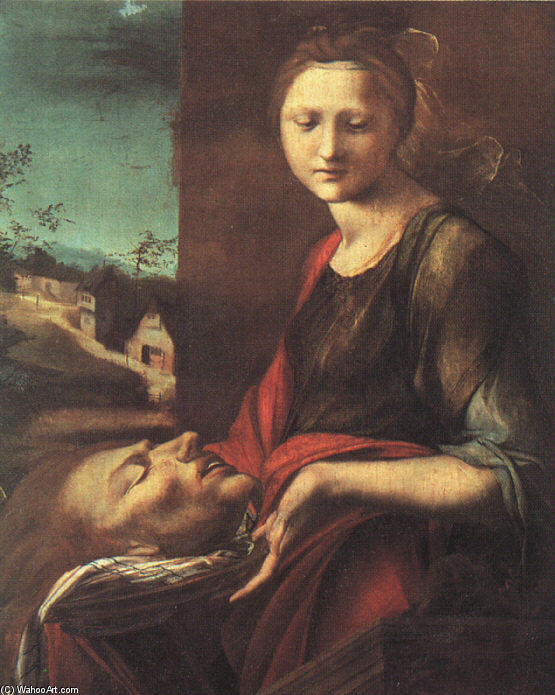
The Allure of Renaissance Drama: Salome by Alonso Gonzalez De Berruguete
To stand before a depiction such as Salome is to step directly into the charged atmosphere of the Italian Renaissance. This masterpiece, painted in 1512 by the prodigious Spanish artist Alonso González de Berruguete, is far more than just an image; it is a profound meditation on beauty, devotion, and the perilous currents of human desire. The painting captures the dramatic moment where Salome confronts the severed head of John the Baptist, rendering a scene steeped in both exquisite realism and palpable tension.
Berruguete’s command over oil paint allows him to achieve a startling sense of life on canvas. Observe how the light seems to emanate from within the composition itself, catching the folds of Salome's rich red garment and illuminating the pale skin of her contemplation. The meticulous attention paid to naturalistic proportions—a hallmark of Renaissance mastery—gives every figure an almost breathing quality, inviting the viewer into their silent drama.
Mastery in Technique and Form
Technically speaking, this work showcases Berruguete’s incredible skill as a painter who was equally adept at sculpture. The handling of form is breathtaking; the weight of the severed head resting on her lap feels physically present, while the background landscape—with its suggestion of houses and trees beneath a cloudy sky—provides necessary depth without ever distracting from the central narrative drama. Berruguete utilizes chiaroscuro with an expert hand, allowing deep shadows to contrast sharply with brightly lit areas, thereby enhancing the three-dimensionality that makes this piece so captivating.
For those considering bringing such historical grandeur into a modern space, knowing the depth of technique is key. Reproductions of this caliber aim not just for visual likeness, but for replicating the very *feel* of the aged oil paint and the artist's careful layering of color.
Symbolism and Emotional Resonance
The subject matter itself—the story of Salome—is rich with layers of biblical symbolism. It speaks to themes of obedience versus temptation, the cost of desire, and the complex relationship between earthly beauty and spiritual consequence. Salome’s expression, often interpreted as a blend of contemplation or perhaps nascent remorse, draws the viewer into an empathetic space. We are forced to question our own moral compasses while gazing at her downward gaze.
The contrast between the vibrant red of her attire and her fair complexion is not merely decorative; it heightens the emotional charge of the piece. It suggests passion contained, or perhaps passion unleashed. This inherent tension—the beautiful façade masking a profound narrative weight—is what continues to draw art lovers across centuries.
A Piece for the Connoisseur's Collection
Owning a reproduction of Salome by Alonso González de Berruguete is acquiring more than just wall decor; it is curating a piece of cultural history. It speaks to an appreciation for the High Renaissance period, when art served as both devotional guide and intellectual playground. Whether placed in a formal drawing-room where classical gravitas is desired, or within a gallery setting that celebrates historical artistry, this painting commands attention. It offers depth, narrative power, and undeniable aesthetic splendor, making it a timeless centerpiece for any discerning collector.