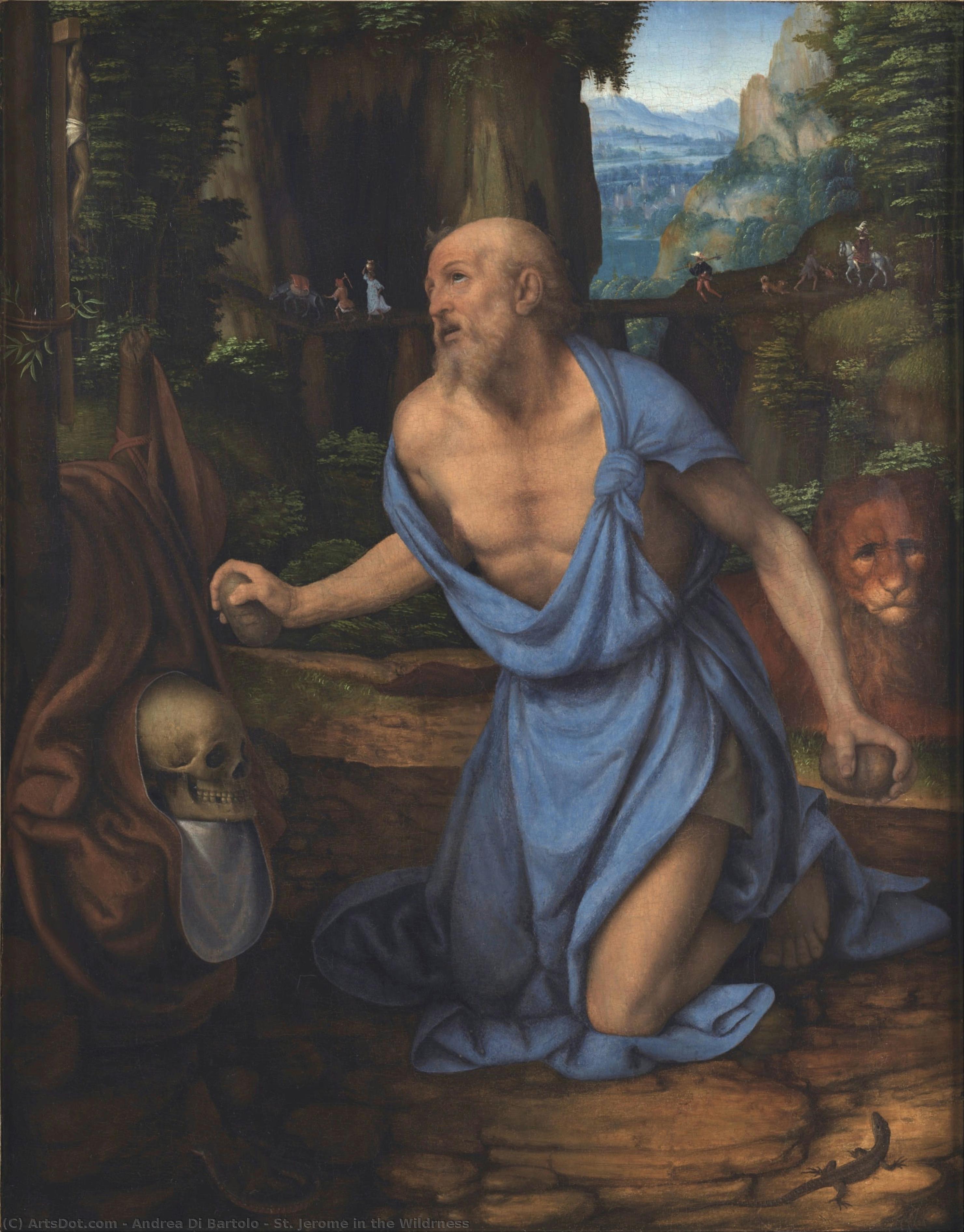
A Soul in Solitude: The Devotion of St. Jerome
In the quiet, rugged expanse of a landscape that feels more European than Syrian, we encounter a moment of profound spiritual intensity. St. Jerome in the Wilderness is not merely a depiction of a saint; it is an immersive experience of penance and prayer. As the viewer’s eye meets the kneeling figure of St. Jerome, there is an immediate sense of the weight of devotion. The artist captures the saint in a state of deep contemplation, his body positioned in a powerful pyramidal structure that anchors the composition. This arrangement draws us into his private struggle, making the viewer a silent witness to his ascetic life among the hermits of the desert. Though historical records place Jerome in the Syrian wilderness around 374 A.D., the artist has reimagined this sacred space through a lens of familiar, mountainous terrain, creating a bridge between the biblical past and the viewer's own world.
The visual language of the piece is steeped in the meticulous traditions of the Early Netherlandish style, where every texture tells a story. The heavy, rhythmic folds of his red cardinal’s robes—a color signifying his prestigious yet burdened office—contrast beautifully with the soft blue of his inner garment. Through the masterful application of oil glazes, the artist achieves a luminous depth that makes the skin appear supple and the rocky ground feel tactile and raw. There is a deliberate tension between the smooth, light-drenched surfaces of the saint’s face and the rugged, shadowed textures of the surrounding wilderness. This interplay of light and shadow does more than create depth; it mirrors the internal conflict of a man wrestling with his own mortality and divine calling.
Symbolism and the Language of the Renaissance
Every element within this frame serves as a silent sermon, rich with the symbolic vocabulary of the Renaissance. Beside the saint, the presence of the lion—a creature often associated with both temptation and protection—serves as a powerful metaphor for the wilder impulses of the human spirit being tamed by faith. Nearby, the skull rests as a memento mori, a stark reminder of the fleeting nature of earthly existence and the inevitability of death. Even the subtle inclusion of a star on a draped cloth suggests a celestial guidance, a glimmer of hope amidst the harshness of the desert. These symbols are not merely decorative; they are intellectual anchors that invite collectors and art lovers to meditate on the deeper meanings of life, loss, and redemption.
For the discerning collector or interior designer, this painting offers more than just aesthetic beauty; it provides a focal point of profound emotional gravity. The palette, dominated by earthy browns and deep blues but punctuated by regal reds and golds, allows the work to integrate seamlessly into sophisticated environments, whether in a classical study or a contemporary gallery setting. To possess a reproduction of such a masterpiece is to bring a sense of historical continuity and spiritual stillness into a space. It is an invitation to pause, to reflect, and to find beauty in the quiet strength of a soul in prayer.