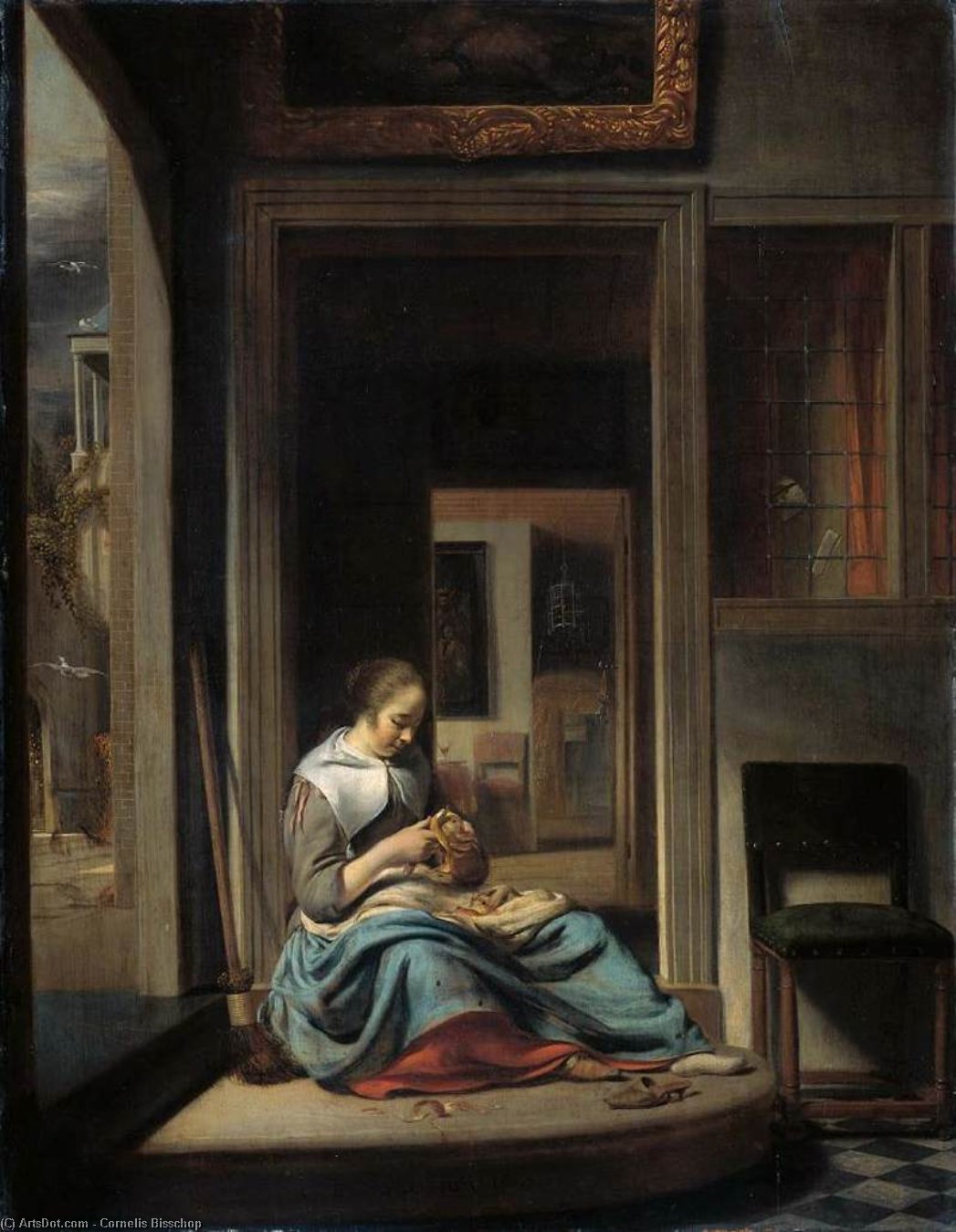
Cornelis Bisschop's 'Woman Peeling Apple' (1667) captures a serene domestic scene with masterful detail and light. A captivating glimpse into Dutch Golden Age life.
Cornelis Bisschop (1630-1674): Dutch Golden Age painter famed for trompe l'oeil, allegories & portraits. Student of Ferdinand Bol, he mastered Baroque realism.
Rijksmuseum
(Amsterdam, Netherlands)
Istražite holandske umetnosti i istoriju u Rijksmuseumu Amsterdam! Oduševite se remek-delima Rendvrika, Vermeer i Van Goga u ikoničnoj zgradi – putovanje kroz 800 godina kulture.
The Quietude of Domesticity: Cornelis Bisschop’s “Woman Peeling Apple”
Cornelis Bisschop's "Woman Peeling Apple," painted in 1667, isn’t merely a depiction of a woman preparing food; it’s a carefully constructed tableau brimming with subtle symbolism and an exquisite mastery of light. This intimate genre scene, now residing within the Wallace Collection in London, offers a rare glimpse into the domestic life of a prosperous Dutch household during the Golden Age. The painting immediately draws the viewer in with its soft, diffused light – a hallmark of Bisschop’s technique and a deliberate departure from the stark realism favored by some of his contemporaries. Notice how the sunlight streams through an unseen window, bathing the room in a warm glow that highlights the textures of the fur-trimmed jacket, the intricate details of the Delft tiles adorning the fireplace, and most importantly, the delicate curve of the woman’s hand as she peels an apple. This masterful use of chiaroscuro – the dramatic contrast between light and shadow – creates a sense of depth and realism that was revolutionary for its time.
A Portrait of Comfort and Prosperity
The subject herself is presented with a quiet dignity, seated on a simple stool before a richly appointed room. Her attire—a black velvet jacket adorned with fur, a red skirt, and a crisp white apron— speaks volumes about her family’s status and wealth. The inclusion of luxurious details like the embroidered fabrics, the ornate fireplace, and the presence of a small child suggests a life of comfort and security. However, Bisschop doesn't indulge in ostentatious display; rather, he subtly conveys prosperity through carefully chosen objects and textures. The cupid nestled between the woman and her child reinforces this theme, hinting at a future filled with love and happiness. The scene is not one of grand gestures or dramatic events, but rather a quiet moment of everyday life—a testament to the values of family, domesticity, and prosperity that were highly prized during the Dutch Golden Age.
The Art of Trompe-l'Oeil and Baroque Realism
Bisschop’s skill as a painter is particularly evident in his masterful application of *trompe l'oeil*, a technique designed to deceive the eye into perceiving three-dimensional reality on a two-dimensional surface. Observe how he renders the details of the room with astonishing accuracy—the texture of the fur, the sheen of the tiles, and even the reflection in the mirror. This meticulous attention to detail is not merely decorative; it’s integral to the painting's overall effect, creating an illusion of depth and realism that draws the viewer into the scene. Furthermore, Bisschop seamlessly blends elements of Baroque realism with his innovative *trompe l'oeil* techniques, resulting in a sophisticated and visually compelling composition. His style reflects the broader artistic trends of the period, characterized by a focus on naturalism, dramatic lighting, and intricate detail.
Symbolic Layers and Emotional Resonance
Beyond its technical brilliance, “Woman Peeling Apple” is rich in symbolic meaning. The apple itself has long been associated with temptation, knowledge, and mortality – themes that resonate throughout Western art history. Here, however, the apple represents nourishment, domesticity, and the cycle of life. The child’s presence symbolizes hope for the future, while the woman's serene expression suggests contentment and fulfillment. The painting isn’t simply a record of a mundane activity; it’s an exploration of human emotions and relationships within the context of a stable and prosperous home. It evokes a feeling of quiet contemplation, inviting the viewer to pause and reflect on the simple pleasures of everyday life. The overall effect is one of understated beauty and profound emotional resonance—a testament to Bisschop's artistic genius.
Reproductions and Interior Design Inspiration
Today, “Woman Peeling Apple” remains a captivating work of art, offering valuable insights into the culture and aesthetics of 17th-century Holland. High-quality reproductions capture the painting’s exquisite detail and evocative atmosphere, making it an ideal addition to any home or office space. Its timeless themes of family, comfort, and domesticity resonate with contemporary audiences, while its masterful technique and subtle symbolism continue to inspire artists and designers alike. Consider incorporating elements of Bisschop's composition—the use of light, the attention to texture, and the focus on intimate scenes—into your own interior design projects to create a space that is both beautiful and inviting.