

 Pregledaj u prostoru
 Pošalji
 Podeli
 Detalji o delu

 Преузми
 Slični predmeti
 Rendgenski snimak
 Slajdovi
 Stats
StatsPanoramic View of the Norica Needle Works with the Manufacturer


 Pročitaj više
Ručno rađena uljana reprodukcija
Ručno oslikano uljanim bojama na platnu u dimenzijama i okviru po vašem izboru, izrađeno po porudžbini od strane naših umetnika. ( Switch to Print Switch to Digital Image)




P118B $10

P118H $10

P118W $10

P438Z $10

P508JH $12

P508YH $12

P805H $10

P805Z $10

P919BZ $10

P919G $10

P919XJ $10

P959ZH $10

P968JZ $12

W106C $8

W218G $10

W218JH $8

W218Y $10

W307PJ $10

W316G $10

W316PJ $8

W316Y $10

W398PJ $8

W4111J $10

W500HY $15

W500JH $15

W692G $12

W849H $8

W940BG $15

W953PJ $8




Izaberite jednu od naših unapred definisanih veličina koje odgovaraju originalnim proporcijama umetničkog dela.

Можете унети сопствене димензије како бисте прилагодили дело одређеном оквиру или простору. Ако одабрана величина не одговара пропорцијама оригинала, слика ће бити исечена или проширена додатним елементима који се ручно насликавају. Дигитални prikaz ће вам бити послат на одобрење пре почетка производње.
Имајте на уму да преглед на екрану не одражава стварно исецање или проширење. Само приказ (mockup) ће тачно приказати коначну композицију.
Иако су доступне прилагођене величине, препоручујемо да одаберете димензију из дефинисане листе како бисте сачували оригиналне пропорције.
Nakon narudžbine, tim ArtsDot.com će klijentu putem e-pošte poslati uputstva i dostaviti prikaz predloženog rešenja
Isporuka širom sveta () za 3/4 nedelje umesto uobičajenih 5 nedelja. (8 септембар). Bez kompromisa po pitanju kvaliteta.

Besplatna ekspresna dostava širom sveta

Visokokvalitetno laneno platno

Kompletno osiguranje transporta

Garancija povraćaja carine i uvoznih dažbina

Garancija vernosti boja

Politika povraćaja u roku od 100 dana (isključivo u slučaju nedostataka)

Garancija povrata novca od 100%

Popust pri grupnoj kupovini
 Opcija sa staklom dostupna je samo za dimenzije manje od 110 cm

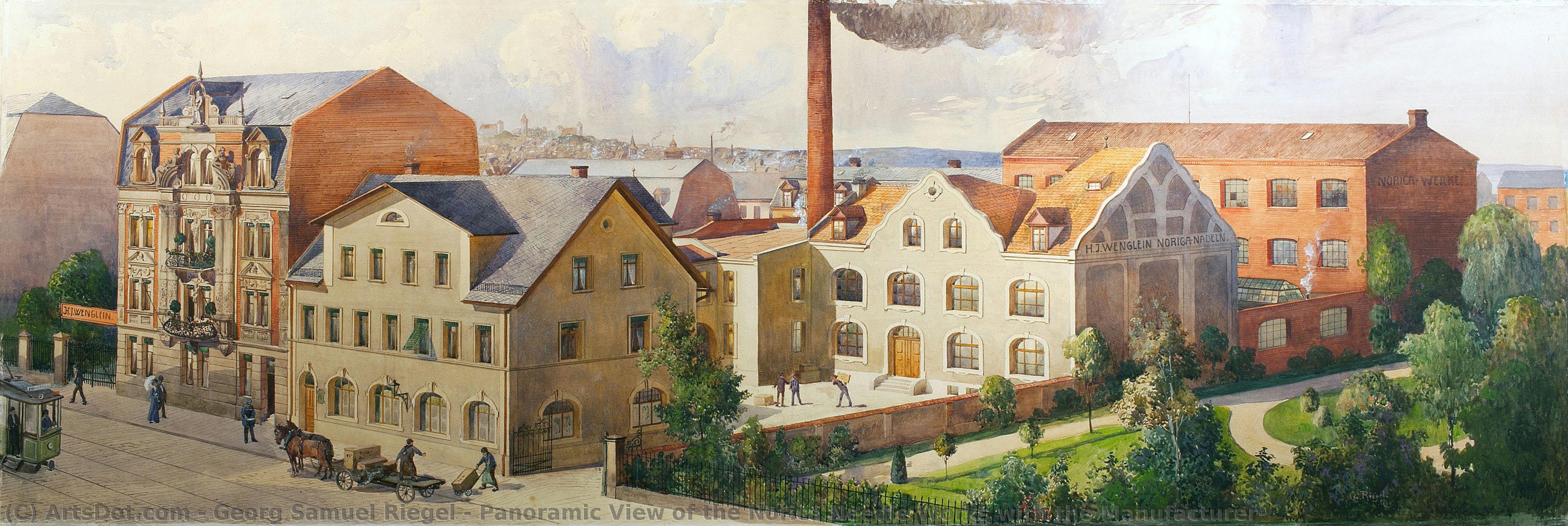
Panoramic View of the Norica Needle Works with the Manufacturer
Tehnika reprodukcije
Dimenzije reprodukcije
-


Konačna cena
$ 263
A Window into Industrial Nuremberg
In the delicate, translucent layers of Georg Samuel Riegel’s 1892 watercolor, Panoramic View of the Norica Needle Works with the Manufacturer, we find a breathtaking intersection of industrial progress and historical grandeur. This piece serves as more than just a topographical record; it is a soulful meditation on a city in transition. As the viewer’s eye wanders across the composition, they are transported to the Glockenhof district of Nuremberg, where the burgeoning energy of the late 19th century meets the timeless silhouette of the medieval skyline. The painting captures a specific, fleeting moment in history—the era when the smoke of new industry began to mingle with the ancient air of the German landscape.
The composition is masterfully structured to guide the observer from the intimate details of the foreground to the sweeping majesty of the horizon. In the lower reaches of the work, Riegel presents a lively, breathing street scene. We see the rhythmic pulse of daily life: figures engaged in quiet labor, horses navigating the thoroughfares, and even the small, charming presence of dogs wandering near the edges of the frame. This grounded, human element provides a vital contrast to the imposing brick architecture of the Norica needleworks that dominates the mid-ground. Through his expert use of watercolor, Riegel achieves a sense of atmospheric depth, where the distant Nuremberg Castle and the iconic Frauentor tower emerge through a soft, ethereal haze.
The Artistry of Atmosphere and Light
Technically, this work showcases Riegel’s profound mastery of the watercolor medium. Eschewing the cold, clinical precision often found in industrial illustrations of the period, the artist embraces an impressionistic warmth. He utilizes a sophisticated palette to depict the subtle interplay of light and shadow, most notably seen in the way the factory smoke softly veils the background. This intentional blurring of the distant skyline creates a sense of nostalgia and romanticism, suggesting that while the factory represents the future, it is still cradled within the protective embrace of the old world. The greenery interspersed throughout the industrial complex adds a layer of organic harmony, softening the hard edges of the brickwork and creating a balanced, aesthetically pleasing landscape.
For the discerning collector or interior designer, this reproduction offers a profound sense of narrative depth. It is a piece that invites conversation, acting as a focal point that bridges the gap between historical documentation and fine art. The painting’s ability to evoke both the strength of industrial achievement and the quiet beauty of a summer afternoon makes it an ideal addition to any sophisticated space. Whether placed in a library, a study, or a contemporary living area, this work brings with it a sense of timelessness, reminding us of a period when progress and tradition walked hand in hand under the watchful gaze of Nuremberg’s ancient towers.
Srodna umetnička dela
Biografija umetnika
The Delicate Vision of Georg Samuel Riegel
Born on January 28, 1792, in the quiet Bavarian town of Monchshöfen, Georg Samuel Riegel emerged as a painter of profound observational skill and technical grace. As the son of Johann Paul Riegel and Anna Katharina Stahl, his early life was rooted in the heart of Germany, a landscape that would later serve as both his subject and his inspiration. Riegel’s artistic journey unfolded during a transformative era in European history, a period where the serene traditions of Romanticism began to encounter the burgeoning realities of the Industrial Revolution. Through his mastery of watercolor, he captured a world caught between the timeless beauty of the German countryside and the rising silhouettes of industrial progress.
Riegel’s technique was defined by the fluid, luminous nature of watercolor, a medium that demands both precision and an intuitive understanding of light. He possessed a rare ability to manipulate pigments suspended in liquid to evoke the atmospheric nuances of the sky and the textured surfaces of the earth. His work is not merely a documentation of scenery but an emotional engagement with his surroundings. By blending the soft, dreamlike qualities of Romanticism with a burgeoning Realist sensibility, he created compositions that feel both nostalgic and strikingly present. This duality allowed him to portray landscapes that were at once poetic and meticulously detailed.
A Witness to Industrial Transformation
One of the most significant aspects of Riegel’s legacy is his role as a visual chronicler of change. While many of his contemporaries focused solely on idealized pastoral scenes, Riegel turned his gaze toward the evolving industrial landscape of 19th-century Germany. His celebrated work, 'Panoramic View of the Norica Needle Works with the Manufacturer's Mansion', stands as a testament to this unique perspective. In this piece, he masterfully integrates the architectural grandeur of a manufacturer's estate with the functional complexity of the needle works, offering a panoramic window into an era of economic and structural metamorphosis.
This ability to find beauty within the industrial sphere is what distinguishes his oeuvre. He did not view the encroaching factories as scars upon the land, but rather as integral components of a new, modern landscape. His paintings serve as historical documents that preserve the memory of Nuremberg’s industrial heritage. The following elements characterize his most impactful contributions:
- Mastery of Light: Using watercolor to capture the fleeting effects of sunlight on water and stone.
- Topographical Accuracy: A keen eye for the architectural and geographical details of the Bavarian and Nuremberg regions.
- Historical Documentation: Providing a visual record of the Norica Needle Works and the surrounding social structures.
- Stylistic Synthesis: The seamless blending of Romantic atmosphere with Realist observation.
Legacy and Artistic Significance
The enduring significance of Georg Samuel Riegel lies in his ability to bridge the gap between two worlds. His works are held in esteemed collections, such as the Nuremberg Municipal Museums, where they continue to offer scholars and art lovers a glimpse into the soul of 19th-century Germany. Through his delicate brushstrokes, he ensured that the transition from an agrarian society to an industrial power was recorded with dignity and artistic splendor.
Today, Riegel is remembered not just as a regional painter, but as an artist who understood the profound shifts of his time. His ability to find harmony between the natural world and human industry remains a powerful lesson in perception. To study his work is to walk through the misty mornings of old Bavaria and to witness the very moment when the gears of modernity began to turn, all captured within the translucent, shimmering layers of his exquisite watercolors.

georg samuel riegel
1792 - 1879 , Germany
Osnovne informacije
- Artistic Movement Or Style: Grand Manner, Portraiture
- Artists Or Movements Influenced By This Artist:
- Thomas Lawrence
- John Russell
- Artists Who Influenced This Artist:
- Rembrandt
- Rubens
- Van Dyck
- Date Of Birth: 16 July 1723
- Date Of Death: 23 February 1792
- Full Name: Sir Joshua Reynolds
- Nationality: English
- Notable Artworks:
- Omai
- Marlborough Family
- Philip Gell
- Earl of Carlisle
- Place Of Birth: Plympton, Devon
Povezani članci

Ephemeral Visions: Exploring the Artistic Legacy & Contemporary Practice of Watercolor Painting
Explore the captivating world of watercolor painting! Discover its rich history, essential techniques, influential artists & collecting tips. A comprehensive guide for art enthusiasts from ArtsDot.

Watercolor Wonders: 10 Masterpieces That Redefined Art History | ArtsDot
Journey through 10 legendary watercolor masterpieces by Sargent, Turner & Homer! Explore iconic landscapes, portraits & floral art that redefined history. Find museum-quality reproductions and curated decor ideas at ArtsDot.com.
25 Remek-dela Žorža Seurea: Putovanje kroz Svet Tačizma i Impresionističke Revolucije
Istražite 25 remek-dela Žorža Seurea i uronite u svet tačizma i impresionističke revolucije. Otkrijte priče iza slika, tehnike i inspiraciju ovog francuskog umetnika. Reprodukcije vrhunskog kvaliteta dostupne na ArtsDot.com!

Georges Braque: 25 Remek-dela Kubizma za Inspirisanje Vašeg Doma | ArtsDot
Istražite 25 remek-dela Georges Braquea, pionira kubizma. Otkrijte priče iza slika, tehnike i inspiraciju za dizajn enterijera. Reprodukcije vrhunskog kvaliteta dostupne na ArtsDot.com! Pronađite savršeno umetničko delo online.

Ephemeral Visions: Exploring the History & Emotional Resonance of Watercolor Painting
Explore the captivating history of watercolor painting, from ancient techniques to modern masters like Kandinsky & Blake. Discover essential artists, collecting tips & the emotional power of this luminous medium. Expert insights for art enthusiasts.