

 Pregledaj u prostoru
 Kupi print
 Pošalji
 Podeli


 Преузми
 Slični predmeti
 Rendgenski snimak
 Slajdovi
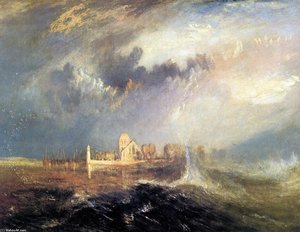
Quillebeuf, at the Mouth of Seine
 Oil On Canvas
- WallArt
- Romanticism
 1833
1833- 19th Century
 88.0 x 120.0 cm
 Музей имени Гулбенкяна
A Storm Unleashed: The Dramatic Vision of Quillebeuf
Joseph Mallord William Turner’s “Quillebeuf, at the Mouth of Seine,” painted in 1833, isn't merely a depiction of a coastal scene; it’s an immersive experience. This large oil on canvas plunges the viewer directly into the heart of a tempestuous storm brewing over the Normandy coastline. The painting captures a fleeting moment of intense drama – a collision between the raw power of nature and the fragile beauty of human settlement. The village of Quillebeuf, nestled precariously at the river’s edge, is rendered as a collection of dark, huddled buildings, dwarfed by the colossal forces unleashed above. Turner masterfully utilizes light and shadow to create an atmosphere thick with tension, where the clouds churn like liquid darkness and the sea roars with barely contained energy.
Romanticism and the Sublime: A Shift in Artistic Perception
“Quillebeuf” stands as a pivotal work within Turner’s oeuvre and a cornerstone of the Romantic movement. Prior to this era, landscape painting often focused on idyllic scenes and precise representation. However, Turner rejected these conventions, instead prioritizing emotional response and capturing the *sublime* – that overwhelming feeling of awe and terror inspired by nature's grandeur. He wasn’t interested in simply showing a coastal view; he aimed to convey the very essence of its power. The painting reflects a shift in artistic perception, moving away from rational observation towards subjective experience. Turner’s use of loose brushstrokes, vibrant color palettes (particularly the deep blues and purples), and an emphasis on atmospheric effects – the swirling mist, the dramatic lighting – all contribute to this intensely emotional impact.
Technique and Composition: A Dance of Light and Color
Turner’s technique is revolutionary for its time. He employed a layering method, applying thin washes of color over thick impasto, creating a remarkable sense of texture and movement. The composition itself is dynamic and unbalanced, drawing the eye across the canvas. The church, with its prominent clock tower, acts as an anchor amidst the chaos, yet even it seems vulnerable to the storm’s fury. Notice how Turner uses diagonal lines – the receding shoreline, the crashing waves – to create a sense of depth and movement. The small boats scattered across the water are not merely incidental details; they represent humanity's struggle against nature's dominance. The inclusion of a lone bird soaring above adds a touch of fragile beauty to this otherwise turbulent scene, symbolizing resilience in the face of adversity.
Symbolism and Historical Context: A Village Under Siege
Beyond its immediate visual impact, “Quillebeuf” carries symbolic weight. The village itself represents human vulnerability and the precariousness of existence against the backdrop of an indifferent universe. The storm can be interpreted as a metaphor for life’s challenges – unpredictable events that threaten to overwhelm us. Turner's fascination with the Seine estuary is evident; he revisited Quillebeuf multiple times, documenting its changing landscape over several decades. The painting reflects his deep connection to the region and his desire to capture its unique character. Furthermore, it aligns with the broader historical context of 19th-century England, a period marked by rapid industrialization and social upheaval – themes that often found expression in Romantic art.
Bringing Turner’s Vision Home: A Hand-Painted Reproduction
ArtsDot offers meticulously crafted hand-painted reproductions of “Quillebeuf, at the Mouth of Seine,” allowing you to experience the power and beauty of this iconic artwork in your own space. Our skilled artists faithfully recreate Turner's techniques and color palette, ensuring that every detail is captured with exceptional accuracy. Whether you’re an art collector, interior designer, or simply a lover of fine art, our reproductions provide a stunning way to bring Turner’s dramatic vision into your home. Explore the full artwork details and order your custom reproduction today at ArtsDot.
Јозеф Турнер (1775 – 1851)
Откријте ЈМВ Тунера (1775-1851), британског романтичара познатог по својим изразним панорама и мастерском употреби света, који је утицао на импресионизам. Истражите његове најзначајније слике данас!
Музей имени Гулбенкяна (Лион, Portugal)
Posetite Muzej Čalousta Gulbenkijana u Lisabonu! otkrijte izuzetan umetnički kolekciju i arhitekturu – nasledje filantropije koje pokreće umetnost, znanost i obrazovanje. Lisabonski muzej Čalousta Gulbenkijana, umetnička kolekcija Čalousta Gulbenkijana, portugalska umetnost, egipatska umetnost, umetnost islamskog sveta, Rembrandt, Degas, moderna umetnost, arhitektura parka Čalousta Gulbenkijana
O ovom umetničkom delu
- Naslov: Quillebeuf, at the Mouth of Seine
- Umetnik: Јозеф Турнер
- Godina: 1833
- Prvobitne dimenzije: 88.0 x 120.0 cm
- Format: Landscape
- Status autorskih prava: Javno vlasništvo
- Mesto izlaganja: Музей имени Гулбенкяна
- Pokret: Romanticism
- Tehnika izrade: WallArt
- Kreativni period: Mature Period
Osnovne informacije
- Location: Calouste Gulbenkian, Lisbon
- Year: 1833
- Influences: Turner
- Notable elements: Church, boats, bird
- Title: Quillebeuf, at the Mouth of Seine
- Medium: Oil on canvas
- Artist: J.M.W. Turner
QR kod


