


 Pregledaj u prostoru
 Pošalji
 Podeli
 Detalji o delu

 Преузми
 Slični predmeti
 Rendgenski snimak
 Slajdovi
A winterlandscape with peasants near a windmill
 Pročitaj više
Ručno rađena uljana reprodukcija
Ručno oslikano uljanim bojama na platnu u dimenzijama i okviru po vašem izboru, izrađeno po porudžbini od strane naših umetnika. ( Kupi print Kupi digitalnu sliku)




































Izaberite jednu od naših unapred definisanih veličina koje odgovaraju originalnim proporcijama umetničkog dela.

Можете унети сопствене димензије како бисте прилагодили дело одређеном оквиру или простору. Ако одабрана величина не одговара пропорцијама оригинала, слика ће бити исечена или проширена додатним елементима који се ручно насликавају. Дигитални prikaz ће вам бити послат на одобрење пре почетка производње.
Имајте на уму да преглед на екрану не одражава стварно исецање или проширење. Само приказ (mockup) ће тачно приказати коначну композицију.
Иако су доступне прилагођене величине, препоручујемо да одаберете димензију из дефинисане листе како бисте сачували оригиналне пропорције.
Nakon narudžbine, tim ArtsDot.com će klijentu putem e-pošte poslati uputstva i dostaviti prikaz predloženog rešenja
Isporuka širom sveta () za 3/4 nedelje umesto uobičajenih 5 nedelja. (28 август). Bez kompromisa po pitanju kvaliteta.

Besplatna ekspresna dostava širom sveta

Visokokvalitetno laneno platno

Kompletno osiguranje transporta

Garancija povraćaja carine i uvoznih dažbina

Garancija vernosti boja

Politika povrata u roku od 60 dana (samo u slučaju nedostataka)

Garancija povrata novca od 100%

Popust pri grupnoj kupovini
 Opcija sa staklom dostupna je samo za dimenzije manje od 110 cm

A winterlandscape with peasants near a windmill
Tehnika reprodukcije
Dimenzije reprodukcije
-


Konačna cena
$ 263
Srodna umetnička dela
Biografija umetnika
A Quiet Observer of the Dutch Landscape: The Life and Art of Johannes Franciscus Hoppenbrouwers
Johannes Franciscus Hoppenbrouwers, a name perhaps less celebrated than some of his Dutch Romantic contemporaries, nevertheless occupies a significant place in the pantheon of 19th-century landscape painting. Born in 1819 in the Netherlands, Hoppenbrouwers dedicated his life to capturing the subtle beauty and melancholic atmosphere of his homeland’s countryside. While biographical details remain somewhat sparse, the enduring quality of his work speaks volumes about a keen eye for detail, a sensitive understanding of light, and a profound connection to the natural world. He wasn't a painter of grand historical narratives or dramatic allegories; instead, Hoppenbrouwers found poetry in the everyday—in frozen dykes, windswept dunes, and the quiet labors of rural life. His paintings offer a glimpse into a Netherlands undergoing change, yet steadfastly rooted in its traditions.Early Influences and Artistic Development
Hoppenbrouwers’ artistic journey unfolded during a period when Romanticism was flourishing across Europe. Though not directly associated with any specific school or movement, his work clearly reflects the Romantic sensibility—a fascination with nature's power, an emphasis on emotion and atmosphere, and a tendency towards introspection. The Dutch landscape tradition itself provided a strong foundation for his development. Artists like Jacob van Ruisdael and Jan van Goyen, masters of depicting cloudscapes and expansive vistas, likely served as early inspirations. However, Hoppenbrouwers distinguished himself through a more subdued palette and a focus on winter scenes—a subject matter that allowed him to explore the nuances of light and shadow in a particularly evocative way. His initial works demonstrate a careful study of realism, but he gradually moved towards a looser brushstroke and a greater emphasis on capturing the *feeling* of a place rather than its precise topographical details.Themes and Techniques: A World Shrouded in Winter
The defining characteristic of Hoppenbrouwers’ oeuvre is undoubtedly his depiction of winter landscapes. These are not merely representations of snow-covered fields; they are imbued with a sense of stillness, solitude, and quiet contemplation. Frozen dykes, often featuring solitary figures skating or walking across the ice, became a recurring motif. He masterfully rendered the textures of ice and snow, capturing their crystalline quality and subtle variations in tone. Beyond winter scenes, Hoppenbrouwers also painted dune landscapes—evocative depictions of the Dutch coastline with its shifting sands and windswept grasses. His technique is characterized by a delicate layering of paint, creating a soft, atmospheric effect. He employed a muted palette dominated by grays, browns, and blues, which further enhances the sense of melancholy and introspection that pervades his work. Light plays a crucial role in his paintings—often diffused and ethereal, it bathes the landscapes in a gentle glow, highlighting the beauty of even the most desolate scenes.Major Achievements and Lasting Legacy
While Hoppenbrouwers may not have achieved widespread fame during his lifetime, his work has garnered increasing recognition in recent years. Paintings such as “View in the Dunes” (1855) and “A Man Skating on a Frozen Dyke, Passing a Bridge” are particularly admired for their atmospheric quality and technical skill. His ability to capture the essence of the Dutch landscape—its quiet beauty, its subtle variations in light and shadow—sets him apart from his contemporaries. Hoppenbrouwers’ paintings offer a valuable glimpse into 19th-century rural life in the Netherlands, providing a counterpoint to more dramatic or idealized depictions of the countryside. His work continues to resonate with viewers today, offering a moment of quiet contemplation in an increasingly fast-paced world.- Masterful depiction of winter landscapes.
- Sensitive use of light and shadow.
- Evocative portrayal of Dutch rural life.
Historical Significance and Continued Appreciation
Johannes Franciscus Hoppenbrouwers’ historical significance lies in his ability to capture a specific moment in time—a Netherlands poised between tradition and modernity. His paintings are not simply landscapes; they are reflections of a changing society, imbued with a sense of nostalgia and quiet beauty. He represents a strand of Dutch Romanticism that prioritized observation and emotional resonance over grand narratives or dramatic spectacle. Today, his work is appreciated for its technical skill, atmospheric quality, and ability to evoke a sense of place. As interest in 19th-century landscape painting continues to grow, Hoppenbrouwers’ contribution to the art world is sure to be further recognized and celebrated—a testament to the enduring power of quiet observation and artistic sensitivity.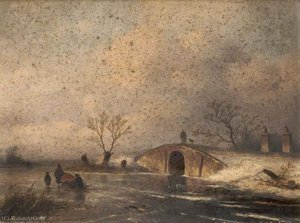
johannes franciscus hoppenbrouwers
1819 - 1866 , Netherlands
Osnovne informacije
- Artistic Movement Or Style: Romantic Painting
- Artists Who Influenced This Artist: ['Andreas Schelfhout']
- Date Of Birth: 1819
- Date Of Death: 1866
- Full Name: Johannes Franciscus Hoppenbrouwers
- Nationality: Dutch
- Notable Artworks:
- View in the Dunes
- A Winter Landscape
- Man Skating on Dyke
- Place Of Birth: The Hague, Netherlands

