

 Pregledaj u prostoru
 Pošalji
 Podeli
 Detalji o delu

 Преузми
 Slični predmeti
 Rendgenski snimak
 Slajdovi
 Stats
StatsStep of Time Memoire


 Pročitaj više
Giclee štampa / Umetnički otisak
Giclée štampa ili print na platnu muzejskog kvaliteta uz brzu proizvodnju i fleksibilne opcije završne obrade. ( Kupi ručno naslikanu sliku Switch to Digital Image)




































Izaberite jednu od naših unapred definisanih veličina koje odgovaraju originalnim proporcijama umetničkog dela.

Možete uneti sopstvene dimenzije kako biste umetničko delo prilagodili specifičnom okviru ili prostoru. Ako odabrani format ne odgovara proporcijama originalne slike, mi ćemo ili iscrtati deo dela ili proširiti sliku pomoću ogledane ivice ili jednobojnog popunjavanja. Digitalni prikaz će vam biti poslat na odobrenje pre početka proizvodnje.
Imajte na umu da pregled na ekranu ne odražava stvarno iscrtavanje ili proširivanje. Samo će prikaz (mockup) precizno pokazati finalnu kompoziciju.
Iako su prilagođene dimenzije dostupne, preporučujemo da odaberete dimenziju sa unapred definisane liste kako biste očuvali originalne proporcije.
Dostava širom sveta () za 2 nedelje umesto uobičajenih 4/5 nedelja. (8 септембар)

Besplatna ekspresna dostava širom sveta

Visokokvalitetno laneno platno

Kompletno osiguranje transporta

Garancija povraćaja carine i uvoznih dažbina

Garancija vernosti boja

Politika povraćaja u roku od 100 dana (isključivo u slučaju nedostataka)

Garancija povrata novca od 100%

Popust pri grupnoj kupovini
 Opcija sa staklom dostupna je samo za dimenzije manje od 110 cm

Step of Time Memoire
Giclee štampa / Umetnički otisak
Dimenzije reprodukcije
-


Konačna cena
$ 62
A Dance of Light and Geometry
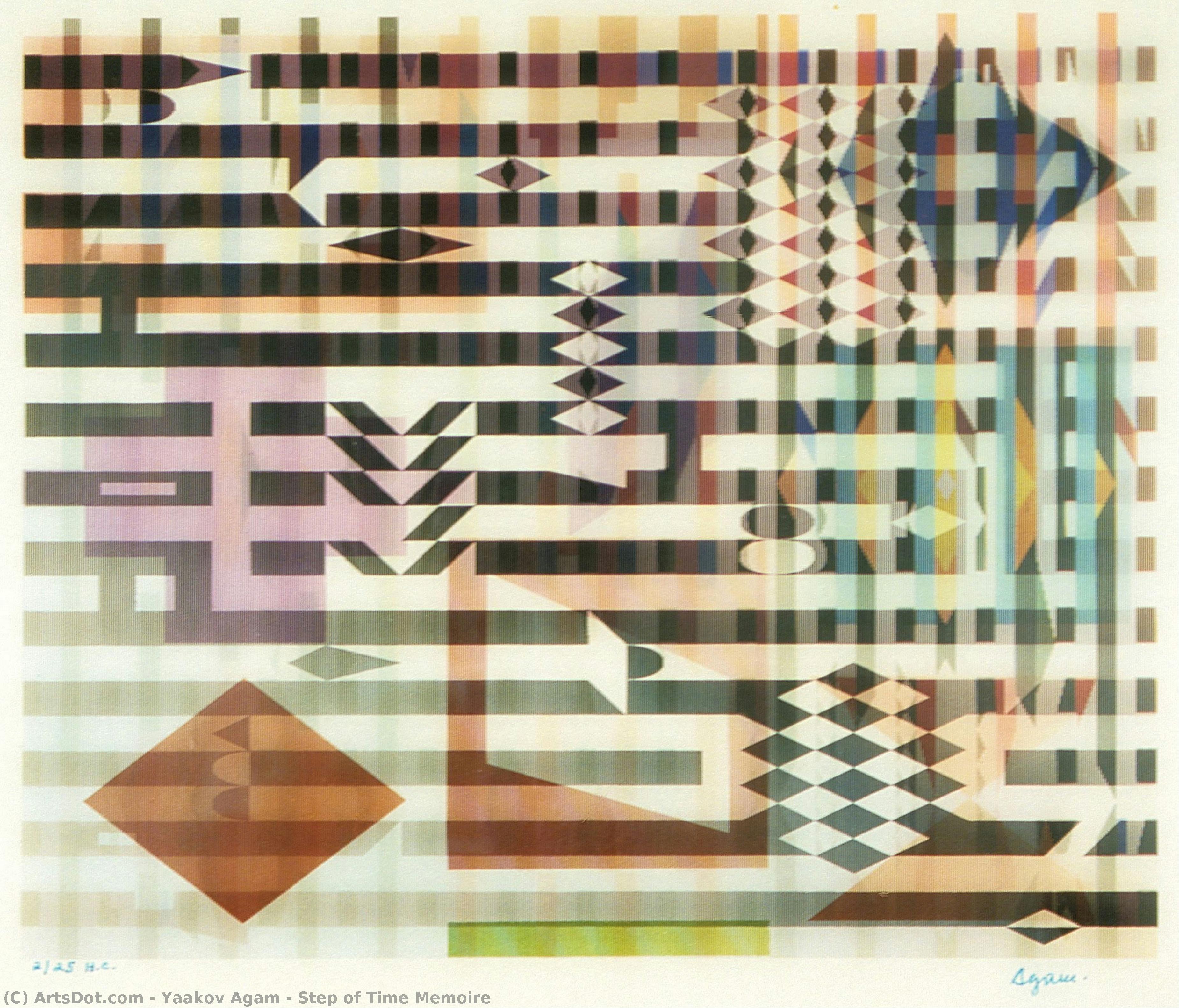
In the mesmerizing realm of kinetic art, few works capture the ephemeral essence of existence as profoundly as Yaakov Agam’s Step of Time Memoire. Created in 1989, this breathtaking hologram painting serves as a window into a multidimensional universe where perception is never static. As a foundational figure of the legendary 1955 Le Mouvement exhibition in Paris, Agam has spent his career challenging the viewer to move, to look closer, and to realize that art is not merely an object to be observed, but an experience to be lived. This particular piece utilizes the holographic medium to breathe life into geometric forms, creating a visual symphony that shifts and evolves with every subtle change in the observer's perspective.
The composition is a masterful arrangement of mathematical precision and organic fluidity. Scattered across the canvas is a rhythmic dance of triangles and circles, each shape acting as a vessel for light and color. In the upper reaches of the work, sharp triangular forms anchor the eye, while throughout the center and periphery, soft circular motifs drift like celestial bodies in a cosmic sea. The interplay between these shapes creates a sense of perpetual motion; as one moves around the piece, the layers of the hologram appear to slide over one ent, creating an illusion of depth that feels almost architectural. For the discerning collector or interior designer, this work offers a dynamic focal point that refuses to remain dormant, constantly reinventing itself within the space it inhabits.
The Intersection of Time and Perception
Beyond its striking visual geometry, Step of Time Memoire carries a deep philosophical weight. The title itself suggests a reflection on the passage of moments—a "memoir" written not in words, but in light and shadow. Agam’s technique draws heavily from his roots in perceptual abstraction, where the goal is to dissolve the boundary between the artwork and the viewer's consciousness. By using holographic technology, he captures the very concept of time: the way a single moment can contain infinite layers of meaning depending on how we choose to view it. The painting does not represent a fixed memory; rather, it embodies the fluid, ever-changing nature of our own recollections.
For those seeking to infuse a contemporary interior with intellectual depth and artistic prestige, a high-quality reproduction of this masterpiece offers an unparalleled opportunity. It brings the avant-garde spirit of the mid-century kinetic movement into the modern home, providing a sophisticated dialogue between classical geometric beauty and futuristic technology. To possess such a piece is to invite a sense of wonder into one's surroundings, ensuring that every glance toward the wall becomes a moment of discovery, a brief escape into a world where time stands still even as it appears to move.
Srodna umetnička dela

Biografija umetnika
Andrew Warhola: A Pop Icon Forged in Pittsburgh
Born Andrew Warhola Jr. on August 6, 1928, in Pittsburgh’s working-class Hill District, Andy Warhol wasn't initially destined for the art world. His parents, Andrej and Julia Warhola, were Slovak immigrants who instilled a strong work ethic and a deep appreciation for their heritage. Early life was marked by a close-knit family and a vibrant neighborhood, experiences that would later subtly inform his artistic vision. He graduated from Carnegie Institute of Technology (now Carnegie Mellon University) in 1949 with a degree in pictorial design, a foundation that proved surprisingly crucial to his future success as a commercial illustrator. It was this early career—producing advertisements and illustrations for companies like Tiffany & Co., *The New York Times*, and I. Miller Shoes – that initially established Warhol’s reputation and honed his skills in capturing the essence of consumer culture, a skill he would later transform into a revolutionary art form.
- Early Commercial Success: Warhol quickly rose to prominence as one of the most sought-after illustrators of his time. His ability to replicate photographs with uncanny accuracy and his understanding of advertising techniques made him invaluable to numerous clients.
- Transition to Fine Art: Despite his commercial success, Warhol yearned for artistic recognition. He began exhibiting his work in galleries during the early 1960s, gradually shifting from purely illustrative work to exploring more conceptual and experimental approaches.
The Rise of Pop Art and the Factory
The burgeoning art scene of New York City in the mid-1960s proved to be a catalyst for Warhol’s transformation. He became deeply involved with the movement known as Pop Art, alongside artists like Roy Lichtenstein and James Rosenquist. However, Warhol's approach was distinctly unique – he didn’t simply replicate popular imagery; he interrogated it, deconstructed it, and presented it back to the public in a way that challenged conventional notions of art and beauty. Crucially, he established “The Factory,” a sprawling studio space that became a legendary hub for artists, musicians, filmmakers, socialites, and celebrities alike. This unconventional environment fostered collaboration, experimentation, and a blurring of boundaries between high art and popular culture.
- Campbell’s Soup Cans (1962): Warhol's iconic series of 32 canvases depicting Campbell’s soup cans is widely considered the work that launched him into the stratosphere of artistic fame. The repetition, bold colors, and mass-produced aesthetic directly confronted the consumerist values of the era.
- Marilyn Diptych (1967): This double-panel painting, featuring multiple images of Marilyn Monroe, is a poignant meditation on celebrity, beauty, and death – themes that would recur throughout Warhol’s oeuvre.
Technique and Style: Silk Screen and Beyond
Warhol's signature technique was the silk screen print—a method he perfected through meticulous experimentation. He embraced this process not just for its efficiency but also for its ability to create a sense of mechanical reproduction, mirroring the mass-produced world around him. He often used stencils and photographic negatives, layering images and colors to achieve complex effects. Beyond silkscreening, Warhol explored film, performance art, and even television, constantly pushing the boundaries of artistic expression. His work wasn’t always about grand statements; it was frequently characterized by a detached coolness, a deliberate lack of emotional investment that reflected the anxieties and uncertainties of the 1960s.
- Silk Screen Process: Warhol's mastery of the silk screen allowed him to create multiple identical prints, emphasizing themes of repetition and mass production.
- Exploration of Media: From film to performance art, Warhol consistently experimented with diverse mediums, solidifying his position as a multimedia artist.
Legacy and Influence
Andy Warhol’s impact on the art world is immeasurable. He fundamentally shifted our understanding of what constitutes “art,” blurring the lines between high culture and popular culture, and challenging traditional notions of artistic skill and originality. His work continues to resonate today, influencing generations of artists and shaping contemporary visual culture. The Factory itself became a symbol of the counterculture movement, representing a space where creativity, experimentation, and social interaction thrived. Warhol’s legacy extends far beyond his iconic images; he remains a potent reminder of the power of art to reflect, critique, and transform society.
Sources: Wikipedia, The Andy Warhol Museum
yaakov agam
1928 - , Israel
Osnovne informacije
- Artistic Movement Or Style: Pop Art
- Artists Or Movements Influenced By This Artist:
- Andy Warhol
- Nouveau Réalisme
- Artists Who Influenced This Artist:
- Yves Klein
- Carnegie Institute of Technology
- Date Of Birth: August 6, 1928
- Date Of Death: February 22, 1987
- Full Name: Andrew Warhola Jr.
- Nationality: American
- Notable Artworks:
- Campbell's Soup Cans
- Marilyn Diptych
- Chelsea Girls
- Place Of Birth: Pittsburgh, Pennsylvania
Povezani članci

Top 10 dela geometrijske apstrakcije koje morate videti | ArtsDot.com
Istražite 10 remek-dela geometrijske apstrakcije – Mondrian, Malevič i Kandinski. Otkrijte priče iza ovih ikoničnih slika i pronađite inspiraciju za dekoraciju enterijera sa ArtsDot.com! Reprodukcije vrhunskog kvaliteta.
Beyond Form & Color: Geometric Abstraction's Enduring Legacy in Art History
Explore the captivating world of geometric abstraction! Discover its origins, key artists like Malevich & Mondrian, and why this movement remains highly valued by art collectors today. Expert insights at ArtsDot.
Beyond Form & Color: Geometric Abstraction's Evolution in 20th/21st Century Art
Explore the evolution of geometric abstraction from Cubism to contemporary art. Discover key artists like Malevich & Mondrian, investment insights, and expert collecting advice at ArtsDot.
Kandinsky's Masterpieces: 25 Paintings That Define Abstract Art | ArtsDot
Journey through Wassily Kandinsky's 25 most iconic abstract paintings. Explore his revolutionary use of color, form & spiritual expressionism. Find museum-quality Kandinsky reproductions and elevate your home decor with ArtsDot.com. Discover all masterpieces on ArtsDot.com!
Beyond Form: Exploring the Philosophical Foundations of Geometric Abstraction
Explore the philosophical roots & artistic evolution of geometric abstraction with ArtsDot. Discover Mondrian, Malevich, De Stijl & more. Expert insights for collectors and art enthusiasts.