

The Aftermath of War: From Expressionist Emotion to New Objectivity
 Neue Sachlichkeit: The Raw Realism and Social Critique of German New Objectivity
The Aftermath of War: Rejection of Expressionism and the Rise of New Objectivity To understand the emergence of Neue Sachlichkeit , one must first walk through the scarred landscapes of post-World War I Germany. The Great War had left the nation in a...
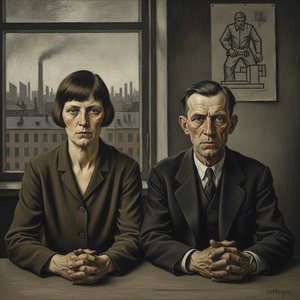
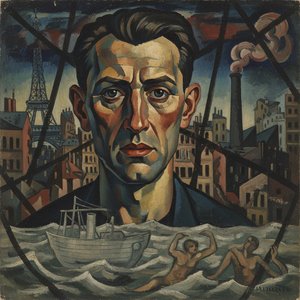
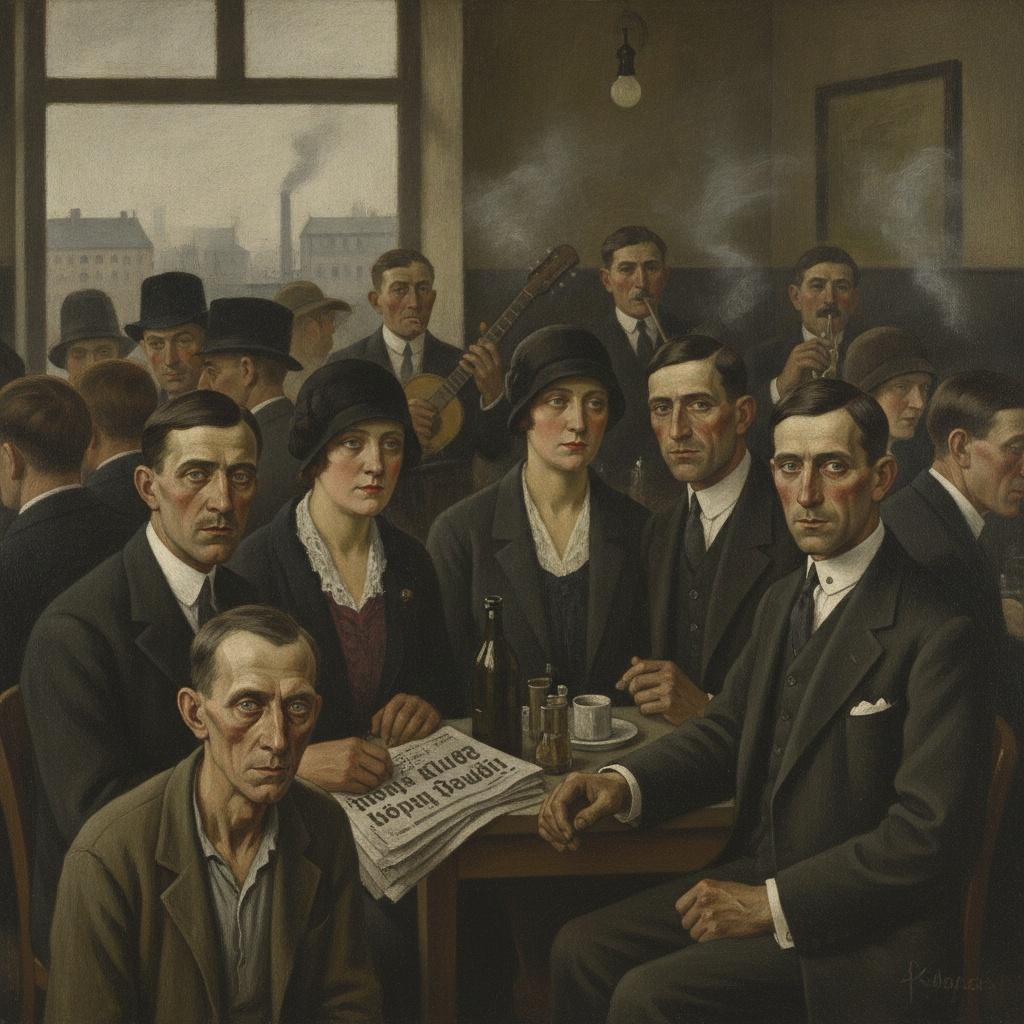
To truly comprehend the emergence of Neue Sachlichkeit, one must first walk through the scarred and psychologically fragmented landscapes of post-World War I Germany. The Great War had not merely redrawn borders; it had shattered the very foundations of European idealism. Before this era of stark clarity took hold, the German art world was dominated by German Expressionism, a movement that functioned as a visceral, often agonizing scream against the horrors of conflict. Character, emotion, and the internal storm of the soul were rendered through swirling, distorted forms and intense, subjective palettes.
However, as the dust of the trenches settled and the 1920s unfolded, a new generation of artists began to feel that such emotional abstraction had become insufficient. The feverish dreams of the subconscious could no longer adequately document the tangible decay of a nation grappling with hyperinflation, political assassinations, and profound social upheaval. There was a growing, desperate need to move away from the internal psyche and toward an external, unblinking observation of the present moment. This transition was not merely a change in brushstroke, but an existential shift—a movement from the romanticized longing of the past toward a cold, much-needed confrontation with the reality of a broken society.
Defining Neue Sachlichkeit: The Pursuit of Clinical Realism and Order
 New Objectivity
The New Objectivity (in German: Neue Sachlichkeit) was a movement in German art that arose during the 1920s as a reaction against expressionism. The term was coined by Gustav Friedrich Hartlaub, the director of the Kunsthalle in Mannheim, who used it...
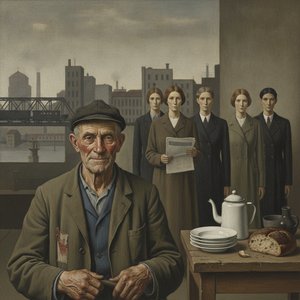
The term Neue Sachlichkeit, or New Objectivity, was famously coined by Gustav Friedrich Hartlaub, the director of the Kunsthalle Mannheim, to describe an exhibition staged in 1925. While English translations often vary—ranging from "New Sobriety" to "New Matter-of-factness"—the essence of the movement lies in its rejection of romantic idealism. It represented a pivotal turn toward a clinical, almost detached realism. These artists sought to strip away the layers of sentimentality to reveal the unvarnished truth of the Weimar Republic.
This pursuit of order amidst chaos manifested in a sharp, precise technique that emphasized clarity and definition. There was an inherent Sachlichkeit—a matter-of-factness—in how these painters approached their subjects. By focusing on the tangible textures of life, from the heavy weave of a soldier's uniform to the cold gleam of a cocktail glass, they created a visual archive of a civilization in flux. This was art as a mirror, reflecting both the structural stability the era craved and the profound instability it inhabited. It was an all-business attitude, a disciplined gaze that refused to look away from the uncomfortable details of modern existence.
Masters of the Unblinking Eye: Otto Dix, George Grosz, and the Social Critique
 Attack
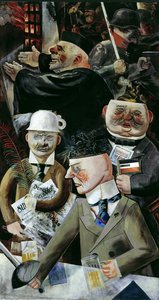
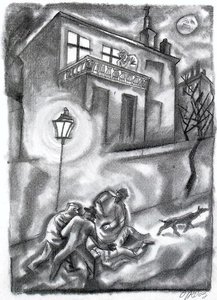
Attack by George Grosz: A Monochromatic Vision of Urban Conflict George Grosz's "Attack" is a striking charcoal drawing that plunges the viewer into a chaotic and unsettling nighttime scene within an urban environment. Created during the tumultuous p...
At the heart of this movement stood figures whose work remains some of the most provocative in the history of modern art. Otto Dix, a veteran of the Great War, brought a ruthless honesty to his canvases. His experiences in the trenches informed a style that was both haunting and hyper-realistic. In works such as his portraits, one sees an unflinching attention to detail that captures not just the physical likeness, but the psychological weight of the era. His ability to blend soft lines with sharp, unsettling textures allows the viewer to feel the tension of the Weimar streets.
Parallel to Dix was George Grosz, whose work often served as a scathing, satirical critique of German society. In pieces like "Attack," Grosz utilized monochromatic palettes and dynamic compositions to plunge the viewer into scenes of urban conflict and moral corruption. His art exposed the hypocrisy of the ruling classes and the decay of the social fabric with a biting, almost aggressive precision. Alongside contemporaries such as Max Beckmann and Christian Schad, these masters utilized the New Objectivity to perform a surgical dissection of their era, ensuring that the political and social rot of the time could never be ignored by the watching world.
The New Woman and Urban Decadence: Capturing the Spirit of Weimar Berlin
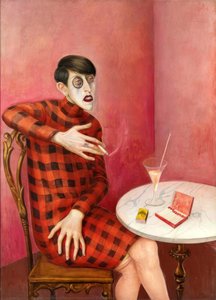
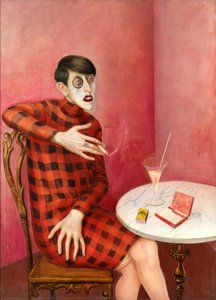 Portrait of the Journalist Sylvia Von Harden
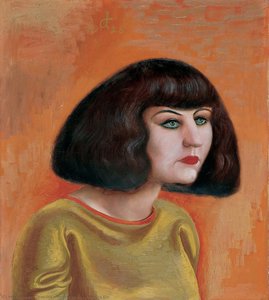
The Enigmatic Allure of Sylvia von Harden Otto Dix's "Portrait of the Journalist Sylvia Von Harden" is an iconic masterpiece that captures the essence of the Weimar Republic era. This striking portrait, created in 1926, features Sylvia von Harden, a ...
The movement also served as a profound document of the shifting cultural tides within Berlin, particularly the emergence of the "New Woman." This archetype—characterized by bobbed hair, modern attire, and an unprecedented level of social autonomy—became a central subject for New Objectivity artists. Otto Dix’s "Portrait of the Journalist Sylvia von Harden"* stands as an iconic masterpiece of this transition. Through his use of oil and tempera, Dix captures the enigmatic allure of von Harden, seated with a cigarette and cocktail, embodying the progressive attitudes towards gender and sexuality that defined the era.
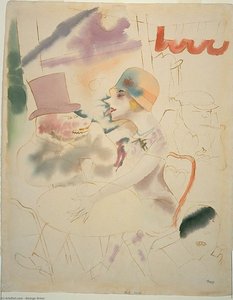
This period was marked by a fascinating duality: the glittering decadence of Berlin's nightlife contrasted against the grim reality of the streets. The art of this time captures the leisure and indulgence of the café culture while simultaneously highlighting the underlying tension. The geometric shapes of modern architecture and the sharp, clean lines of contemporary fashion provided a new visual language for an era that was both celebrating liberation and mourning loss. It was a world of intense light and deep shadow, where the allure of the modern was inseparable from its inherent instability.
Beyond the Canvas: The Influence of New Objectivity on Photography and Design
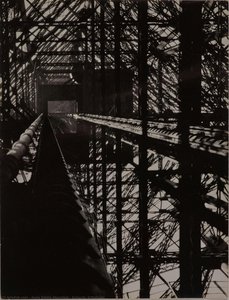 anna sibilla sternfeld
A Pioneer of New Objectivity: The Life and Legacy of Anna Sibilla Sternfeld Anna Sibilla Sternfeld, known professionally as Aenne Biermann, was a quietly revolutionary figure in the landscape of early 20th-century photography. Born on March 8, 1898, ...
While primarily associated with painting, the spirit of Neue Sachlichkeit extended deeply into the realms of photography and design. The movement’s demand for uncompromising clarity and precision found a natural ally in the evolving medium of photography. Artists like Aenne Biermann (known professionally as Anna Sibilla Sternfeld) pioneered a way of capturing reality through an acute observational eye, moving beyond mere documentation toward a deeper exploration of form, light, and shadow.
This photographic approach mirrored the painterly pursuit of "objectivity," seeking to present the world with a scientific, almost clinical accuracy. This aesthetic influence bled into the broader culture of the Weimar Republic, informing the functionalism of the Bauhaus movement and the radical new approaches to graphic design. The emphasis on pure form, stripped of unnecessary ornament, echoed the New Objectivity's rejection of Expressionist distortion. In this way, the movement helped shape the very visual identity of the 20th century, bridging the gap between fine art and the functional modern world.
Preserving the Era: Collecting the Sharp Realism of the 1920s
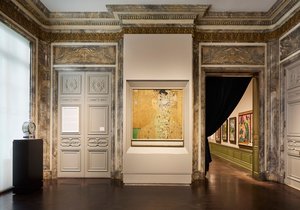 Museum for German and Austrian Art and Private Collection
A Sanctuary of Modernity: Discovering the Neue Galerie New York The early twentieth century was a crucible of artistic innovation, a period where tradition fractured and new modes of expression surged forth. In the heart of New York City, the Neue Ga...
For the modern historian and collector, the works of the New Objectivity offer an unparalleled window into one of history's most turbulent decades. To possess a reproduction of such a piece is to hold a fragment of the Weimar soul. The power of these works lies in their tactile presence—the visible brushstrokes and deep tonal ranges that a simple print cannot replicate. At ArtsDot.com, we specialize in bringing these historical masterpieces into the modern home through meticulous, hand-painted oil reproductions.
Our artists, all holders of prestigious Fine Arts degrees, work on 100% cotton canvas to ensure that the texture and "soul" of the original are preserved. Whether it is the biting satire of a Grosz or the haunting realism of a Dix, our process—from digital mockup to the final application of Damar varnish—is designed to meet museum-grade standards. We invite you to explore our collection of canonical masterpieces, where history is not just studied, but lived through the enduring beauty of fine art.