The Dawn of Verticality: From Romanesque Solidity to Gothic Aspiration
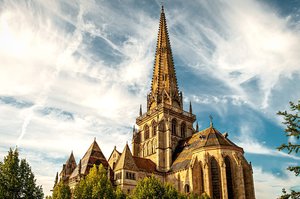 Saint-Lazare Cathedral
A Sanctuary of Stone: The Eternal Spirit of Saint-Lazare Cathedral In the heart of Burgundy, where the ancient roads of the Camino Francés converge, stands the Saint-Lazare Cathedral in Autun—a monumental testament to the spiritual fervor and artisti...
To understand the Gothic movement, one must first contemplate the heavy, earthbound silence of the era that preceded it. The Romanesque period was defined by a sense of fortress-like stability; churches were structures of thick limestone walls, small apertures, and rounded arches that seemed to press downward with the weight of mortal existence. However, as the twelfth century progressed, a profound architectural metamorphosis began to take root in Northern France. This was not merely a change in masonry, but a fundamental shift in the human spirit—a desire to break free from the terrestrial and reach toward the celestial.
The transition was marked by the revolutionary introduction of the pointed arch, the ribbed vault, and the flying buttress. These innovations allowed architects to redistribute the immense weight of stone ceilings away from the walls and onto external supports. As a result, the massive, opaque barriers of the Romanesque era dissolved, replaced by soaring heights and skeletal frameworks that seemed to defy gravity itself. This newfound verticality served a singular theological purpose: it drew the eye—and the soul—upward, mimicking the ascent of prayer toward the heavens. In places like the Saint-Lazare Cathedral in Autun, we witness this breathtaking moment of transition, where the sturdy foundations of the past begin to embrace the light-filled ambitions of a new, ascending age.
The Theology of Light: Stained Glass and the Divine Presence
 Divine Splendor: A Guide to the Sacred Beauty and Symbolic Depth of High Medieval Art
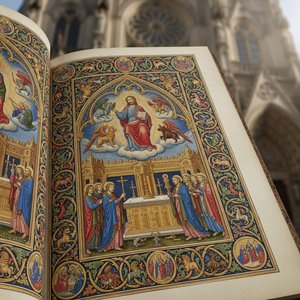
The Celestial Canvas: Understanding the Spiritual Purpose of High Medieval Art To step into the world of High Medieval art is to leave the mundane behind and enter a realm where every brushstroke serves as a bridge between the earthly and the divine....
If architecture provided the skeletal framework for Gothic aspiration, then stained glass provided its very soul. In the medieval mind, light was never merely a physical phenomenon; it was an expression of the divine essence. Theologians of the era spoke of lux nova, or "new light," a concept where the filtered, multicolored radiance passing through cathedral windows was believed to be a direct manifestation of God’s grace. To step into a Gothic nave was to leave the mundane, monochromatic world behind and enter a realm transformed by a kaleidoscope of sacred hues.
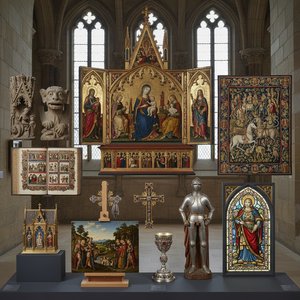
The windows functioned as luminous membranes between the earthly and the divine. Through the use of intricate tracery and vibrant pigments, stories of the saints and the mysteries of the liturgy were projected onto the stone floors and columns. This was an immersive, multisensory experience designed to facilitate anagogical contemplation—the process of leading the mind from material beauty to spiritual truth. The interplay of shadow and brilliance created a dynamic environment where the boundaries of the physical world felt intentionally blurred, inviting the faithful to witness the eternal through the medium of colored light.
Sacred Narratives: Decoding Symbolism in Medieval Panel Painting
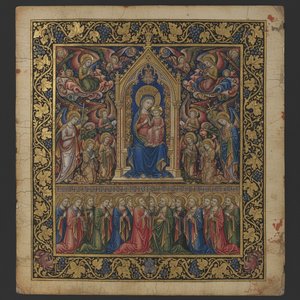 Divine Details: A Masterclass in the Spiritual Grandeur of Late Medieval Art
The Sacred Canvas: Understanding the Spiritual Intent of Late Medieval Art To gaze upon a Late Medieval masterpiece is to step through a portal into a world where the boundary between the earthly and the divine was intentionally blurred. During this ...
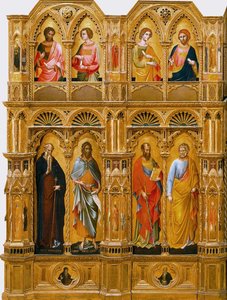
Beyond the grand scale of cathedrals, the Gothic era flourished in the intimate space of the wooden panel. In an age where literacy was a rare privilege, art served as the Biblia Pauperum, or the Bible of the Poor. Every brushstroke on a devotional panel was an act of theological instruction, and every element within the composition carried a hidden, sophisticated language of symbols. To the untrained eye, a painting might appear as a simple depiction of a holy figure; to the medieval observer, it was a complex text waiting to be read.
Consider the profound symbolism embedded in the natural world. A single white lily, often found in depictions of the Annunciation, was far more than a botanical detail; it was a potent emblem of the Virgin Mary’s purity. A pomegranate, with its many seeds bursting from a single rind, served as a metaphor for the unity of the Church or the promise of the Resurrection. Even the use of gold leaf held deep significance, representing the incorruptible, unapproachable light of heaven. In masterpieces such as those by the Limbourg Brothers, this intricate iconography creates a window into a world where nothing is accidental, and every color and texture serves to reinforce the sanctity of the divine narrative.
Architectural Grandeur: The Evolution of Cathedrals and the Gothic Spirit
Basics to get you started · Gothic architecture, an introduction · Florence in the Late Gothic period, an introduction · Spanish Gothic cathedrals, an introduction.
The evolution of the Gothic cathedral represents one of the greatest collective achievements in human history. These structures were not merely buildings; they were living chronicles of faith, engineering, and civic pride. As the movement spread from France across Europe—reaching the unique, trade-influenced styles of Venetian Gothic or the alabaster-carved traditions of the Nottingham Workshop—each region infused the style with its own cultural identity. The cathedral became a microcosm of the universe, a structured hierarchy of stone that mirrored the celestial order.
The Transition to Naturalism: Late Gothic Art and the Early Netherlandish Influence
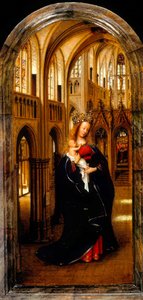
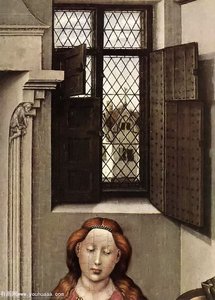 Madonna with the Child (detail)
A Window into Fourteenth-Century Faith: The Masterful Detail of Campin’s Madonna Robert Campin, often referred to as the Master of Flémalle, stands as a pivotal figure in the transition from the Byzantine formality of medieval art to the burgeoning n...
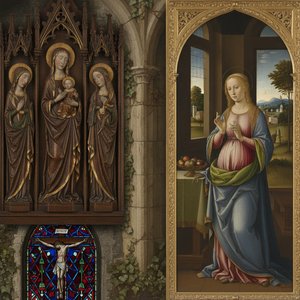
As the Gothic period drew toward its conclusion, a subtle but revolutionary shift began to occur. The rigid, stylized abstractions of the High Middle Ages started to give way to a burgeoning naturalism. This era saw the emergence of artists like Robert Campin, often known as the Master of Flémalle, who acted as a bridge between medieval formality and the profound realism of the Early Netherlandish school. In his works, such as the Madonna with the Child, we see a move toward capturing the tangible textures of the world—the soft sheen of fabric, the delicate folds of skin, and the subtle play of light and shadow.
This transition did not abandon Gothic symbolism; rather, it integrated it into a more recognizable, humanized reality. The divine was no longer found only in distant, golden abstractions but was increasingly glimpsed within the familiar details of everyday life. This movement toward emotional depth and physical accuracy laid the groundwork for the Renaissance, forever changing the course of Western art. It was a period where the sacred and the human began to converge, creating a legacy of beauty that continues to inspire collectors and historians alike.
At ArtsDot.com, we celebrate this profound history by preserving the essence of these masterpieces. Our mission is to make the grandeur of the Old Masters accessible to the modern connoisseur through exquisite, hand-painted oil reproductions. Each piece is meticulously crafted by academic artists on 100% cotton canvas, ensuring that the visible brushstrokes and deep tonal ranges of the original era are honored in every reproduction. Whether you seek a monumental multi-panel work for a grand hall or a delicate devotional piece, our collection offers a window into the splendor of the past. We invite you to explore our library of canonical masterpieces and bring the enduring light of Gothic art into your own collection.