




The Manifesto of Modernity: Origins of the Futurist Movement
At the dawn of the twentieth century, as the gears of the Industrial Revolution began to grind with unprecedented ferocity, a group of Italian intellectuals and artists felt a profound, almost violent, urge to break from the weight of the past. The air in Milan and Rome was thick with the scent of coal smoke and the electric hum of progress, signaling an era where tradition felt increasingly like a shroud. In 1909, Filippo Tommaso Marinetti published his incendiary "Futurist Manifesto" on the front page of Le Figaro, effectively declaring war on museums, libraries, and the stagnant aesthetics of classical antiquity. This was not merely an artistic shift; it was a cultural insurrection designed to celebrate the roar of the motorcar, the frantic energy of the urban crowd, and the sheer, unadulterated power of the machine.
To understand Futurism is to understand a rejection of the "passéist" obsession with Renaissance perfection. The movement sought to align human perception with the rapid-fire rhythm of modern life. For the history lover, this period represents one of the most radical redefinitions of beauty in the Western canon—a transition from the contemplative stillness of the Old Masters to a fragmented, vibrating reality where nothing remains static. It was an era that demanded art move as fast as the locomotives crossing the Italian plains, forcing the viewer to abandon passive observation in favor of a visceral, immersive experience of change.
The Aesthetics of Velocity: Capturing Speed and Kinetic Energy
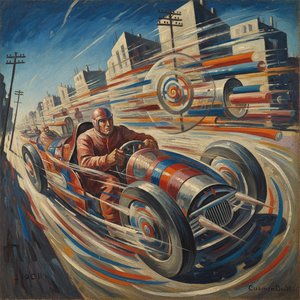
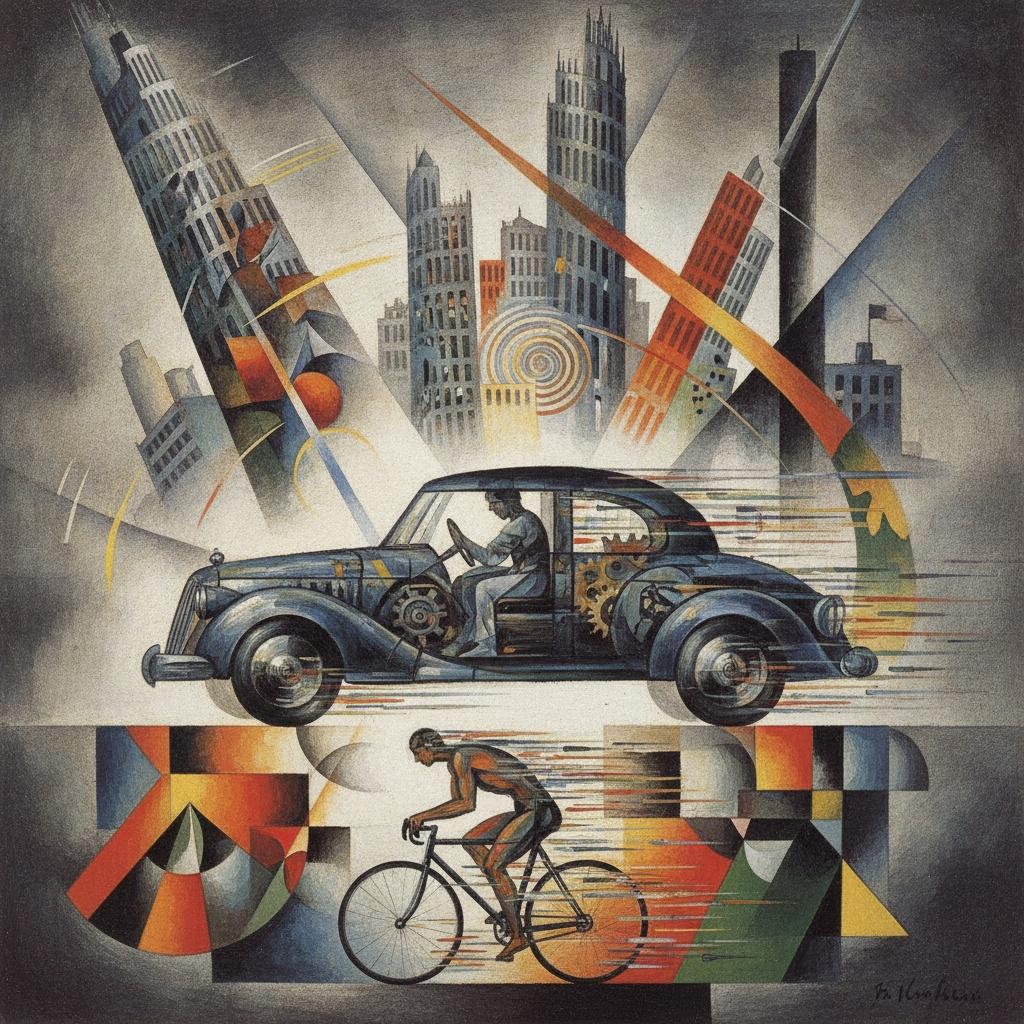
How does one paint the invisible? How can a stationary canvas convey the blur of a passing cyclist or the rhythmic pulse of a city street? The Futurists found their answer in the concept of dynamism. They believed that objects were not isolated entities but were instead inextricably linked to their environment through motion and light. This led to the development of "force-lines"—visual trajectories that suggest the path an object takes through space, effectively pulling the viewer into the slipstream of the subject.
In works such as Umberto Boccioni’s Soccer (Dynamic Action Image), we witness the attempt to freeze a moment of pure athletic exertion while simultaneously illustrating its momentum. The painting does not merely show players on a field; it captures the swirling energy and the displacement of air that accompanies the game. Similarly, in Dynamism of a Cyclist, the artist utilizes fragmented forms and bold, intersecting colors to simulate the sensation of wind and velocity. By deconstructing the physical boundaries of the subject, the Futurists achieved a sense of "simultaneity," where memory, movement, and present perception collide on a single plane. For collectors seeking to bring this palpable energy into a contemporary space, these hand-painted reproductions offer a profound way to anchor a room with historical intensity.
Umberto Boccioni and the Deconstruction of Form
At the heart of this aesthetic revolution stood Umberto Boccioni, perhaps the most gifted practitioner of the Futurist vision. While Marinetti provided the ideological fire, Boccioni provided the technical soul. His work represents a sophisticated bridge between the structural lessons of Cubism and the emotive power of Italian tradition. Boccioni’s genius lay in his ability to treat the human form not as a solid mass, but as a fluid entity subject to the laws of physics and light.
Consider the breathtaking Dynamism of a Human Body. Here, the artist employs a palette of vibrant reds and oranges to evoke a sense of internal heat and external motion. The body is no longer a static anatomical study; it is an explosion of energy, where muscles and limbs seem to dissolve into the surrounding atmosphere. This deconstruction of form was revolutionary, challenging the very definition of sculpture and painting. Boccioni’s ability to manipulate volume and space paved the way for future generations to explore abstraction, proving that even when a figure is broken into fragments, its essential spirit can be more powerfully communicated than through traditional realism.
Technological Triumph: The Influence of Industry and Urbanization
The Futurist movement was deeply rooted in the physical transformations of the landscape. The rise of the metropolis—with its electric streetlights, steel structures, and deafening factory whistles—provided an endless reservoir of inspiration. The artists looked to the locomotive, the airplane, and the industrial plant as the new cathedrals of the modern age. This fascination with technology was not merely about subject matter; it was about a new way of seeing. The flickering light of electric lamps created shadows that were sharper and more transient than those found in the soft glow of candlelight.
This era of urbanization brought about a sensory overload that the Futurists embraced. They sought to replicate the "noise" of the city through visual texture—using thick, impasto brushstrokes and clashing color palettes to mimic the cacophony of urban life. The movement celebrated the triumph of man over nature through the medium of steel and steam. For those who appreciate the architectural grandeur of the industrial era, owning a reproduction of such works serves as a tribute to the period when humanity first truly mastered the mechanics of speed.
Legacy of the Machine Age: From Futurism to Contemporary Abstraction
Though the original Futurist movement was short-lived, its impact on the trajectory of 20th-century art is immeasurable. The techniques developed by Boccioni and his contemporaries—the fragmentation of form, the emphasis on light as a dynamic force, and the celebration of motion—became foundational elements for subsequent movements like Vorticism, Constructivism, and even the development of Abstract Expressionism. They taught us that art could be more than a window into a scene; it could be an engine of sensation.
Today, we see the echoes of Futurism in our digital age, where motion is constant and the boundaries between the physical and virtual worlds continue to blur. The movement’s obsession with the "new" remains a vital part of our cultural DNA. For the discerning enthusiast, collecting these works is an act of preserving a pivotal moment in human history—a moment when we dared to look at a speeding machine and see not just metal, but poetry. At ArtsDot.com, we take immense pride in offering meticulously hand-painted oil reproductions of these canonical masterpieces, ensuring that the vibrant, kinetic spirit of the Futurists continues to inspire homes and galleries across the globe.