
- Startseite

- Digitales Bild
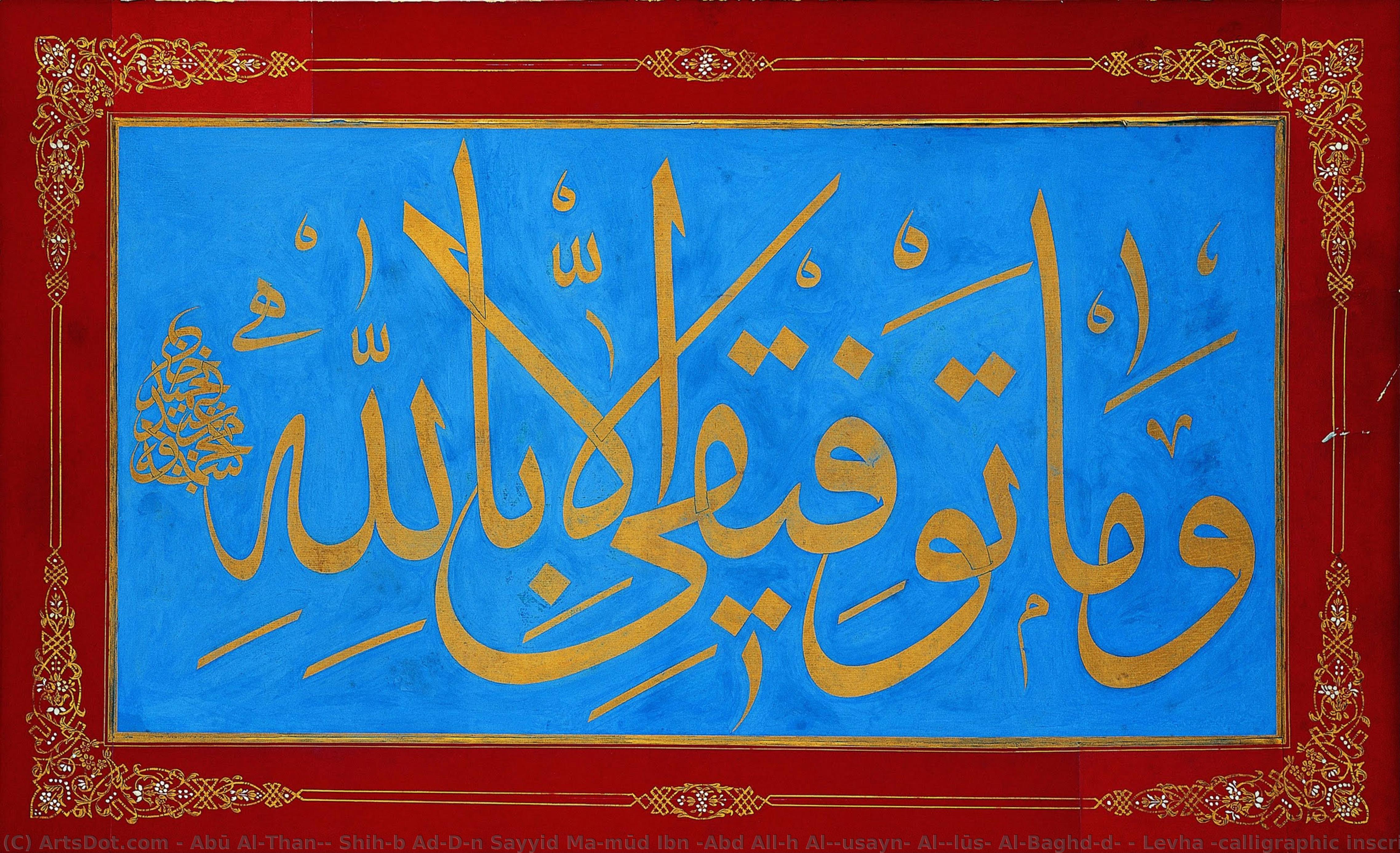
- Abū Al-Thanā’ Shihāb Ad-Dīn Sayyid Maḥmūd Ibn ‘Abd Allāh Al-Ḥusaynī Al-Ālūsī Al-Baghdādī
 Vorschau anzeigen
 Versenden
 Teilen
 Details anzeigen

 Herunterladen
 Ähnliche Objekte
 Röntgenaufnahme
 Diashow
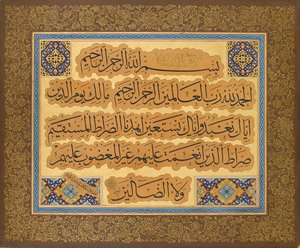
Levha (calligraphic inscription)
 Painting
- Islamic Calligraphy
 1800
1800- 19th Century
 86.0 x 53.0 cm
 Sakıp Sabancı Müzesi
 Weiterlesen
Erwerben Sie ein hochauflösendes, optimiertes digitales Bild, das der Online-Vorschau weit überlegen ist.
Jede Datei wird von unseren hauseigenen Spezialisten mit modernsten Werkzeugen und fachmännischer manueller Retusche sorgfältig vorbereitet. Wir stellen sicher, dass jedes Bild eine außergewöhnliche Klarheit, präzise Farbgenauigkeit und feinste Details aufweist.
Die endgültige Datei wird innerhalb von 72 Stunden per E-Mail zugestellt und ist für den sofortigen Einsatz in professionellen, redaktionellen und Druckumgebungen optimiert. Es handelt sich um dieselbe Qualität, der führende Designstudios, Verlage und Galerien vertrauen.
Digitales Bild
Laden Sie eine hochauflösende Datei für die persönliche Präsentation, den Druck und kreative Projekte herunter. ( Druck bestellen Handgemalte Reproduktion bestellen)
In jeder Bestellung digitaler Bilder enthalten
Professionelle digitale Bereitstellung, garantiert
Wenn Sie sich für ArtsDot.com entscheiden, erhalten Sie nicht nur ein Bild – Sie erhalten ein professionell aufbereitetes digitales Kunstwerk, das mit höchster Präzision erstellt und durch eine Zufriedenheitsgarantie abgesichert wird. Hier ist alles, was automatisch mit Ihrer Bestellung geliefert wird:

Schnelle E-Mail-Zustellung
Ihre hochauflösende digitale Bilddatei wird Ihnen innerhalb von 72 Stunden nach der Bestellung per E-Mail zugestellt – bereit zur sofortigen Verwendung.

KI-optimierte digitale Datei
Ihre Kunstwerke werden professionell mithilfe fortschrittlicher KI-Tools und manueller Bearbeitung optimiert, um maximale Detailtreue, Klarheit und Farbgenauigkeit zu gewährleisten.

Lebenslanger kostenloser Neudruckservice
Datei versehentlich gelöscht oder verloren? Keine Sorge – wir senden sie Ihnen jederzeit kostenlos erneut zu.

Keine Einfuhrgebühren – jemals
Genießen Sie Ihr Kunstwerk sofort ohne Zollgebühren, Einfuhrabgaben oder Versandkosten – digitale Downloads sind immer steuerfrei.

Garantierte Farbtreue
Wir garantieren, dass Ihr digitales Bild mithilfe professioneller Werkzeuge und Farbmanagement die Originalfarben so präzise wie möglich wiedergibt.

60-Tage-Zufriedenheitsgarantie
Sollten Sie mit Ihrem digitalen Bild nicht zufrieden sein, werden wir es überarbeiten oder Ihnen innerhalb von 60 Tagen 100% erstatten – ohne Wenn und Aber.

100% Geld-zurück-Garantie
Nicht zufrieden? Erhalten Sie innerhalb von 60 Tagen nach Erhalt Ihrer digitalen Datei eine vollständige Rückerstattung – ohne Angabe von Gründen.

Rabatte bei Großbestellungen
3 Bilder kaufen, 10% sparen – 5 Bilder kaufen, 15% sparen – Ab 10 Bildern 20% sparen. Ideal für kreative Projekte, Galerien und Agenturen.
A Divine Presence in Ink and Azure
In the quiet contemplation of Islamic art, few forms possess the immediate spiritual gravity of the Levha. This exquisite calligraphic inscription, created around 1800 by the venerable scholar-artist Abū Al-Thanā’ Shihāb Ad-Dīn Sayyid Maḥmūd Ibn ‘Abd Allāh Al-Ḥusaynī Al-Ālūsī Al-Baghdādī, serves as a profound meditation on the divine. At its heart, the piece centers on the sacred name "Allah," rendered in masterful Arabic script that dances across a deep, celestial blue background. The composition is framed by a delicate red trim, a warm contrast that anchors the ethereal blue and draws the eye inward toward the luminous center of the work. To behold this painting is to experience a moment of stillness, where the weight of history meets the lightness of spiritual devotion.
The technique employed in this piece reflects the high tradition of 19th-century calligraphic mastery. The artist, who was not only a master of the pen but also one of Baghdad's most esteemed religious authorities, utilizes the fluid, rhythmic strokes characteristic of classical Islamic calligraphy to breathe life into the sacred text. Each curve and terminal point of the script is deliberate, designed to guide the viewer’s gaze in a meditative loop. The interplay between the saturated blue pigment and the precise, dark ink creates a sense of depth, as if the holy name is floating within an infinite cosmic void. For collectors and designers, this piece offers a sophisticated balance of bold color and intricate detail, making it a centerpiece capable of commanding any space.
Historical Resonance and Symbolic Depth
Beyond its aesthetic brilliance, the Levha is a window into the intellectual and spiritual landscape of the early 19th-century Ottoman era. The artist, Al-Alusi, was a figure of immense prestige—a mufti whose lineage traced back to the Prophet Muhammad himself. His ability to blend scholarly precision with artistic grace is evident in every stroke of this work. This piece does not merely represent a word; it embodies the concept of dhikr, or the remembrance of God, which is central to Islamic practice. The choice of blue—a color often associated with the infinite sky and the depths of the ocean—serves as a symbolic bridge between the earthly realm and the divine presence.
For those looking to integrate such a masterpiece into a contemporary interior, the Levha offers more than just decoration; it provides an atmosphere of tranquility and intellectual heritage. Whether placed in a curated gallery setting or used as a focal point in a refined living space, the painting invites conversation about the intersection of faith, history, and fine art. A high-quality reproduction of this work allows the enduring legacy of Al-Alusi to reside within modern homes, bringing a sense of timelessness and sacred beauty to the walls of any discerning collector.
Ähnliche Kunstwerke




Biografie des Künstlers
The Luminary of Baghdad: Abū al-Thanā’ Shihāb ad-Dīn Sayyid Maḥmūd ibn ‘Abd Allāh al-Ḥusaynī al-Ālūsī
Abū al-Thanā’ Shihāb ad-Dīn Sayyid Maḥmūd ibn ‘Abd Allāh al-Ḥusaynī al-Ālūsī, often simply known as Al-Allusi, stands as a towering figure in 19th-century Islamic scholarship. Born in Baghdad on December 10, 1802, into a family of considerable religious standing, his life unfolded against the backdrop of a declining Ottoman Empire and burgeoning intellectual currents. Al-Allusi wasn’t merely an academic; he was a *mufti* – a legal expert empowered to deliver rulings on Islamic law – deeply involved in the socio-political fabric of his time. His lineage connected him to the esteemed ‘Alid family, descendants of Prophet Muhammad, lending further weight to his authority and influence within the Sunni Muslim community. He passed away on July 29th, 1854, leaving behind a legacy that continues to resonate through Islamic thought.A Life Dedicated to Interpretation: The Genesis of *Rūḥ al-Ma‘ānī*
Al-Allusi’s most enduring contribution is undoubtedly his monumental commentary on the Qur'an, titled *Rūḥ al-Ma‘ānī fī tafsīr al-Qur’ān al-‘aẓīm wa-al-sab‘ al-mathānī* – “The Spirit of the Meaning in Commentary upon the Mighty Qur’ān and the Seven Oft-Repeated Verses.” This work, spanning approximately thirty volumes, is a testament to his profound knowledge of Islamic theology, jurisprudence, Arabic language, literature, and history. It wasn't simply an exegesis; it was a comprehensive exploration of the Qur'anic text, drawing upon a vast array of sources and perspectives. Al-Allusi’s approach was characterized by its meticulous detail, intellectual honesty, and willingness to engage with diverse interpretations. He didn’t shy away from acknowledging differing viewpoints, often presenting them before offering his own reasoned analysis. The sheer scale of *Rūḥ al-Ma‘ānī* reflects a lifetime devoted to understanding the divine word, making it one of the largest and most respected tafsirs in existence.Intellectual Influences and Scholarly Positioning
Al-Allusi’s intellectual formation was deeply rooted in the traditions of Sunni Islam, particularly the Hanafi school of jurisprudence. However, he wasn't confined by rigid adherence to a single school of thought. He demonstrated a remarkable openness to other perspectives, including those from the Shafi'i school and even elements of Sufism. This eclecticism is evident in *Rūḥ al-Ma‘ānī*, where he frequently references scholars from various backgrounds. His connection to the Naqshbandi *tariqa* (Sufi order) further broadened his intellectual horizons, imbuing his work with a mystical sensibility and an appreciation for the inner dimensions of faith. He engaged with contemporary debates within Islamic scholarship, navigating complex theological issues with nuance and sophistication. He corresponded with figures like Sayyid Kāẓim Rashtī, a prominent Shaykhī leader, demonstrating his willingness to engage in dialogue even with those holding differing beliefs.Historical Significance and Enduring Legacy
Al-Allusi’s significance extends beyond the realm of purely theological scholarship. He lived during a period of significant upheaval, witnessing the decline of traditional power structures and the rise of new intellectual forces. His commentary on the Qur'an served not only as an interpretation of scripture but also as a reflection of the challenges facing the Muslim world at the time. His willingness to engage with diverse perspectives and his emphasis on reasoned analysis made him a respected figure among both scholars and laypeople. *Rūḥ al-Ma‘ānī* continues to be studied today, serving as a valuable resource for understanding the Qur'an and Islamic thought. His work has been reprinted numerous times, ensuring its accessibility to future generations of scholars. Furthermore, his engagement with contemporary issues, such as the Bābī movement, provides insights into the intellectual landscape of 19th-century Iraq.Beyond *Rūḥ al-Ma‘ānī*: A Broader Intellectual Contribution
While *Rūḥ al-Ma‘ānī* remains his most celebrated work, Al-Allusi’s contributions extended beyond Qur'anic exegesis. He was a prolific writer on various Islamic topics, including jurisprudence, theology, and Arabic grammar. His writings demonstrate a deep understanding of classical Islamic texts and a commitment to preserving the intellectual heritage of Islam. He also engaged in practical religious leadership as a *mufti*, providing guidance and rulings on matters of law for his community. He was known for his fairness, integrity, and dedication to upholding justice. The fact that he held the position of mufti while simultaneously producing such a monumental scholarly work speaks volumes about his intellectual capacity and unwavering commitment to both theory and practice. His legacy is one of profound scholarship, intellectual openness, and dedicated service to the Muslim community.
Kurzinfos
- Artistic Movement Or Style: Islamic scholarship
- Date Of Birth: December 10, 1802
- Date Of Death: July 29, 1854
- Full Name: Abū Al-Thanā’ Shihāb Ad-Dīn Sayyid Maḥmūd Ibn ‘Abd Allāh Al-Ḥusaynī Al-Ālūsī Al-Baghdādī
- Nationality: Iraqi
- Notable Artworks: ["Ruh al-Ma'ani"]
- Place Of Birth: Baghdad, Iraq

