 Vorschau anzeigen
 Versenden
 Teilen
 Details anzeigen

 Herunterladen
 Ähnliche Objekte
 Röntgenaufnahme
 Diashow
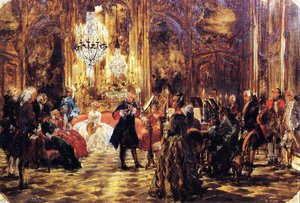
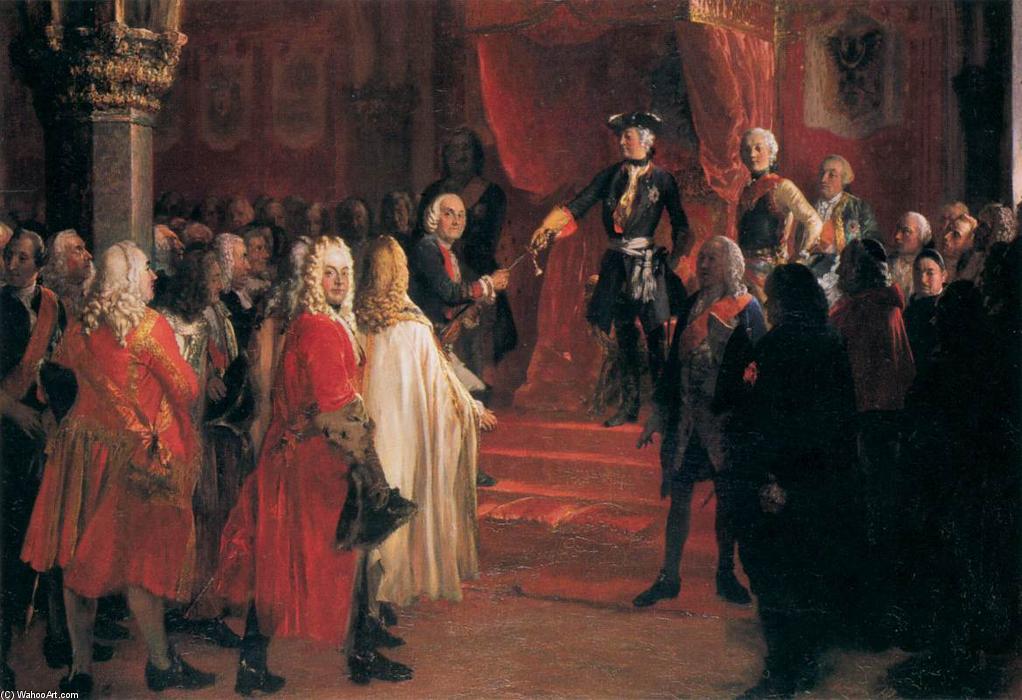
The Allegiance of the Silesian Diet before Frederick II in Breslau
 Oil On Canvas
- WallArt
- Baroque
 1855
1855 98.0 x 136.0 cm
 Nationalgalerie
 Weiterlesen
Handgefertigte Ölreproduktion
Handgemaltes Ölgemälde auf Leinwand in Ihrer Wunschgröße und mit Rahmen, auf Bestellung von unseren Künstlern angefertigt. ( Druck bestellen Bild kaufen)




P118B $10

P118H $10

P118W $10

P438Z $10

P508JH $12

P508YH $12

P805H $10

P805Z $10

P919BZ $10

P919G $10

P919XJ $10

P959ZH $10

P968JZ $12

W106C $8

W218G $10

W218JH $8

W218Y $10

W307PJ $10

W316G $10

W316PJ $8

W316Y $10

W398PJ $8

W4111J $10

W500HY $15

W500JH $15

W692G $12

W849H $8

W940BG $15

W953PJ $8




Wählen Sie aus unseren vordefinierten Formaten, die den ursprünglichen Proportionen des Kunstwerks entsprechen.

Sie können Ihre eigenen Maße eingeben, um einen bestimmten Rahmen oder Platz auszufüllen. Wenn die gewählte Größe nicht den Proportionen des Originalbildes entspricht, werden wir das Kunstwerk entweder beschneiden oder das Gemälde durch zusätzliche, handgemalte Elemente erweitern. Ein digitales Mockup wird Ihnen zur Genehmigung zugesandt, bevor die Produktion beginnt.
Bitte beachten Sie, dass die Bildschirmvorschau nicht die tatsächliche Beschneidung oder Erweiterung widerspiegelt. Nur das Mockup zeigt die endgültige Komposition exakt an.
Obwohl Sondermaße verfügbar sind, empfehlen wir, eine Größe aus der vordefinierten Liste zu wählen, um die ursprünglichen Proportionen beizubehalten.
Nach der Bestellung wird das ArtsDot.com-Team dem Kunden Anweisungen per E-Mail zusenden und eine Mockup-Vorschau bereitstellen.
Weltweiter Versand () in nur 3 bis 4 Wochen statt der üblichen 5 Wochen. (29 August). Keine Kompromisse bei der Qualität.

Kostenloser weltweiter Expressversand

Hochwertige Leinenleinwand

Umfassender Versicherungsschutz beim Versand

Zollgebühren-Rückerstattungsgarantie

Garantie für exakte Farbtreue

60 Tage Rückgaberecht (nur bei Mängeln)

100% Geld-zurück-Garantie

Mengenrabatt verfügbar
 Die Glasoption ist nur für Größen unter 110 cm verfügbar.

The Allegiance of the Silesian Diet before Frederick II in Breslau
Art der Reproduktion
Format der Reproduktion
-


Gesamtpreis
$ 488
A Glimpse into Prussian Power: Adolph von Menzel’s ‘The Allegiance of the Silesian Diet’
Adolph von Menzel's “The Allegiance of the Silesian Diet before Frederick II in Breslau” is more than just a historical painting; it’s a meticulously crafted tableau vivant, a frozen moment brimming with political intrigue and regal authority. Completed in 1855, this imposing oil on canvas transports us to the heart of 18th-century Prussia, offering a rare and intimate view into the elaborate rituals surrounding power and succession. The sheer scale of the work – measuring an impressive 98 x 136 cm – immediately commands attention, drawing the viewer into a densely populated scene teeming with figures rendered in astonishing detail.
Menzel’s genius lies not merely in his technical skill—though that is undeniably remarkable, evidenced by the remarkably lifelike quality of each face and garment—but also in his ability to distill complex historical events into a powerfully symbolic narrative. The painting depicts a formal ceremony where the Silesian Diet, a regional governing body, pledged their allegiance to Frederick II, the “Great King” of Prussia. The central figure, a stern-faced man holding aloft a sword, embodies this power—a potent symbol of military might and political control. His posture is deliberate, radiating an aura of command that dominates the composition.
A Baroque Foundation: Style and Technique
While firmly rooted in Realism, Menzel’s work demonstrates a clear debt to the dramatic conventions of the Baroque period. The use of chiaroscuro—the stark contrast between light and shadow—is particularly striking, creating a theatrical atmosphere that elevates the scene beyond mere documentation. Strong directional lighting focuses attention on Frederick II and his immediate entourage, while the background figures fade into relative obscurity, reinforcing the hierarchy of power. Menzel’s brushwork is deliberately loose in areas, contributing to a textured surface that adds depth and visual interest – particularly noticeable in the fabrics and armor.
The artist's meticulous attention to detail extends beyond mere representation; he seems intent on capturing not just what was *seen*, but also the *feeling* of the event. The elaborate costumes, the carefully rendered architecture (a grand hall with columns and drapery), and the expressions on the faces of the assembled dignitaries all contribute to a sense of formality, solemnity, and underlying tension.
Historical Context: Silesia and Frederick II
To fully appreciate “The Allegiance of the Silesian Diet,” it’s crucial to understand its historical context. Silesia, a region with a complex and often turbulent past, was a key prize in European politics during the 18th century. Frederick II, known as Frederick the Great, was a brilliant military strategist and an ambitious ruler who sought to expand Prussian territory and influence. His reign marked a period of significant modernization and expansion for Prussia, transforming it into a major European power.
The Silesian Diet played a vital role in this political landscape, representing the interests of the region’s nobility and providing Frederick II with crucial support. The ceremony depicted in Menzel's painting was a formal affirmation of loyalty—a symbolic act designed to solidify his authority and ensure the stability of his rule. Interestingly, Menzel’s work reflects the broader artistic trends of the time, which often sought to glorify military achievements and celebrate the virtues of leadership.
Symbolism and Emotional Resonance
Beyond its historical significance, “The Allegiance of the Silesian Diet” is rich in symbolism. The sword represents power, authority, and the willingness to defend one’s realm. The elaborate attire worn by the dignitaries signifies their status and importance within the political hierarchy. The very act of pledging allegiance underscores the concept of loyalty—a cornerstone of both military and political systems.
Despite its formal subject matter, the painting evokes a sense of drama and intrigue. The viewer is drawn into a world of courtly ceremony and political maneuvering, where appearances are carefully constructed and alliances are constantly shifting. Menzel’s masterful use of light and shadow creates an atmosphere of both grandeur and tension, leaving us with a lingering sense of the complexities inherent in the pursuit of power.
Ähnliche Kunstwerke

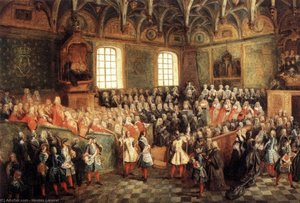
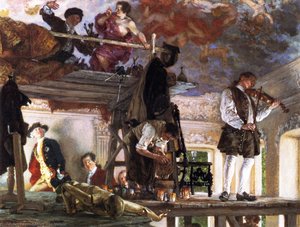
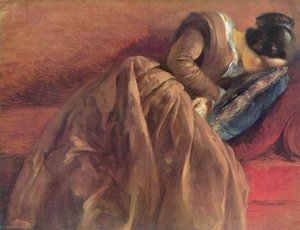
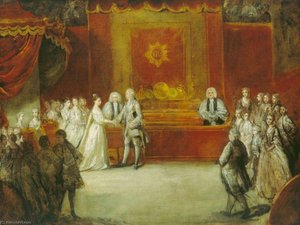

Über den Künstler
Ein Leben voller künstlerischer Exzellenz (1815–1905)
Adolph Friedrich Erdmann von Menzel, ein deutscher Realist, hinterließ mit seinen Zeichnungen, Radierungen und Gemälden einen bleibenden Eindruck in der Kunstwelt. Geboren am 8. Dezember 1815 in Breslau, Schlesien (heute Wrocław, Polen), war Menzels Leben ein Beweis für seine Hingabe, die Essenz der Realität durch seine Kunst einzufangen.Frühes Leben und Ausbildung
Menzels Vater, ein Lithograph, beabsichtigte zunächst, dass sein Sohn Professor werden sollte. Adolphs Leidenschaft für die Kunst setzte sich jedoch durch, was zu einem kurzen Studium an der Berliner Akademie der Künste im Jahr 1833 führte. Anschließend machte er sich selbstständig und verbesserte seine Fähigkeiten durch unermüdliches Üben.Künstlerische Leistungen
- Die Eisenhütte (1872–1875): Ein Meisterwerk, das Menzels scharfe Beobachtungsgabe und handwerkliches Können demonstriert.
- Der Marktplatz in Verona: Ein Beweis für seine Fähigkeit, die Atmosphäre des täglichen Lebens einzufangen.
- Die Kanzelpredigt in der Pfarrkirche zu Innsbruck (1857): Ein beeindruckendes Beispiel für Menzels Meisterschaft, das in der Sammlung Hugo Fischer (Bühl, Deutschland) zu finden ist.
Einfluss und Bedeutung
Menzels Ruf wuchs posthum vor allem durch seine grafischen Arbeiten und informellen Gemälde. Sein Einfluss reichte über Deutschland hinaus; Edgar Degas bewunderte und kopierte seine Werke und nannte ihn den "größten lebenden Meister". Menzels Verbindung zur französischen und englischen Kunst zeigt sich in seinen Genreszenen, wie Das Französische Fenster und Der Palastgarten von Prinz Albert.Vermächtnis und Rezeption
Adolph von Menzel gilt als einer der bedeutendsten deutschen Maler des 19. Jahrhunderts. Seine Werke spiegeln die gesellschaftlichen und industriellen Veränderungen seiner Zeit wider und bieten einen einzigartigen Einblick in das Leben im Deutschland des 19. Jahrhunderts. Er beeinflusste nachfolgende Generationen von Künstlern und seine Arbeiten werden bis heute für ihre Detailgenauigkeit, ihren Realismus und ihre emotionale Tiefe geschätzt. Seine Fähigkeit, sowohl monumentale historische Szenen als auch intime Alltagsmomente mit gleicher Meisterschaft darzustellen, macht ihn zu einer Schlüsselfigur der realistischen Kunstbewegung.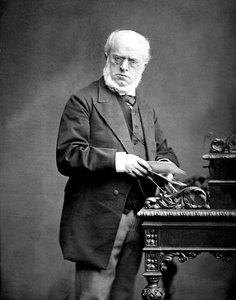
Adolph von Menzel
1815 - 1905 , Polen
Kurzinfos
- Beeinflusste Künstler: ['Edgar Degas']
- Bemerkenswerte Werke:
- Eisenwalzwerk (1872-1875)
- Marktplatz in Verona
- Deutsche Kanzelpredigt in Innsbruck
- Geburtsdatum: 8. Dezember 1815
- Geburtsort: Breslau, Polen
- Künstlerische Richtung: Realismus
- Nationalität: Deutsch
- Sterbedatum: 9. Februar 1905
- Vollständiger Name: Adolph Friedrich Erdmann von Menzel
- Von Künstlern Beeinflusst: ['Caspar David Friedrich']
Ähnliche Artikel

Barocke Pracht: Wie Sie Opulenz und Emotionen in zeitgenössische Innenräume bringen
Entdecken Sie die Pracht des Barock! Expertenratgeber für luxuriöse Innenräume mit barocken Elementen. Inspiration, Tipps & hochwertige Kunst bei .

The Dramatic Flourish: Exploring the Baroque Movement's Enduring Legacy in Art History
Explore the dramatic world of Baroque art! Discover iconic artists like Caravaggio & Rubens, defining techniques, and its lasting impact on art history. Expert insights for collectors & enthusiasts at ArtsDot.
Adolph von Menzel: Preußischer Realismus und die malerische Chronik einer Epoche
Entdecken Sie Adolph von Menzels Meisterwerke des Preußischen Realismus! Erfahren Sie mehr über seine Historienmalerei, soziale Kommentare und seinen Einfluss auf die deutsche Kunstgeschichte. Jetzt lesen!
Meisterwerke des 19. Jahrhunderts: Kunst für Ihr Zuhause | ArtsDot
Entdecken Sie die 10 bedeutendsten Kunstwerke des 19. Jahrhunderts! Von Impressionismus bis Realismus – erleben Sie die Geschichten berühmter Maler und ihre Meisterwerke. Hochwertige Reproduktionen für Ihr Zuhause auf ArtsDot.com.

Barock Meisterwerke: Die 10 prägendsten Kunstwerke für Ihr Zuhause |
Entdecken Sie die 10 prägendsten Meisterwerke des Barock! Caravaggio, Rembrandt & Co. – Erfahren Sie die Geschichten hinter ikonischen Gemälde und finden Sie hochwertige Kunst Reproduktionen für Ihr Zuhause auf .