 Vorschau anzeigen
 Versenden
 Teilen
 Details anzeigen

 Herunterladen
 Ähnliche Objekte
 Röntgenaufnahme
 Diashow
Aretino and the Envoy of Charles V


 Weiterlesen
Giclée / Kunstdruck
Giclée- oder Leinwanddruck in Museumsqualität mit schneller Produktion und flexiblen Veredelungsoptionen. ( Handgemalte Reproduktion bestellen Bild kaufen)




P118B $10

P118H $10

P118W $10

P438Z $10

P508JH $12

P508YH $12

P805H $10

P805Z $10

P919BZ $10

P919G $10

P919XJ $10

P959ZH $10

P968JZ $12

W106C $8

W218G $10

W218JH $8

W218Y $10

W307PJ $10

W316G $10

W316PJ $8

W316Y $10

W398PJ $8

W4111J $10

W500HY $15

W500JH $15

W692G $12

W849H $8

W940BG $15

W953PJ $8




Wählen Sie aus unseren vordefinierten Formaten, die den ursprünglichen Proportionen des Kunstwerks entsprechen.

Sie können Ihre eigenen Maße eingeben, um ein bestimmtes Format oder einen speziellen Platz einzupassen. Wenn das von Ihnen gewählte Format nicht den Proportionen des Originalbildes entspricht, werden wir das Kunstwerk entweder beschneiden oder das Bild mit einem gespiegelten oder einfarbigen Rand erweitern. Ein digitaler Entwurf wird Ihnen zur Genehmigung zugesandt, bevor die Produktion beginnt.
Bitte beachten Sie, dass die Vorschau auf dem Bildschirm nicht den tatsächlichen Zuschnitt oder die Erweiterung widerspiegelt. Nur der Entwurf zeigt die endgültige Komposition präzise an.
Obwohl Sondermaße verfügbar sind, empfehlen wir die Auswahl eines Maßes aus der vordefinierten Liste, um die ursprünglichen Proportionen zu bewahren.
Weltweiter Versand () innerhalb von 2 Wochen statt der üblichen 4/5 Wochen. (5 September)

Kostenloser weltweiter Expressversand

Hochwertige Leinenleinwand

Umfassender Versicherungsschutz beim Versand

Zollgebühren-Rückerstattungsgarantie

Garantie für exakte Farbtreue

60 Tage Rückgaberecht (nur bei Mängeln)

100% Geld-zurück-Garantie

Mengenrabatt verfügbar
 Die Glasoption ist nur für Größen unter 110 cm verfügbar.

Aretino and the Envoy of Charles V
Giclée / Kunstdruck
Format der Reproduktion
-


Gesamtpreis
$ 62
Aretino and the Envoy of Charles V: A Masterful Commentary on Power and Artistic Independence
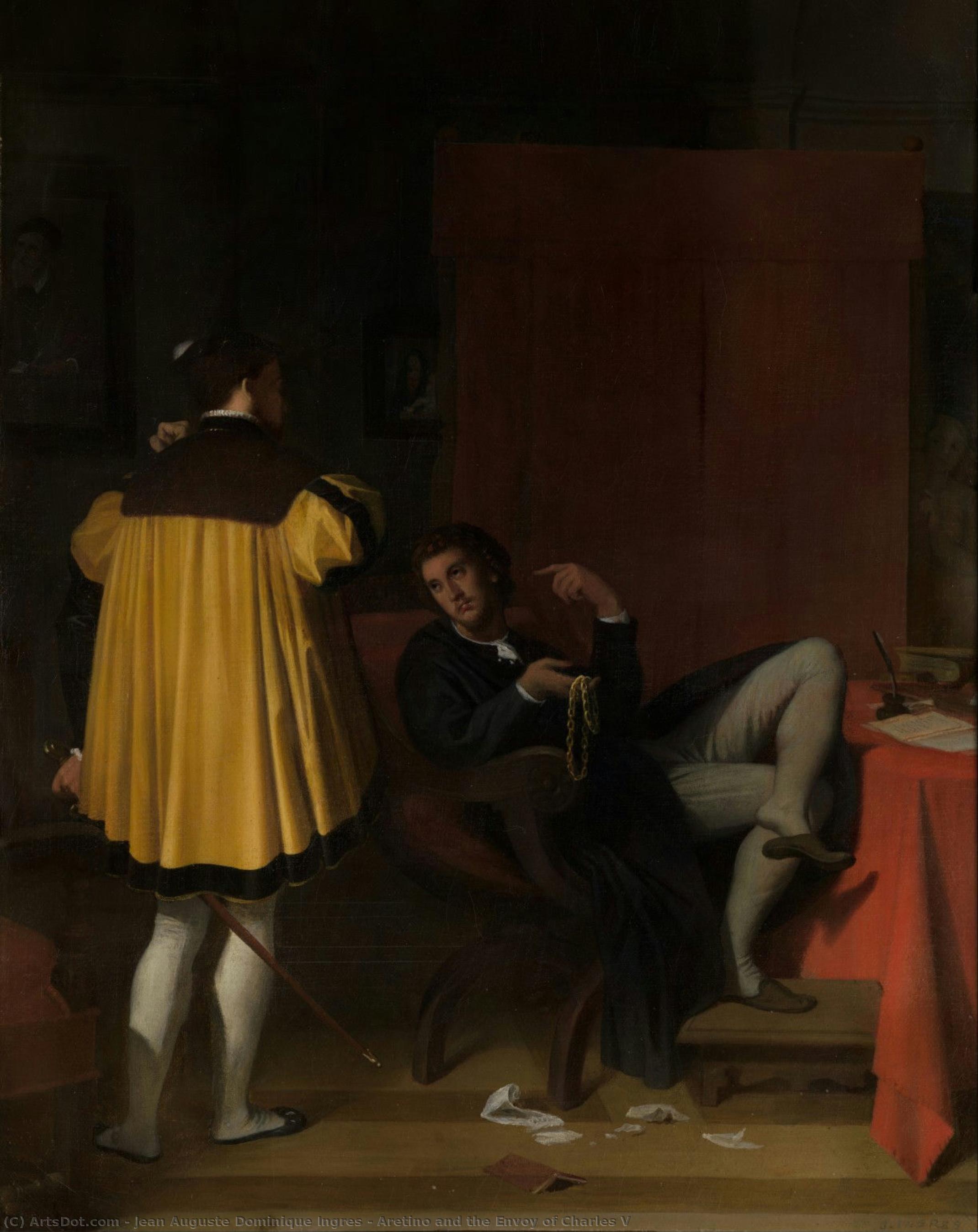
Jean-Auguste-Dominique Ingres’s “Aretino and the Envoy of Charles V,” painted in 1848, is more than a mere portrait; it's a meticulously crafted narrative brimming with historical resonance and profound artistic commentary. This small yet powerfully evocative work captures a legendary episode from the life of Pietro Aretino, the Venetian writer whose scandalous pamphlets famously challenged the authority of European monarchs. The scene unfolds with a deliberate irony, portraying Aretino’s audacious response to Emperor Charles V's attempted bribery – a gold chain offered as recompense for his military defeat – and Ingres brilliantly uses this anecdote to explore themes of artistic independence and the relationship between power and creativity.
- Subject Matter: The painting depicts Aretino, seated with nonchalant disdain, accepting the imperial envoy’s gift. The envoy, enraged by Aretino's audacity, stands poised with his sword hilt raised, while two young women observe the scene with a mixture of curiosity and perhaps amusement.
- Composition & Technique: Ingres employs his signature Neoclassical style – characterized by precise lines, smooth surfaces, and a sculptural quality – to render the figures with remarkable clarity and detail. The use of light and shadow is masterful, emphasizing the textures of the clothing, the gold chain, and the faces of the characters.
- Historical Context: Painted during a period of burgeoning artistic nationalism and a renewed interest in classical ideals, “Aretino” reflects Ingres’s commitment to preserving the traditions of Western art. The inclusion of Titian's self-portrait in the background is a deliberate homage to the Venetian master, further solidifying Aretino’s place within the lineage of great artists.
Symbolism and Narrative Layers
Beyond the surface depiction of an incident, “Aretino” is laden with symbolic meaning. The gold chain itself represents not just material wealth but also the corrupting influence of power – a gift intended to silence Aretino’s voice. The envoy's gesture, frozen in mid-action, embodies the frustration and anger of those who attempt to control artistic expression. Ingres cleverly uses the setting—a richly appointed room filled with books and classical artifacts—to underscore the importance of learning and intellectual pursuits within the artist’s world. The presence of the two nude women adds a layer of sensuality and intrigue, subtly referencing Aretino's notorious reputation for licentiousness and highlighting the tension between art and morality.
- Titian’s Presence: The inclusion of Titian’s self-portrait is not merely decorative; it establishes a direct line of artistic influence, demonstrating Ingres’s deep respect for Venetian masters.
- The Young Women: Their observation suggests a critical perspective on the power dynamics at play and perhaps hints at the role of female patrons in supporting the arts.
Emotional Impact and Artistic Legacy
“Aretino and the Envoy of Charles V” resonates with a potent emotional charge, capturing a moment of defiance and intellectual sparring. Ingres’s masterful handling of light, form, and gesture creates a scene that is both captivating and thought-provoking. The painting's enduring appeal lies in its ability to engage viewers in a timeless debate about the nature of artistic freedom, the responsibilities of power, and the enduring legacy of great artists. It stands as a testament to Ingres’s skill and vision, solidifying his place as one of the most influential figures in 19th-century art.
Reproductions AvailableÄhnliche Kunstwerke
Über den Künstler
Jean-Auguste-Dominique Ingres: Ein Meister des Neoklassizismus
- Geboren: 29. August 1780, Montauban, Frankreich
- Gestorben: 14. Januar 1867, Paris
Frühes Leben und Ausbildung
Jean-Auguste-Dominique Ingres wurde in eine bescheidene Familie in Montauban geboren. Sein Vater, Jean-Marie-Joseph Ingres, war Maler und Bildhauer und vermittelte ihm so ein frühes künstlerisches Fundament. Ingres erhielt zunächst Unterricht von seinem Vater, bevor er an der Académie Royale de Peinture, Sculpture et Architecture in Toulouse unter Guillaume-Joseph Roques eingeschrieben wurde. 1797 zog er nach Paris, um bei Jacques-Louis David zu studieren, einer führenden Figur des Neoklassizismus. Diese Mentorschaft erwies sich als entscheidend für Ingres' künstlerische Entwicklung.
Künstlerische Entwicklung und Einflüsse
Ingres’ Stil war tief in den Traditionen der italienischen Renaissance und flämischer Meister wie Raffael und Nicolas Poussin verwurzelt. Er studierte ihre Werke akribisch und bemühte sich, deren Klarheit, Eleganz und idealisierte Formen nachzuahmen. Der Einfluss von Jacques-Louis David zeigt sich auch in Ingres' anfänglicher Einhaltung neoklassizistischer Prinzipien – einem Fokus auf Linie, Form und historische oder mythologische Themen. Allerdings entwickelte Ingres allmählich seinen eigenen unverwechselbaren Stil, der durch eine einzigartige Mischung aus Präzision und Sinnlichkeit gekennzeichnet ist.
Wichtige Werke und Stil
Ingres erlangte bedeutende Anerkennung durch mehrere bemerkenswerte Werke:
- Die Boten des Agamemnon in Achills Zelt (1801): Dieses Gemälde brachte ihm den Prix de Rome ein, was einen Wendepunkt in seiner Karriere markierte.
- Der Eid Ludwigs XIII. (1827): Ein Werk, das seinen raffaelesken Stil demonstriert und ihm weitreichenden Ruhm einbrachte.
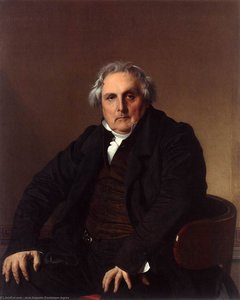
- Porträt von Monsieur Bertin (1833-1834): Dieses Porträt markierte eine Zeit des großen Erfolgs und zeigte seine Fähigkeit, den individuellen Charakter einzufangen.
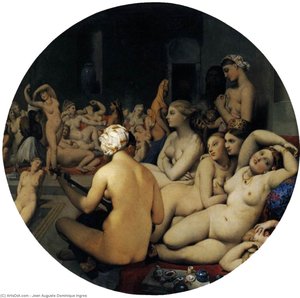
- Das türkische Bad (1862): Eines seiner späteren Werke und ein Beispiel für seine Orientalistenmalerei mit Aktendarstellungen, fertiggestellt als er 83 Jahre alt war.
Ingres' Porträts werden besonders für ihre ausdrucksstarke Verzerrung von Form und Raum gefeiert – eine Abweichung von streng neoklassizistischen Konventionen, die moderne Kunstrichtungen vorwegnahm. Er verwendete einen linearen Stil mit präzisen Konturen und lebendigen Farben und erzeugte oft eine Illusion der Tiefe durch subtile Schattierungen.
Vermächtnis und historische Bedeutung
Ingres’ Vermächtnis reicht weit über seine eigene umfangreiche Produktion hinaus. Er hatte einen tiefgreifenden Einfluss auf nachfolgende Generationen von Künstlern, darunter Henri Matisse und Pablo Picasso, die seinen innovativen Ansatz in Bezug auf Form und Komposition bewunderten. Sein Engagement für klassische Ideale bei gleichzeitiger Überschreitung der Grenzen künstlerischen Ausdrucks festigte seine Position als Brücke zwischen Neoklassizismus und Moderne. Ingres’ Werke werden weiterhin in wichtigen Museen weltweit ausgestellt, was Zeugnis von ihrer bleibenden Schönheit und historischen Bedeutung ist.
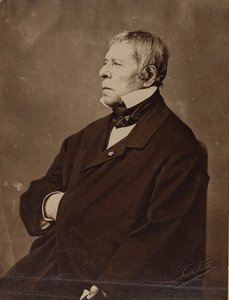
Jean-Auguste-Dominique Ingres
1780 - 1867 , Frankreich
Kurzinfos
- Beeinflusste Künstler:
- Raphael
- Nicolas Poussin
- Jacques-Louis David
- Bemerkenswerte Werke:
- Die Botschafter Agamemnons
- Der Eid Ludwigs XIII.
- Porträt von Monsieur Bertin
- Das türkische Bad
- Geburtsdatum: 29. August 1780
- Geburtsort: Montauban, Frankreich
- Künstlerische Richtung: Neoklassizismus
- Nationalität: Französisch
- Sterbedatum: 14. Januar 1867
- Vollständiger Name: Jean-Auguste-Dominique Ingres
- Von Ihm Beeinflusste Künstler:
- Henri Matisse
- Pablo Picasso
Ähnliche Artikel
Pierre-Auguste Renoir: Die 25 Meisterwerke des Impressionismus für Ihr Zuhause | ArtsDot
Entdecken Sie die 25 schönsten Meisterwerke von Pierre-Auguste Renoir! Tauchen Sie ein in die Welt des Impressionismus, erleben Sie berühmte Gemälde wie 'Bal au moulin de la Galette' und finden Sie hochwertige Kunstdrucke für Ihr Zuhause. Jetzt auf ArtsDot.com!
Neoklassizismus: Die 10 Meisterwerke, die eine Epoche prägten – Kunst für Ihr Zuhause
Entdecken Sie die 10 prägendsten Meisterwerke des Neoklassizismus! Von David bis Canova – erfahren Sie die Geschichten hinter ikonischen Gemälden & Skulpturen. Finden Sie hochwertige Reproduktionen für Ihr Zuhause auf
Die 10 Meisterwerke des Neoklassizismus: Kunst für Ihr Zuhause |
Entdecken Sie die 10 Meisterwerke des Neoklassizismus! Von David bis Canova – erleben Sie Kunstgeschichte, elegante Ästhetik & zeitlose Schönheit. Hochwertige Reproduktionen auf .
Jean Dominique Antony Metzinger: Pioneering Cubism & the Evolution of Abstract Form
Explore the life & work of Jean Metzinger, a pivotal Cubist painter and theorist. Discover his innovations in proto-Cubism, 'Du Cubisme,' and Crystal Cubism – a journey through modern art's evolution.
Jean-Baptiste Carpeaux: Sculpting Passion & Controversy in 19th-Century France
Explore the passionate life & controversial works of Jean-Baptiste Carpeaux, a leading French sculptor of the Second Empire. Discover his realism, iconic sculptures like 'Ugolino,' and lasting legacy as a precursor to Rodin.