

 Vorschau anzeigen
 Versenden
 Teilen
 Details anzeigen

 Herunterladen
 Ähnliche Objekte
 Röntgenaufnahme
 Diashow
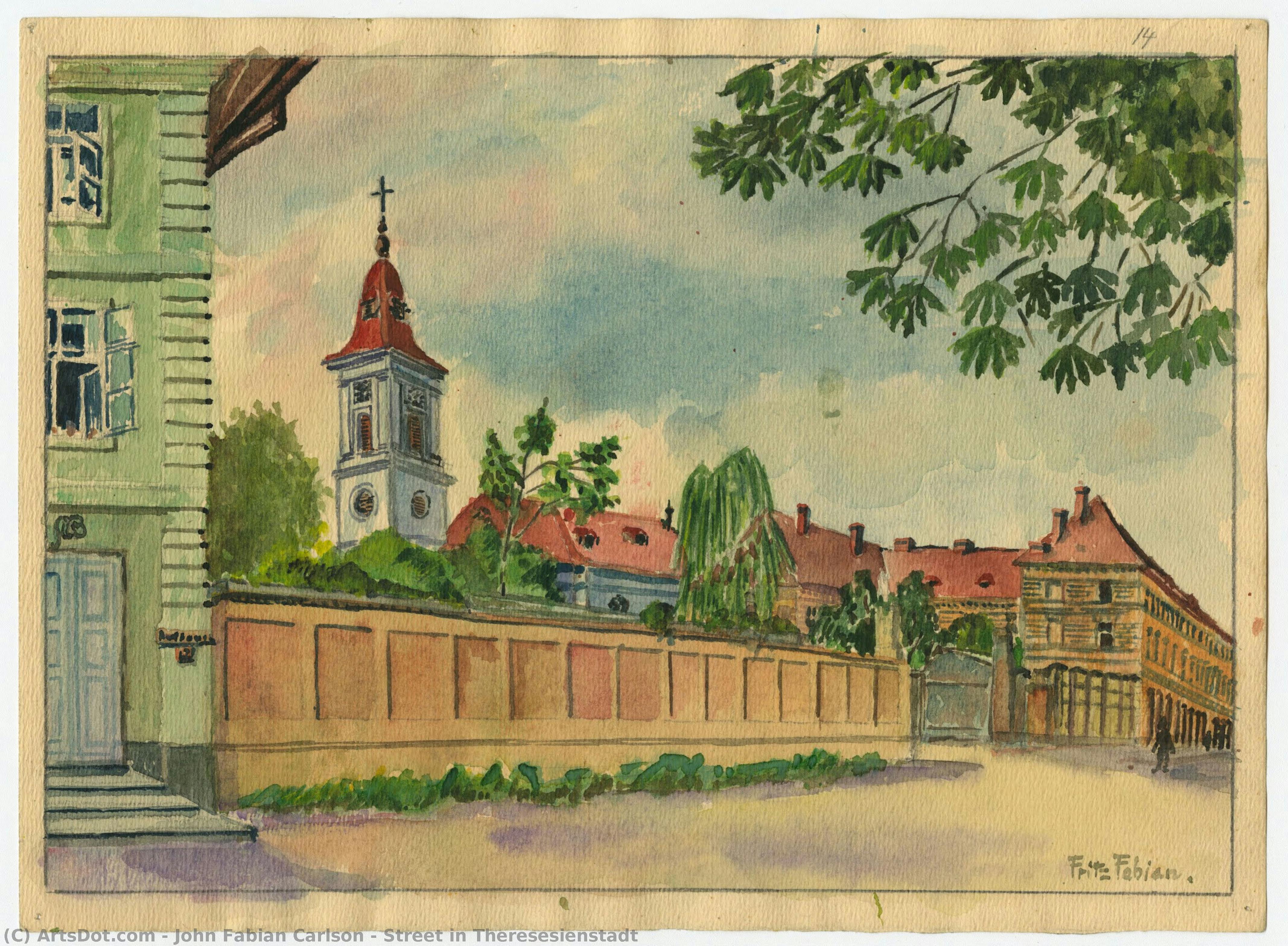
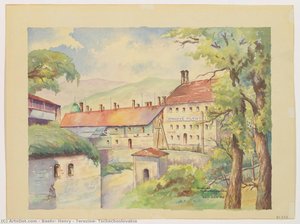
Street in Theresesienstadt
 Watercolor
- WallArt
- Impressionism
 1944
1944- Modern
 30.0 x 22.0 cm
 Leo Baeck Institut
 Weiterlesen
Handgefertigte Ölreproduktion
Handgemaltes Ölgemälde auf Leinwand in Ihrer Wunschgröße und mit Rahmen, auf Bestellung von unseren Künstlern angefertigt. ( Druck bestellen Bild kaufen)




P118B $10

P118H $10

P118W $10

P438Z $10

P508JH $12

P508YH $12

P805H $10

P805Z $10

P919BZ $10

P919G $10

P919XJ $10

P959ZH $10

P968JZ $12

W106C $8

W218G $10

W218JH $8

W218Y $10

W307PJ $10

W316G $10

W316PJ $8

W316Y $10

W398PJ $8

W4111J $10

W500HY $15

W500JH $15

W692G $12

W849H $8

W940BG $15

W953PJ $8




Wählen Sie aus unseren vordefinierten Formaten, die den ursprünglichen Proportionen des Kunstwerks entsprechen.

Sie können Ihre eigenen Maße eingeben, um einen bestimmten Rahmen oder Platz auszufüllen. Wenn die gewählte Größe nicht den Proportionen des Originalbildes entspricht, werden wir das Kunstwerk entweder beschneiden oder das Gemälde durch zusätzliche, handgemalte Elemente erweitern. Ein digitales Mockup wird Ihnen zur Genehmigung zugesandt, bevor die Produktion beginnt.
Bitte beachten Sie, dass die Bildschirmvorschau nicht die tatsächliche Beschneidung oder Erweiterung widerspiegelt. Nur das Mockup zeigt die endgültige Komposition exakt an.
Obwohl Sondermaße verfügbar sind, empfehlen wir, eine Größe aus der vordefinierten Liste zu wählen, um die ursprünglichen Proportionen beizubehalten.
Nach der Bestellung wird das ArtsDot.com-Team dem Kunden Anweisungen per E-Mail zusenden und eine Mockup-Vorschau bereitstellen.
Weltweiter Versand () in nur 3 bis 4 Wochen statt der üblichen 5 Wochen. (26 August). Keine Kompromisse bei der Qualität.

Kostenloser weltweiter Expressversand

Hochwertige Leinenleinwand

Umfassender Versicherungsschutz beim Versand

Zollgebühren-Rückerstattungsgarantie

Garantie für exakte Farbtreue

60 Tage Rückgaberecht (nur bei Mängeln)

100% Geld-zurück-Garantie

Mengenrabatt verfügbar
 Die Glasoption ist nur für Größen unter 110 cm verfügbar.

Street in Theresesienstadt
Art der Reproduktion
Format der Reproduktion
-


Gesamtpreis
$ 263
Beschreibung des Kunstwerks
A Somber Glimpse into History: Street in Theresesienstadt
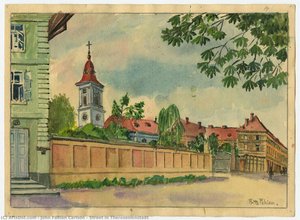
In the delicate, translucent layers of John Fabian Carlson’s 1944 watercolor, Street in Theresesienstadt, we encounter a scene that transcends mere landscape painting to become a profound historical witness. While Carlson is celebrated as a master of luminous winter landscapes and the ethereal glow of American Impressionism, this particular work carries a weight far heavier than the soft snowfall of his more famous compositions. The watercolor captures a street scene within the confines of the Theresienstadt concentration camp, presenting a view that is simultaneously mundane and hauntingly significant. Through his expert command of the medium, Carlson invites the viewer to walk alongside the figures in the street, navigating a world defined by both architectural permanence and human fragility.
The composition is structured around the stark reality of enclosure, where a formidable brick wall serves as a boundary between the town and the unknown. A church rises above the skyline, its presence offering a silent, spiritual sentinel over the inhabitants below. Carlson utilizes the fluid nature of watercolor to create a sense of atmosphere that feels both airy and oppressive. The light, though captured with his signature impressionistic touch, does not merely illuminate; it exposes the quiet movement of people traversing the cobblestones. Small details, such as the two birds caught in flight and the subtle presence of a clock in the lower corner, ground the piece in a fleeting moment of time, reminding us that even within the most harrowing historical contexts, life continues its rhythmic, albeit shadowed, progression.
Technically, the painting showcases Carlson’s ability to balance fine detail with broad, emotive washes. The way the pigment settles into the paper creates a textured depth that mimics the grit of the street and the weathered surfaces of the architecture. For the collector or interior designer, this piece offers more than just aesthetic beauty; it provides a conversational centerpiece that demands reflection. It is an artwork of immense emotional gravity, suitable for spaces dedicated to contemplation, history, or the preservation of memory. To possess a reproduction of this work is to hold a fragment of a difficult truth, rendered with the grace and technical mastery of a pioneer of the American Impressionist movement.
Ähnliche Kunstwerke
Über den Künstler
John Fabian Carlson (1874 – 1945): A Pioneer of Winter Landscapes
John Fabian Carlson was a Swedish-born American Impressionist painter whose distinctive style—characterized by luminous color palettes and textured brushwork—captured the ethereal beauty of winter landscapes. Born in Kolsebo, Västergötland, Sweden, on May 5, 1874, Carlson’s artistic journey began with formative years spent immersed in Swedish folklore and landscape traditions before he emigrated to the United States in 1884, establishing a home in Buffalo, New York. His exposure to European art movements, particularly Impressionism fostered by luminaries like Claude Monet and Camille Pissarro, profoundly shaped his artistic vision.- Early Influences: Carlson’s initial artistic inclinations were nurtured at the Art Students League of Buffalo where he studied under Lucius Wolcott Hitchcock, a former pupil of Auguste Renoir and Edgar Degas. Hitchcock instilled in Carlson a meticulous approach to observation and a dedication to capturing fleeting moments of light and color—principles that would become hallmarks of his oeuvre.
- The Byrdcliffe Colony & Landscape Studies: A pivotal moment arrived when Carlson secured a scholarship to the Byrdcliffe Colony in Woodstock, New York (1903-1904), where he honed his skills alongside fellow artists like Robert Henri and George Ives Shepard. This experience solidified his fascination with capturing the grandeur of nature, specifically winter vistas—a subject that would occupy him for decades.
- Notable Works: Among Carlson’s most celebrated paintings are “Winter, Woodstock” (1906), a breathtaking depiction of Mount Tomhannock bathed in winter sunlight; “Snowy Waters” (1912), showcasing the tranquil beauty of Lake George under a blanket of snow; and “Street in Theresienstadt,” which captures the poignant atmosphere of Prague’s Jewish Quarter during World War II.
- Recognition & Legacy: Carlson's artistic achievements garnered significant recognition, culminating in membership of the National Academy of Design (1911) and prestigious awards from organizations like the Carnegie Prize and the Altman First Prize (1918). He continued to teach landscape painting at Woodstock School of Landscape Painting until 1922, fostering a new generation of artists dedicated to capturing the sublime qualities of winter landscapes.
Kurzinfos
- Artistic Movement Or Style: Impressionism
- Artists Or Movements Influenced By This Artist: ['American Impressionism']
- Artists Who Influenced This Artist: ['Lucius Wolcott Hitchcock']
- Date Of Birth: May 5, 1874
- Date Of Death: May 19, 1945
- Full Name: John Fabian Carlson
- Nationality: Swedish-American
- Notable Artworks:
- Winter, Woodstock
- Snowy Waters
- Street in Theresesienstadt
- Place Of Birth: Kolsebo, Sweden
Ähnliche Artikel

Die 10 legendärsten Aquarellwerke der Kunstgeschichte – Meisterwerke für Ihr Zuhause
Entdecken Sie die 10 legendärsten Aquarellwerke der Kunstgeschichte! Von Turner bis Monet – erleben Sie die Geschichten, Techniken & Farben dieser Meisterwerke. Finden Sie hochwertige Kunstdrucke auf ArtsDot.com und gestalten Sie Ihr Zuhause mit zeitloser Eleganz.
John Singer Sargent: Die 25 Meisterwerke des Porträts – Kunst für Ihr Zuhause | ArtsDot
Entdecken Sie die 25 Meisterwerke von John Singer Sargent! Tauchen Sie ein in die Welt der Porträtmalerei, des Impressionismus & der Belle Époque. Hochwertige Kunstdrucke & Reproduktionen für Ihr Zuhause – jetzt auf ArtsDot.com!

Ephemeral Visions: Exploring the Artistic Legacy & Contemporary Practice of Watercolor Painting
Explore the captivating world of watercolor painting! Discover its rich history, essential techniques, influential artists & collecting tips. A comprehensive guide for art enthusiasts from ArtsDot.

Flüchtige Visionen: Die Geschichte und emotionale Resonanz der Aquarellmalerei
Entdecken Sie die faszinierende Welt der Aquarellmalerei! Von historischen Ursprüngen bis zu modernen Techniken – wir bieten Expertenwissen, Inspiration und Tipps für Anfänger & Fortgeschrittene.

John Constable: Die 25 Meisterwerke des englischen Landschaftsgenies – ArtsDot
Entdecken Sie die 25 Meisterwerke von John Constable! Erleben Sie englische Landschaftsmalerei vom Hay Wain bis zur Stour Valley. Hochwertige Reproduktionen & Kunst für Ihr Zuhause auf ArtsDot.com.

