 Vorschau anzeigen
 Versenden
 Teilen
 Details anzeigen

 Herunterladen
 Ähnliche Objekte
 Röntgenaufnahme
 Diashow
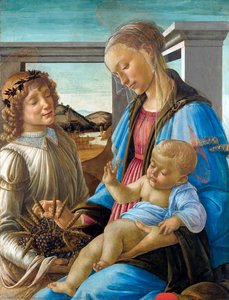
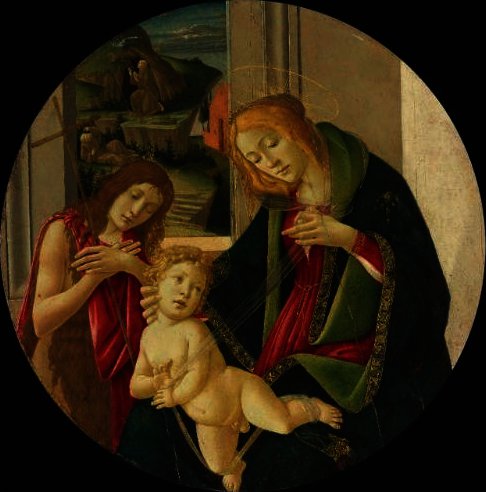
Madonna und Kind mit dem jungen Baptist, Saint Francis Empfang des Stigmata in der Ferne


 Weiterlesen
Giclée / Kunstdruck
Giclée- oder Leinwanddruck in Museumsqualität mit schneller Produktion und flexiblen Veredelungsoptionen. ( Handgemalte Reproduktion bestellen Bild kaufen)




P118B $10

P118H $10

P118W $10

P438Z $10

P508JH $12

P508YH $12

P805H $10

P805Z $10

P919BZ $10

P919G $10

P919XJ $10

P959ZH $10

P968JZ $12

W106C $8

W218G $10

W218JH $8

W218Y $10

W307PJ $10

W316G $10

W316PJ $8

W316Y $10

W398PJ $8

W4111J $10

W500HY $15

W500JH $15

W692G $12

W849H $8

W940BG $15

W953PJ $8




Wählen Sie aus unseren vordefinierten Formaten, die den ursprünglichen Proportionen des Kunstwerks entsprechen.

Sie können Ihre eigenen Maße eingeben, um ein bestimmtes Format oder einen speziellen Platz einzupassen. Wenn das von Ihnen gewählte Format nicht den Proportionen des Originalbildes entspricht, werden wir das Kunstwerk entweder beschneiden oder das Bild mit einem gespiegelten oder einfarbigen Rand erweitern. Ein digitaler Entwurf wird Ihnen zur Genehmigung zugesandt, bevor die Produktion beginnt.
Bitte beachten Sie, dass die Vorschau auf dem Bildschirm nicht den tatsächlichen Zuschnitt oder die Erweiterung widerspiegelt. Nur der Entwurf zeigt die endgültige Komposition präzise an.
Obwohl Sondermaße verfügbar sind, empfehlen wir die Auswahl eines Maßes aus der vordefinierten Liste, um die ursprünglichen Proportionen zu bewahren.
Weltweiter Versand () innerhalb von 2 Wochen statt der üblichen 4/5 Wochen. (26 August)

Kostenloser weltweiter Expressversand

Hochwertige Leinenleinwand

Umfassender Versicherungsschutz beim Versand

Zollgebühren-Rückerstattungsgarantie

Garantie für exakte Farbtreue

60 Tage Rückgaberecht (nur bei Mängeln)

100% Geld-zurück-Garantie

Mengenrabatt verfügbar
 Die Glasoption ist nur für Größen unter 110 cm verfügbar.

Madonna und Kind mit dem jungen Baptist, Saint Francis Empfang des Stigmata in der Ferne
Giclée / Kunstdruck
Format der Reproduktion
-


Gesamtpreis
$ 62
Sammlerstück-Beschreibung
A Serene Vision of Faith and Family
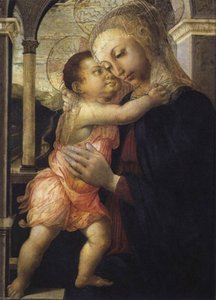
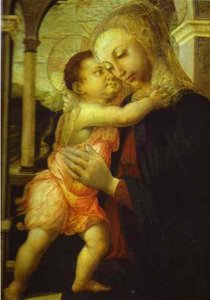
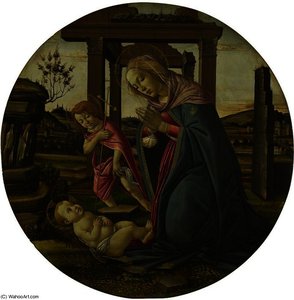
Sandro Botticelli’s “Madonna and Child with the Young Baptist, Saint Francis Receiving the Stigmata in the Distance” is a quietly profound work that encapsulates the spirit of the Early Renaissance. Executed with the meticulous detail and graceful linearity characteristic of Botticelli's style, this circular oil painting offers a tender glimpse into the divine family – Mary cradling the infant Jesus, attended by the young John the Baptist. The composition isn’t merely a depiction of religious figures; it is an invitation to contemplation, a visual poem about faith, maternal love, and spiritual devotion.
Botticelli's Florentine World
Born Alessandro di Mariano di Vanni Filipepi in Florence around 1445, Botticelli lived his entire life within the vibrant artistic heart of Italy. His early training as a goldsmith instilled in him an appreciation for precision and detail that would become hallmarks of his paintings. Florence during the Renaissance was a crucible of innovation, where artists were rediscovering classical ideals while simultaneously forging new paths in realism and humanism. Botticelli absorbed these influences, blending them with a uniquely lyrical style that set him apart. He moved between the late Gothic traditions and the emerging Renaissance aesthetic, creating works that are both spiritually evocative and remarkably grounded in earthly beauty. The painting reflects this Florentine sensibility – a harmonious balance of idealism and observation.
Decoding the Symbolism
Beyond its immediate visual appeal, “Madonna and Child…” is rich with symbolic meaning. The triangular arrangement of the figures—Mary at the apex, holding Jesus—is a traditional compositional device representing the Holy Trinity. The inclusion of the young John the Baptist foreshadows his role as Christ’s herald, while in the distance, the subtle depiction of Saint Francis receiving the stigmata adds another layer of spiritual resonance. This isn't simply a scene frozen in time; it is a narrative unfolding before our eyes, connecting past prophecies with present grace and future sacrifice. The soft, diffused lighting further enhances this sense of reverence, illuminating the central figures while allowing the background to recede into a contemplative haze. The landscape glimpsed through an arched window isn’t merely decorative; it symbolizes the earthly realm blessed by divine presence.
A Masterful Technique
Botticelli's technique in this work is exemplary of his skill and artistry. He employed oil paints on a wood panel, building up layers of color with meticulous precision. The use of glazes—thin, translucent layers of paint—creates a luminosity and depth that are captivating. The flowing drapery of the figures isn’t just visually pleasing; it demonstrates Botticelli's mastery of line and form. His attention to detail is evident in every aspect of the painting, from the delicate features of Mary’s face to the subtle textures of the landscape. The warm earth tones—reds, browns, and ochres—are accented with touches of green and gold, creating a harmonious palette that evokes a sense of serenity and warmth. The overall effect is one of quiet elegance and profound spiritual depth, making this painting a timeless treasure for any collection or interior space.
Ähnliche Kunstwerke
Über den Künstler
frühes Leben und Ausbildung
Sandro Botticelli, geboren Alessandro di Mariano di Vanni Filipepi um 1445, war eine zentrale Figur im frühen italienischen Frührenaissance der Malerei. Zunächst posthumig vernachlässigt, wurde Botticellis Werk im späten 19. Jahrhundert von den Präraffaeliten revitalisiert und führte zu einer Neubewertung seiner künstlerischen Beiträge. Botticelli wurde in Florenz, Italien, geboren und lebte sein ganzes Leben im selben Viertel. Seine Familie, darunter sein Vater Mariano di Vanni d’Amedeo Filipepi, war in verschiedene Berufe involviert, was sie mit Künstlern in Kontakt brachte. Giorgio Vasari berichtete, dass Botticelli zunächst als Goldschmied ausgebildet wurde.Künstlerischer Stil und bemerkenswerte Werke
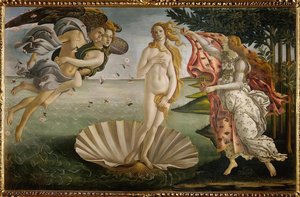
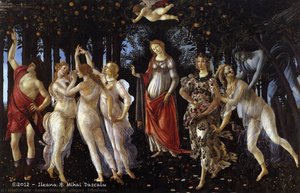
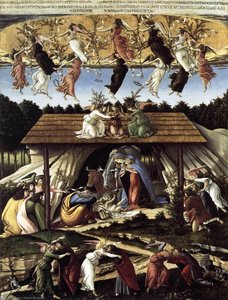
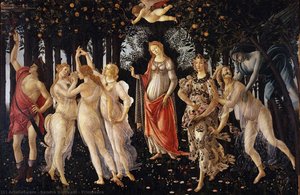
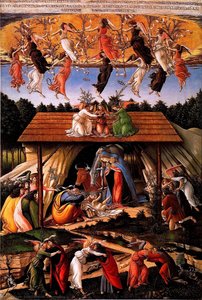
Botticellis Werk ist durch elegante Linearität gekennzeichnet, die die Lücke zwischen der späten italienischen Gotik und dem frühen Frührenaissance schließt. Seine berühmtesten Werke, die Geburt des Venus und Primavera, werden in der Uffizialleerie in Florenz ausgestellt, die eine bedeutende Sammlung seiner Kunst beherbergt. * die Geburt des Venus (ansicht auf ArtsDot) * Primavera (Sandro Botticellis Kunst erkunden auf ArtsDot) * Mystische Geburt (Nationalgalerie, London), datiert 1501, ist das einzige Werk von Botticelli mit einem klaren Datum.Vermächtnis und Einfluss
Botticellis Stil entwickelte sich in den 1490er Jahren zu einem persönlicheren Ansatz und unterschied sich von Zeitgenossen wie Leonardo da Vinci und dem aufkommenden Hochrenaissance-Stil. Sein Werk wurde als bedeutende Beiträge zur italienischen Renaissance Kunstbewegung anerkannt. * Die italienische Renaissance Kunstbewegung * Sandro Botticelli auf Wikipedia- Bekannte Künstler der italienischen Renaissance umfassen Sandro Botticelli, Leonardo da Vinci, Michelangelo und Tizian.
- Die Uffizialleerie in Florenz beherbergt eine bedeutende Sammlung von Botticellis Kunst.
- Botticellis Werk wurde als eine zentrale Figur im frühen italienischen Frührenaissance der Malerei anerkannt.
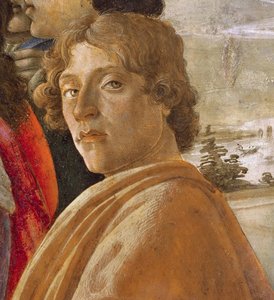
Sandro Botticelli
1445 - 1510 , Italien
Kurzinfos
- Beeinflusste Künstler: ['Präraffaeliten']
- Bemerkenswerte Werke:
- Die Geburt der Venus
- Primavera
- Mystische Geburt
- Einflussreiche Künstler:
- Fra Angelico
- Paolo Uccello
- Geburtsdatum: ca. 1445
- Geburtsort: Florenz, Italien
- Künstlerische Bewegung: Frührenaissance
- Nationalität: Italienisch
- Sterbedatum: 1510
- Vollständiger Name: Sandro Botticelli
Ähnliche Artikel
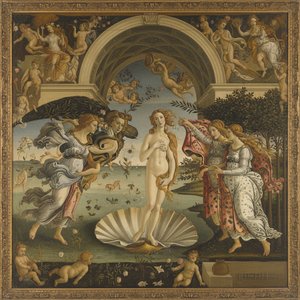
Sandro Botticelli: Die 25 Meisterwerke des Renaissance-Genies – Kunst für Ihr Zuhause
Entdecken Sie die 25 schönsten Meisterwerke von Sandro Botticelli! Erleben Sie die Renaissance-Kunst mit 'Geburt der Venus', 'Primavera' & mehr. Hochwertige Reproduktionen für Ihr Zuhause – jetzt auf ArtsDot.com!

Die 25 Meisterwerke der Uffizien: Kunstgeschichte für Ihr Zuhause | ArtsDot
Entdecken Sie die 25 berühmtesten Meisterwerke der Uffizien, Florenz! Von Botticelli bis Leonardo da Vinci – Kunstgeschichte erleben. Hochwertige Reproduktionen & Inspiration für Ihr Zuhause auf ArtsDot.com.
Frührenaissance: Die 10 Meisterwerke, die eine Epoche prägten – Kunst für Ihr Zuhause
Entdecken Sie die 10 prägendsten Meisterwerke der Frührenaissance! Von Giotto bis Botticelli – erleben Sie Kunstgeschichte hautnah. Hochwertige Reproduktionen für Ihr Zuhause auf .
Raphael: Die 25 Meisterwerke des Renaissance-Genies – Kunst für Ihr Zuhause
Entdecken Sie die 25 schönsten Meisterwerke von Raphael! Tauchen Sie ein in die Welt der Renaissance-Kunst, erfahren Sie faszinierende Geschichten und lassen Sie sich von den Farben und Kompositionen inspirieren. Hochwertige Reproduktionen auf ArtsDot.com.
Sacred Narratives Embodied: A Comprehensive Exploration of Religious Iconography in Art History
Explore the rich history of religious iconography in art! Discover symbolism, movements & masterpieces from Byzantine to Renaissance periods. Expert insights for collectors and enthusiasts at ArtsDot.