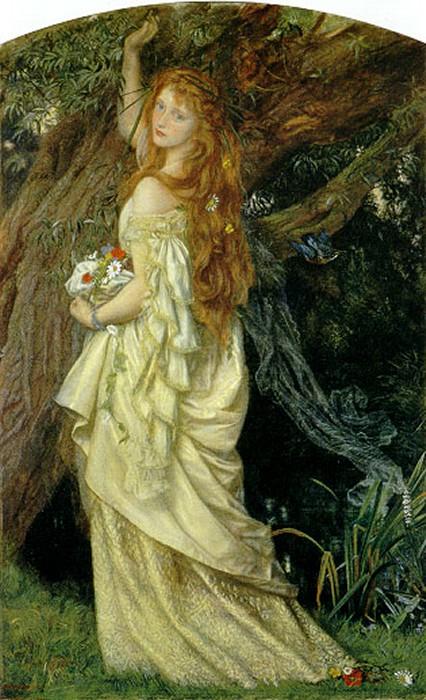
Arthur Hughes's 'Ophelia (And will he not come again.)': A Pre-Raphaelite Lament
Arthur Hughes’s ‘Ophelia (And will he not come again.)’, painted in 1863, is more than just a depiction of Shakespearean tragedy; it’s a profound meditation on loss, longing, and the haunting beauty of despair. This oil-on-canvas masterpiece exemplifies the Pre-Raphaelite Brotherhood's commitment to meticulous detail, vibrant color palettes, and emotionally resonant storytelling – qualities that continue to captivate viewers over 150 years later. Hughes, deeply influenced by the artistic ideals of the early Italian Renaissance, meticulously recreates Ophelia’s final moments, transforming a literary scene into a powerfully evocative visual experience.
A Portrait of Melancholy: Style and Technique
Hughes's technique is characterized by its delicate brushwork and an almost obsessive attention to detail. The painting showcases the Pre-Raphaelite penchant for realism, evident in the rendering of Ophelia’s flowing gown, the intricate folds of her hair, and the subtle textures of the flowers surrounding her. The muted color scheme – dominated by blues, greens, and whites – contributes significantly to the overall atmosphere of sorrow and quiet contemplation. The artist skillfully employs chiaroscuro, using dramatic contrasts between light and shadow to heighten the emotional impact and draw the viewer’s eye to Ophelia's face, partially obscured as she gazes upwards.
Symbolism Woven into Sorrow
- Flowers: The profusion of flowers – violets, poppies, daisies, and willow branches – is laden with symbolic meaning. Violets represent faithfulness and modesty, while poppies symbolize sleep and death. The willow, a traditional symbol of mourning, reinforces the theme of loss.
- Birds: The presence of two birds, one near the top left corner and another towards the center-right, adds to the painting’s unsettling beauty. Birds are often associated with souls ascending to heaven, suggesting Ophelia's journey beyond earthly sorrow.
- The Water: The water itself is a potent symbol, representing both death and purification – Ophelia’s final immersion mirroring the tragic end of her story.
Historical Context and Artistic Influence
‘Ophelia (And will he not come again.)’ was created during a pivotal moment in British art history, coinciding with the rise of the Pre-Raphaelite Brotherhood. This group sought to reject the academic conventions of the Royal Academy and return to the perceived sincerity and beauty of early Italian Renaissance painting. Hughes's work reflects this movement's emphasis on narrative subject matter, detailed observation, and a deep engagement with literature and mythology. His connection to figures like John Everett Millais and Holman Hunt solidified his place within this influential artistic circle, contributing significantly to the Brotherhood’s legacy.
A Timeless Masterpiece
More than just a beautiful painting, ‘Ophelia (And will he not come again.)’ is a poignant exploration of human emotion and the enduring power of Shakespearean tragedy. Its meticulous execution, rich symbolism, and evocative atmosphere continue to resonate with audiences today, cementing its place as one of Arthur Hughes's most significant works and a cornerstone of Pre-Raphaelite art.