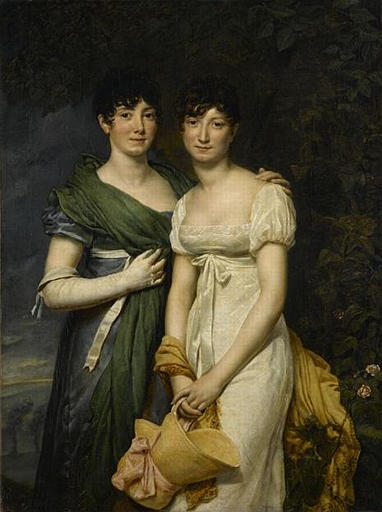
A Portrait of Grace and Quiet Dignity: Exploring Georges Rouget’s “Mesdemoiselles Mollien”
Georges Rouget's "Mesdemoiselles Mollien," painted in 1811, is more than just a portrait; it’s a window into the refined world of early 19th-century French society and a testament to the enduring power of Neoclassical elegance. Commissioned for a wealthy family – the Molliens, prominent figures within Napoleon's administration – the painting captures two young women, Françoise-Elisabeth and Gaspard-Pauline, as they stand poised in a moment of serene contemplation. Rouget, a favored student of David and deeply embedded within the artistic circles surrounding Versailles, masterfully blends classical ideals with subtle Romantic undertones, creating an image that is both formally structured and emotionally resonant.
The scene unfolds against a backdrop of muted greens and browns – a carefully constructed landscape suggesting a secluded garden or perhaps a shaded courtyard. This deliberate choice in color palette immediately establishes a mood of quiet intimacy and understated luxury. The women, dressed in elegant white gowns adorned with delicate green accents, are positioned close together, their bodies subtly overlapping, conveying a sense of familial connection and shared experience. Their expressions are remarkably composed, reflecting the social expectations of the time – dignified yet approachable, hinting at an inner life beyond the confines of formal portraiture.
Neoclassical Composition and Delicate Brushwork
Rouget’s artistic approach is firmly rooted in Neoclassicism, a style characterized by its emphasis on balance, order, and idealized beauty. The composition adheres to strict geometric principles, with the figures arranged symmetrically within the frame, creating a sense of visual harmony. However, subtle Romantic elements peek through – the diffused lighting, reminiscent of Turner’s atmospheric landscapes, softens the overall effect and imbues the scene with a gentle melancholy. The artist's meticulous brushwork is particularly noteworthy; he employs delicate layering techniques to render the textures of the women’s clothing—the smooth silkiness of their gowns, the soft folds of their shawls—with remarkable realism. Close inspection reveals the subtle variations in tone and color that contribute to the painting’s overall depth and luminosity.
- Technique: Oil on canvas – a medium favored for its ability to capture nuanced colors and textures.
- Brushwork: Smooth blending, layered application creating realistic skin tones and fabric details.
- Color Palette: Muted greens, creams, browns, accented with gold and pink—evoking a sense of wealth and refinement.
Symbolism and the Portrait’s Narrative
Beyond its formal beauty, “Mesdemoiselles Mollien” carries layers of symbolic meaning. The close proximity of the two women suggests a strong familial bond – perhaps sisterhood or a deep friendship—a connection valued within aristocratic society. Their serene expressions convey a sense of social standing and inner composure, reflecting the expectations placed upon young women of their era. The painting can be interpreted as a celebration of female beauty and grace, while also subtly hinting at the constraints imposed by societal norms. The inclusion of the landscape adds another layer of meaning; it serves not merely as a backdrop but as a reflection of the women’s inner lives—a space for contemplation and connection.
A Legacy of Napoleonic Grandeur
Georges Rouget's “Mesdemoiselles Mollien” stands as a significant example of Neoclassical portraiture from the era of Napoleon. His work, deeply intertwined with the ambitions of the French Empire, adorned the halls of Versailles and served as a visual record of a pivotal moment in European history. Reproductions of this captivating artwork offer a glimpse into the refined tastes and social dynamics of 19th-century France, inviting viewers to appreciate the enduring beauty and symbolic richness of Rouget’s masterful creation. It remains a poignant reminder of the elegance and quiet dignity that defined an era.