 Preview
 Send
Send Share
Share
 Details

 Download
 Similars
 X-Ray
X-Ray Diaporama
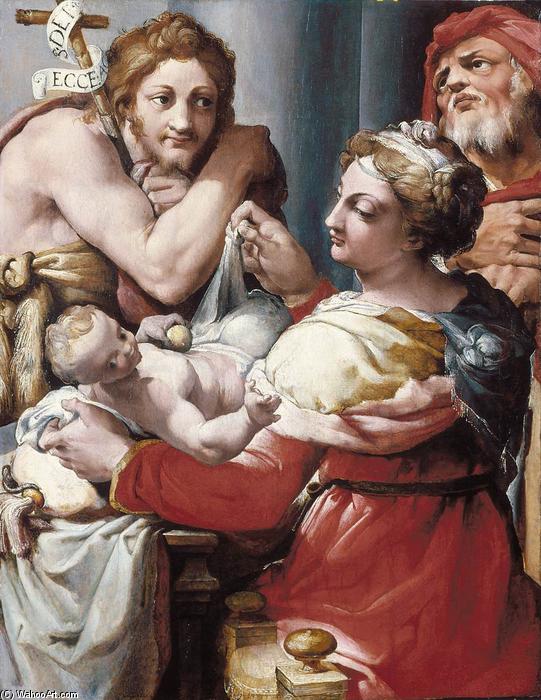
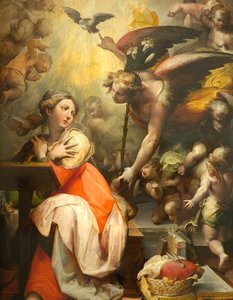
The Holy Family with St John the Baptist
 1550
1550 50.0 x 38.0 cm
 Museum of Art
 Read More
Hand Made Oil Reproduction
Hand-painted oil on canvas in your size and frame, made to order by our artists. ( Buy Print Buy Image)




































Pick from our preset sizes that match the artwork's original proportions.

You may enter your own dimensions to fit a specific frame or space. If your selected size does not match the original image's proportions, we will either crop the artwork or extend the painting with additional hand-painted elements. A digital mockup will be sent for your approval before production begins.
Please note that the on-screen preview does not reflect the actual cropping or extension. Only the mockup will accurately show the final composition.
While custom sizes are available, we recommend selecting a dimension from the predefined list to preserve the original proportions.
After order, ArtsDot.com team will email client for instructions and provide a mockup preview
Worldwide Delivery () in 3/4 weeks instead of standard 5 weeks. (26 August). No compromise on quality.

Free Worldwide Express Shipping

High-Quality Linen Canvas

Full Shipping Insurance

Customs Tax Refund Guarantee

True Color Matching Guarantee

60-Day Return Policy (Defects Only)

100% Money-Back Guarantee

Bulk Discount Offer
 Glass option is only available in size under 110 CM

The Holy Family with St John the Baptist
Reproduction Medium
Reproduction Size
-


Total Price
$ 263
Related Artworks
Artist Biography
The Enigmatic Vision of Nosadella
In the vibrant, swirling currents of the Italian Mannerist period, few figures evoke as much scholarly intrigue as Giovanni Francesco Bezzi, known to history by the evocative moniker Nosadella. A painter and draftsman whose life was as brief as his surviving oeuvre is remarkably sparse, Nosadella remains a phantom of the Bolognese school. Active primarily between 1549 and 1571, he emerged from the rich artistic atmosphere of Bologna, a city then pulsating with the creative energies of the Renaissance. While much of his biography remains shrouded in the mists of time, the traces he left behind—fragments of divine light and dramatic form—suggest an artist of profound sensitivity and technical command.
Nosadella’s artistic identity was inextricably linked to the towering presence of Pellegrino Tibaldi. As a pupil of Tibaldi, Nosadella inherited a stylistic language rooted in the monumental grandeur of Michelangelo, yet filtered through a uniquely Bolognese lens. This mentorship provided him with the tools to navigate the complexities of Mannerism, a style characterized by elongated forms, artificial colors, and a deliberate tension that sought to move the soul rather than merely replicate nature. It is believed that his travels may have taken him to Rome, exposing him to the classical echoes and grand compositions that defined the heart of the Italian Renaissance, further enriching his burgeoning aesthetic.
A Legacy Carved in Light and Devotion
To study the works of Nosadella is to engage in a delicate act of reconstruction. Because so few paintings can be definitively attributed to his hand, each surviving piece carries the weight of immense historical importance. His talent is most clearly glimpsed in religious compositions that served as spiritual anchors for the faithful in Bologna. One such masterpiece, Madonna and Child with Saints, resides within the Oratorio di Santa Maria della Vita, where it continues to radiate a sense of sacred intimacy. In this work, one can observe the echoes of his master’s influence through the dramatic interplay of shadow and the expressive, almost rhythmic, gestures of the holy figures.
Another significant milestone in his short career is the Circumcision of 1571, created for the Church of Santa Maria Maggiore. This work, which was completed by the notable Prospero Fontana, serves as a poignant testament to Nosadella’s place within the professional networks of his era. Through these canvases, we see an artist striving to balance the muscularity of the High Renaissance with the sophisticated, often restless elegance of Mannerism. His ability to utilize good colour—as noted by the contemporary chronicler Giorgio Vasari—suggests a painter who understood how to use pigment not just for decoration, but as a vehicle for emotional and theological depth.
Historical Significance and the Shadow of the Master
The historical significance of Nosadella lies not only in what he painted but in the challenge he presents to modern art historians. For centuries, his identity was often obscured by the overwhelming shadow of Pellegrino Tibaldi; scholars frequently struggled to distinguish where the master’s hand ended and the pupil’s began. This difficulty in attribution has made the recent reassessment of his work a vital endeavor for understanding the evolution of the Bolognese school. He represents a crucial link in the chain of artistic development, embodying the transition from the monumentalism of the early 16th century to the more refined, complex aesthetics that would eventually pave the way for the Baroque.
Ultimately, Giovanni Francesco Bezzi stands as a symbol of the ephemeral nature of genius. Though his life was cut short in 1571, the echoes of his brushstrokes remain. His work serves as a window into a period of intense experimentation, where artists sought to transcend the physical world through artifice and grace. In the quiet corners of Bolognese churches, Nosadella’s vision persists—a haunting, beautiful reminder of an artist who, despite being lost to much of history, continues to illuminate the profound depths of the human spirit.
Quick Facts
- Artistic Movement Or Style: Mannerism
- Artists Or Movements Influenced By This Artist: ['Michelangelo']
- Artists Who Influenced This Artist: ['Pellegrino Tibaldi']
- Date Of Death: 1571
- Full Name: Giovanni Francesco Bezzi called Il Nosadella
- Nationality: Italian
- Notable Artworks:
- Madonna and Saints
- Circumcision
- Place Of Birth: Bologna