

 Preview
 Buy Print
 Send
Send Share
Share


 Download
 Similars
 X-Ray
X-Ray Diaporama
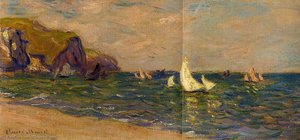
Sailboats at Sea, Pourville


The Essence of Impressionism: Sailboats at Sea, Pourville
Claude Monet’s “Sailboats at Sea, Pourville” isn't merely a depiction of a coastal scene; it’s an immersion into the very heart of Impressionist philosophy. Painted in 1882 during his transformative summer sojourn to the Normandy village of Pourville, this oil on canvas transcends simple representation, instead capturing a fleeting moment of light and atmosphere with breathtaking immediacy. The painting immediately draws the eye – not towards sharp detail or precise form, but toward the shimmering dance of color across the water and sky. It’s a testament to Monet's revolutionary approach: to paint *what he saw*, not necessarily what he knew, prioritizing the subjective experience of light and perception over photographic accuracy.
A Symphony of Light and Color
Monet’s signature technique is vividly on display here. He employs rapid, broken brushstrokes – a hallmark of Impressionism – to build up layers of color that seem to vibrate with light. The blues and greens of the water aren't blended smoothly; instead, they are applied in distinct dabs, creating an illusion of movement and reflecting the shifting conditions of the sea. The boats themselves—scattered across the canvas like whitecaps—are rendered with a similar sensitivity, their forms dissolving into the surrounding atmosphere. Notice how Monet uses complementary colors – the oranges and yellows of the sky juxtaposed against the blues and greens of the water – to heighten the sense of vibrancy and create visual excitement. The overall effect is one of luminous transparency, as if the painting itself is radiating light.
The Significance of Pourville
Monet’s choice of Pourville was deliberate. He sought a location far removed from the bustle of Paris, where he could truly observe and capture the nuances of nature. The village offered him an unspoiled landscape—a place to immerse himself in the changing light and weather conditions. This painting is deeply connected to that experience; it’s not just a record of a scene but a distillation of Monet's sensory impressions during his time there. The inclusion of the lone figure on the beach adds a subtle human element, suggesting contemplation and connection with the natural world – a theme central to much of Monet’s work.
A Legacy of Serenity
“Sailboats at Sea, Pourville” embodies the core tenets of Impressionism: capturing fleeting moments, prioritizing light and color over form, and evoking an emotional response in the viewer. It's a painting that invites us to slow down, to appreciate the beauty of the everyday, and to lose ourselves in the shimmering dance of light on water. Reproductions by ArtsDot.com offer a remarkable opportunity to bring this iconic masterpiece into your home or office, allowing you to experience Monet’s vision firsthand – a testament to his enduring legacy as one of art history's most influential figures. Explore more about Claude Monet and his works on ArtsDot.com.
Claude Monet (1840 – 1926)
Explore the world of Claude Monet, the Impressionist master renowned for capturing fleeting light and color through iconic landscapes like Water Lilies & Haystacks.
About this artwork
- Title: Sailboats at Sea, Pourville
- Artist: Claude Monet
- Year: 1882
- Format: Panoramic
- Copyright status: Public domain
- Medium: Oil
- Creative period: Late Period
- Main color: Espresso
- Keywords: watercolors , painting , serene
- Color hue: Green Spectrum
Quick Facts
- Year: 1882
- Artistic style: Capturing light
- Notable elements: Quick brushstrokes
- Location: Musée Marmottan, Paris
- Medium: Oil on canvas
- Influences: Boudin
- Subject or theme: Seascape, Boats
QR Code


