

 Preview
 Buy Print
 Send
Send Share
Share


 Download
 Similars
 X-Ray
X-Ray Diaporama
Maestà (detail) (27)
 Acrylic On Canvas
- WallArt
- Trecento Gothic Style
 1308
1308 37.0 x 23.0 cm
 Museo dell'Opera del Duomo
A Window into Siena’s Soul: Unveiling the Majesty of Duccio's Maestà
Duccio di Buoninsegna’s “Maestà” – a detail from this monumental altarpiece – isn’t merely a painting; it’s a profound meditation on faith, power, and the human connection to the divine. Completed in 1311 for Siena Cathedral, this work represents a pivotal moment in Italian art history, marking a deliberate shift away from the rigid formality of Byzantine tradition towards a more emotionally resonant and naturalistic style. Imagine standing before the full altarpiece – a breathtaking spectacle of shimmering gold, vibrant colors, and exquisitely rendered figures – and focusing on this intimate detail: two men, hands clasped in prayerful contemplation. These aren’t static representations; they possess an almost palpable sense of devotion, their gestures conveying a deep-seated reverence that transcends the purely visual.
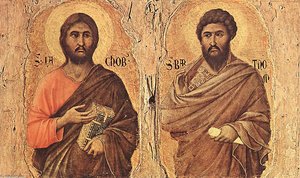
The scene itself is deceptively simple, yet brimming with symbolic weight. The two figures, identified as possibly representing the Virgin Mary and John the Baptist, are enveloped in a rich gold background – a deliberate reference to Byzantine iconography, but here imbued with a newfound warmth and luminosity. Notice the subtle variations in their drapery; Duccio masterfully employs modeling techniques, creating a sense of volume and texture that brings these figures to life. The hands, clasped together, are particularly striking—a gesture of unity, humility, and profound connection. The placement of each hand – one resting gently on the chest, the other raised towards the mouth – speaks volumes about their inner state: a quiet contemplation punctuated by an almost whispered reverence.
The Sienese School and the Dawn of Italian Vision
To truly appreciate “Maestà,” it’s crucial to understand its historical context. Siena, in the early 14th century, was a thriving city-state fiercely independent and deeply rooted in its own artistic traditions. Unlike Florence, which was experiencing a burgeoning Renaissance spirit, Siena maintained a distinct Sienese school of painting characterized by opulent decoration, sinuous lines, elongated figures, and an abundance of gold leaf – elements that are powerfully evident here. Duccio wasn’t simply replicating Byzantine styles; he was building upon them, injecting his own unique vision and imbuing the sacred narratives with a distinctly human quality. As Dr. Beth Harris explains in Smarthistory, Siena's artistic identity was shaped by its history of conflict – battles against Florence and other city-states—and this manifested itself in their art through an emphasis on decorative surfaces and a celebration of civic pride.
The “Maestà” reflects this spirit. It’s not just a religious commission; it's a declaration of Siena’s faith, power, and artistic prowess. The sheer scale of the work – originally comprising multiple panels – underscores its importance within the city’s cultural landscape. It was intended to be a focal point for devotion, drawing pilgrims from across Tuscany and beyond.
Technique and Materials: A Masterclass in Tempera
Duccio's mastery of tempera paint is evident in every brushstroke. The meticulous detail, the subtle gradations of color, and the delicate rendering of textures – particularly the folds of the drapery – demonstrate an extraordinary level of skill and control. The use of gold leaf, applied with painstaking precision, adds a layer of shimmering brilliance that elevates the entire composition. This wasn’t simply decorative; it was integral to the painting's symbolic meaning, representing divine light and glory. The choice of wood panel as the support speaks to the prevalent medium of Italian painting at the time, allowing for both durability and a rich surface for the tempera pigments.
Symbolism and Emotional Resonance
Beyond its technical brilliance, “Maestà” is profoundly moving in its emotional resonance. The figures’ expressions – subtle yet deeply felt – convey a sense of humility, reverence, and quiet contemplation. The composition itself—the central figure of the Virgin Mary surrounded by her attendants—reinforces her role as a mediator between heaven and earth. The inclusion of books suggests wisdom and learning, while the cup hints at the Eucharist and the sacred rituals of the Church. This detail invites us to contemplate not just the visual spectacle but also the spiritual message embedded within the painting’s intricate symbolism. It's a testament to Duccio’s ability to transform religious iconography into a deeply personal and emotionally engaging experience.
Duccio di Buoninsegna (1255 – 1319)
Discover Duccio di Buoninsegna (c. 1255-1319), a pivotal Italian painter of the Trecento & Sienese School. Explore his innovative Gothic style, emotional depth in masterpieces like the Rucellai Madonna & Maestà.
Museo dell'Opera del Duomo (Siena, Italy)
Siena Cathedral - Explore the architectural grandeur and artistic treasures of Siena's iconic cathedral.
About this artwork
- Title: Maestà (detail) (27)
- Artist: Duccio di Buoninsegna
- Year: 1308
- Original dimensions: 37.0 x 23.0 cm
- Format: Panoramic
- Copyright status: Public domain
- Where to see it: Museo dell'Opera del Duomo
- Medium: Acrylic On Canvas
- Medium type: WallArt
- Main color: Driftwood
Quick Facts
- Movement: Sienese Gothic
- Title: Maestà (detail)
- Artistic style: Emotional realism
- Notable elements: Gold background, figures
- Dimensions: 37 x 23 cm
- Location: Museo dell'Opera Metropolitana
- Medium: Tempera on wood
QR Code


