Preview
 Buy Print
 Send
Send Share
Share


 Download
 Similars
 X-Ray
X-Ray Diaporama
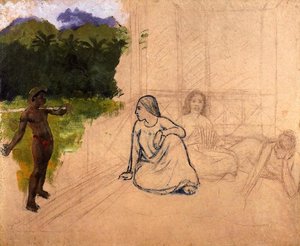
Tahitians at rest (unfinished)


Tahitians at Rest (unfinished): A Window into Gauguin’s Vision of Paradise
Paul Gauguin's “Tahitians at Rest,” completed circa 1891, stands as a cornerstone of Post-Impressionism and an unforgettable testament to the artist’s fascination with primal beauty and spiritual contemplation. More than just a depiction of individuals lounging in a tropical hut—though undeniably captivating in its visual simplicity—the painting embodies Gauguin's profound desire to escape the constraints of Western civilization and reconnect with the untamed spirit of Polynesian culture.
- Subject Matter: The scene portrays several Tahitian men and women engaged in repose, capturing a moment of tranquility amidst the lush vegetation of Tahiti. Gauguin meticulously observed his surroundings, translating them onto cardboard with bold strokes and expressive color palettes.
- Style & Influences: Gauguin’s distinctive style—characterized by flattened perspectives, simplified forms, and vibrant hues—directly echoes the stylistic innovations pioneered by Georges Seurat ("The Circus"), demonstrating a shared commitment to scientific observation combined with artistic intuition. The painting's influence stems from Gauguin’s immersion in Melanesian traditions and his exploration of symbolism rooted in mythology and folklore.
- Technique: Employing oil paint on cardboard, Gauguin utilized a technique known as cloisonné—a method of applying color to panels divided by thin lines—creating distinct areas of pigment that contribute to the painting’s visual impact. The unfinished state of the artwork underscores Gauguin's experimental approach and invites viewers to consider the potential beauty hidden within imperfection.
- Historical Context: Created during Gauguin’s first voyage to Tahiti, “Tahitians at Rest” reflects the broader artistic movement that sought to liberate art from academic conventions. It aligns with the burgeoning interest in primitivism—the belief that indigenous cultures possessed a purity and authenticity unattainable by European societies—a trend championed by artists like Cézanne and Van Gogh.
- Symbolism & Emotional Impact: The painting’s muted color scheme—primarily ochres, reds, and greens—evokes the earthy tones of Tahiti's landscape and symbolizes fertility and renewal. Gauguin’s deliberate simplification of figures conveys a sense of spiritual serenity, inviting contemplation on themes of harmony with nature and transcendence of worldly concerns.
“Tahitians at Rest” resides in a private collection and is available for viewing at ArtsDot.com. For further exploration of Gauguin’s artistic legacy, visit Wikipedia and discover more stunning reproductions at ArtsDot.com.
Eugène Henri Paul Gauguin (1848 – 1903)
Paul Gauguin: A revolutionary Post-Impressionist painter known for bold colors, exotic subjects & Symbolist themes. Explore his journey from finance to artistic legend.
About this artwork
- Title: Tahitians at rest (unfinished)
- Artist: Eugène Henri Paul Gauguin
- Year: 1891
- Format: Landscape
- Copyright status: Public domain
- Movement: Post-Impressionism
- Corpus context: exploring tranquility & spirituality , reflecting gauguin's quest for authenticity
- Main color: Putty
- Keywords: paul gauguin , tahitians at rest , oil painting
- Color hue: Yellow-Green Range
Quick Facts
- Title: Tahitians at rest
- Medium: Oil on cardboard
- Artist: Paul Gauguin
- Subject or theme: Tropical landscape
- Movement: Post-Impressionism
- Artistic style: Synthetism
- Year: 1891
QR Code