

 Preview
 Buy Print
 Send
Send Share
Share


 Download
 Similars
 X-Ray
X-Ray Diaporama
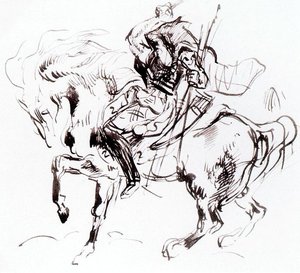
Atila; jinete esgrimiendo un arma


The Raw Energy of Conflict: Delacroix’s ‘Atila’
Ferdinand Victor Eugène Delacroix's “Atila; jinete esgrimiendo un arma” (Atilla, Horseman Fencing) isn’t merely a depiction of battle; it’s a visceral embodiment of Romanticism’s fascination with heroism, drama, and the untamed forces of nature. Completed around 1830-31, this preparatory sketch – remarkably detailed for its status as an early study – offers a glimpse into Delacroix's creative process and his profound engagement with historical narratives, particularly those steeped in legend and conquest. The work’s power resides not in polished realism but in the artist’s masterful manipulation of line, shadow, and movement to convey a sense of urgent action and impending doom.
A Study in Dynamic Line and Monochromatic Drama
Executed primarily in ink on paper, “Atila” immediately captivates with its stark monochrome palette – a deliberate choice that amplifies the drawing’s dramatic intensity. Delacroix eschews color to focus entirely on the expressive potential of line. Short, jagged strokes define the horse's mane and tail, creating an impression of frenzied movement; longer, flowing lines delineate the rider’s posture, conveying both strength and a coiled readiness for action. The artist employs meticulous hatching and cross-hatching techniques to build up tonal variations, suggesting texture – the roughness of armor, the sheen of metal, and the muscularity of the horse's flank. This intricate layering of lines creates a remarkable sense of depth and volume within a seemingly simple drawing.
Historical Echoes and Romantic Symbolism
The subject matter itself is deeply rooted in historical legend. Atila, the Hunnic chieftain, was a figure of immense power and ruthlessness who terrorized Europe in the 5th century. Delacroix’s depiction isn't a literal portrait but rather an interpretation – a Romantic reimagining of this formidable warrior. The secondary figure observing the combat adds to the narrative complexity, hinting at a broader context of conquest and observation. The sword near the bottom right corner is not just a weapon; it represents the decisive moment, the potential for both triumph and tragedy. The composition’s dynamism mirrors the turbulent era in which Atila reigned, reflecting Romanticism's preoccupation with conflict, passion, and the sublime.
Capturing Movement: Delacroix’s Technique
What truly distinguishes “Atila” is Delacroix’s ability to capture movement with astonishing immediacy. The loose, gestural lines suggest a scene unfolding in real time – a whirlwind of action frozen on paper. The artist masterfully utilizes overlapping shapes and variations in line weight to create a sense of perspective, drawing the viewer into the heart of the struggle. The lighting, though unseen, is skillfully implied through the interplay of light and shadow, further enhancing the drama and dynamism of the composition. This preparatory sketch reveals Delacroix’s innovative approach – prioritizing expressive mark-making over meticulous detail, a hallmark of his distinctive Romantic style.
Bringing ‘Atila’ Home: A High-Quality Reproduction
ArtsDot offers exceptional reproductions of “Atila; jinete esgrimiendo un arma,” allowing you to experience the raw power and emotional intensity of Delacroix's masterpiece in your own space. Our hand-painted reproductions capture the essence of the original drawing, faithfully recreating its dynamic lines, dramatic lighting, and evocative symbolism. Choose from a range of sizes and framing options to perfectly complement your décor. Explore our collection today!
Eugène Delacroix (1798 – 1863)
Explore the vibrant world of Eugène Delacroix, a leading French Romantic artist! Discover his dramatic scenes, exotic themes & masterful use of color. See iconic works like 'Liberty Leading the People'. #Delacroix #Romanticism #FrenchArt
About this artwork
- Title: Atila; jinete esgrimiendo un arma
- Artist: Eugène Delacroix
- Format: Square
- Copyright status: Public domain
- Medium: Acrylic On Canvas
- Period: High Medieval
- Medium type: WallArt
- Creative period: Romantic Maturity
- Color palette: Pastels
- Keywords: study , delacroix , atila
Quick Facts
- Movement: Romanticism
- Medium: Ink on paper
- Artistic style: Sketch, Expressive
- Notable elements: Dynamic lines, hatching
- Artist: Delacroix
- Influences:
- Delacroix
- Rubens
QR Code


