

 Preview
 Buy Print
 Send
Send Share
Share


 Download
 Similars
 X-Ray
X-Ray Diaporama
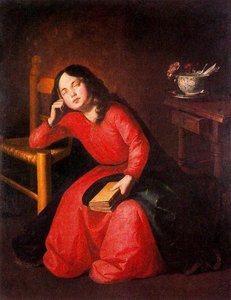
La Virgen niña dormida

Francisco de Zurbarán (1598 – 1664)
Francisco de Zurbarán (1598-1664): Spanish Baroque master of dramatic tenebrism & religious art. Explore paintings of monks, saints & still lifes – the 'Spanish Caravaggio'!
A Portrait of Serenity: Unveiling the Mystique of *La Virgen Niña Dormida*
Francisco de Zurbarán’s *La Virgen Niña Dormida* (The Sleeping Virgin Child) is not merely a depiction of a young girl; it's an immersion into a realm of profound stillness, spiritual contemplation, and the quiet beauty of innocence. Painted circa 1630-1632, this masterpiece resides within the collection of ArtsDot.com, offering you the opportunity to own a meticulously hand-painted reproduction that captures the very essence of Zurbarán’s distinctive style. The painting immediately draws the viewer in with its stark simplicity – a young girl, draped in rich crimson robes, rests her head upon her outstretched hand, lost in slumber. The scene unfolds within a modestly furnished room: a simple wooden chair, a nearby table bearing a bowl and an open book, all bathed in the soft, diffused light characteristic of Zurbarán’s tenebrist technique.
The Master of Tenebrism and Spanish Baroque
Francisco de Zurbarán (1598-1664) stands as a pivotal figure in the development of Spanish Baroque painting, often dubbed “the Spanish Caravaggio” for his dramatic use of light and shadow. Born in Fuente de Cantos, Extremadura, he was deeply influenced by the austere religious landscape of his youth – a region known for its fervent piety and simple living. This upbringing profoundly shaped his artistic vision, leading him to prioritize spiritual depth over elaborate ornamentation. Zurbarán’s style is immediately recognizable through his masterful manipulation of *tenebrismo*, a technique that employs strong contrasts between light and dark to create a sense of drama and heighten the emotional impact of his subjects. He achieved this by meticulously studying nature, particularly the way light falls on surfaces, and then translating those observations onto canvas with astonishing realism.
Symbolism and Spiritual Depth
Beyond its technical brilliance, *La Virgen Niña Dormida* is rich in symbolic meaning. The girl’s slumber represents a state of purity, innocence, and vulnerability – qualities highly valued within the religious context of 17th-century Spain. The crimson robes, a color associated with royalty and sacrifice, further emphasize her sacred status. The book resting on the table symbolizes knowledge and faith, while the bowl suggests nourishment for both body and soul. Notably, Zurbarán frequently depicted monks and saints in similar poses of quiet contemplation, suggesting a connection between this young girl and the broader tradition of religious iconography within his oeuvre. The stillness is not merely physical; it’s an invitation to contemplate themes of faith, mortality, and the divine presence.
A Reproduction for Your Space
ArtsDot.com offers meticulously crafted hand-painted reproductions of *La Virgen Niña Dormida* that faithfully capture the original's atmosphere and detail. Our artists utilize traditional oil painting techniques, replicating Zurbarán’s nuanced use of light, texture, and color with exceptional accuracy. Whether you are a seasoned art collector, an interior designer seeking to infuse your space with serenity, or simply someone captivated by this iconic image, our reproduction provides a beautiful and authentic way to experience the profound beauty and spiritual depth of Francisco de Zurbarán’s masterpiece. Explore the full details and dimensions on ArtsDot.com, and bring this timeless work of art into your home today.
About this artwork
- Title: La Virgen niña dormida
- Artist: Francisco de Zurbarán
- Format: Portrait
- Copyright status: Public domain
- Movement: Spanish Baroque
- Color palette: Earthy
- Main color: Espresso
- Purpose: Statement
- Keywords: serenity , dormant virgin , spanish painting
- Color hue: Amber to Saffron
Quick Facts
- Artist: Francisco de Zurbarán
- Movement: Spanish Baroque
- Notable elements or techniques: Tenebrism, realism
- Influences: Caravaggio
- Medium: Oil on panel
- Artistic style: Religious painting
QR Code


