

 Preview
 Buy Print
 Send
Send Share
Share


 Download
 Similars
 X-Ray
X-Ray Diaporama
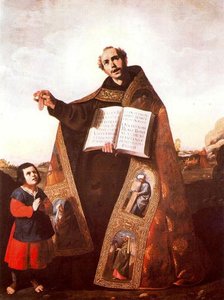
San Román y san Barulo

Francisco de Zurbarán (1598 – 1664)
Francisco de Zurbarán (1598-1664): Spanish Baroque master of dramatic tenebrism & religious art. Explore paintings of monks, saints & still lifes – the 'Spanish Caravaggio'!
The Stark Majesty of Faith: Francisco de Zurbarán’s *San Román y San Barulo*
Francisco de Zurbarán's *San Román y San Barulo*, a painting shrouded in the quiet solemnity characteristic of his oeuvre, offers a profound glimpse into the heart of 17th-century Spanish religious art. More than simply a portrait, it’s an embodiment of austerity and spiritual devotion, reflecting the intense piety that permeated much of Spain during the Counter-Reformation. The painting immediately commands attention with its masterful use of tenebrism – a dramatic contrast between light and shadow – a technique borrowed from Caravaggio but refined to create a uniquely Spanish atmosphere. Zurbarán doesn’t merely depict figures; he sculpts them out of darkness, imbuing them with an almost palpable sense of gravity and inner contemplation.
A Study in Detail and Spiritual Weight
The central figure, identified as Saint Roman and Saint Barulo – early Christian martyrs – is presented with an arresting realism. His robe, rendered in meticulous detail, appears to be sculpted from shadow itself, highlighting the texture of the fabric and suggesting a profound weight borne by his faith. The book he holds isn’t merely an object; it's a symbol of knowledge, scripture, and the unwavering commitment to spiritual truth. Notice the careful rendering of his hands – strong, weathered, yet conveying a quiet dignity. The background, deliberately muted, serves to further emphasize the central figures, drawing the viewer’s eye directly to their solemn expressions.
- Technique: Zurbarán's mastery lies in his ability to capture the texture and weight of materials – particularly fabrics – with astonishing accuracy. He employed a technique known as “alla prima,” working directly onto the canvas without underdrawings, resulting in a remarkably immediate and vibrant quality.
- Color Palette: The painting’s limited palette—primarily browns, blacks, and whites—contributes to its somber mood and reinforces the themes of humility and sacrifice. The stark contrast between light and dark creates a powerful sense of drama and emphasizes the spiritual significance of the scene.
- Composition: The figures are arranged in a pyramidal composition, lending stability and formality to the image. This deliberate arrangement directs the viewer’s gaze towards the central figure, reinforcing his importance within the narrative.
Contextualizing the Masterpiece: Extremadura and the Spanish Baroque
To fully appreciate *San Román y San Barulo*, it's crucial to understand its historical context. Zurbarán’s formative years in the austere landscapes of Extremadura, a region known for its deep religious traditions, profoundly shaped his artistic vision. This environment instilled within him a preference for simplicity, solemnity, and an intense engagement with spirituality – qualities that would become hallmarks of his work. The painting reflects the broader trends of the Spanish Baroque, which sought to evoke emotion and inspire devotion through dramatic lighting, realistic detail, and emotionally charged subjects. The influence of figures like Caravaggio is undeniable, but Zurbarán developed a distinctly Spanish interpretation, prioritizing introspection and spiritual intensity over theatricality.
Furthermore, consider the broader artistic landscape of 17th-century Spain. The Counter-Reformation fueled a surge in religious art patronage, with the Catholic Church commissioning works designed to inspire faith and combat the challenges posed by Protestantism. Zurbarán’s work exemplifies this trend, offering a powerful visual testament to the enduring strength of Catholicism during a period of significant social and political upheaval.
Symbolic Layers: Beyond the Portrait
Beyond the immediate depiction of Saint Roman and Saint Barulo, *San Román y San Barulo* is rich in symbolic meaning. The inclusion of the cell phone, an unexpected element in this otherwise timeless scene, subtly invites reflection on the intersection of faith and modernity – a theme that continues to resonate powerfully today. The bird in the upper-left corner could represent hope or divine guidance, while the clock in the background serves as a reminder of mortality and the fleeting nature of earthly existence. The bowl at the bottom right might symbolize sustenance for the soul. These seemingly minor details contribute to the painting’s layered complexity and invite viewers to contemplate its deeper spiritual significance.
About this artwork
- Title: San Román y san Barulo
- Artist: Francisco de Zurbarán
- Format: Portrait
- Copyright status: Public domain
- Movement: Spanish Baroque
- Medium type: WallArt
- Creative period: Mature Period
- Color palette: Neutrals
- Purpose: Statement
- Keywords: spanish art , religious painting , monks
Quick Facts
- Artist: Francisco de Zurbarán
- Title: San Román y san Barulo
- Artistic style: Religious painting
- Influences: Caravaggio
- Movement: Spanish Baroque
- Subject or theme: Saints, piety
QR Code


